










Borana Weaves approves 384-loom expansion by March 2027
Key highlights
- Borana Weaves approved a Rs 49.92 crore Unit 4 expansion on 2 November 2026.
- The programme will add 384 water-jet looms in two phases of 192 looms each.
- Annual greige-fabric capacity is expected to rise from 349.05 million metres to 459.64 million metres.
- Borana Weaves reported approximately 85% utilisation across its existing 1,212 looms.
powered by IRIS
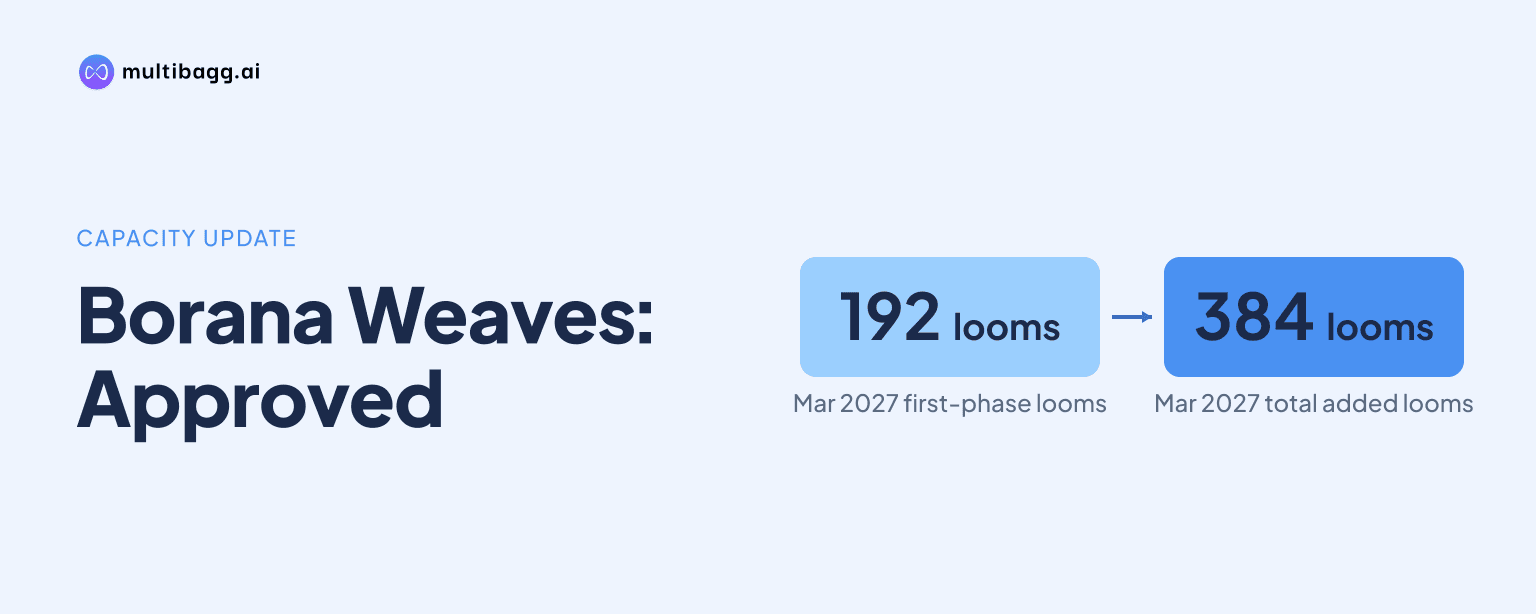
Borana Weaves Limited approved a Rs 49.92 crore expansion on 2 November 2026 to install 384 water-jet looms in two phases, targeting commercial production by March 2027 and annual greige-fabric capacity of about 459.64 million metres. The company reported approximately 85% utilisation across its existing 1,212-loom base.
Know Borana Weaves inside out
Results, valuation, peers and who's buying, in one view.
What did Borana Weaves approve at Unit 4?
Borana Weaves approved the installation of 384 water-jet looms and necessary ancillary machinery at Unit 4, with the board approving the proposal at its 2 November 2026 meeting. The company disclosed the plan to BSE Limited and National Stock Exchange of India Limited under Regulation 30 of the Securities and Exchange Board of India listing regulations.
The project consists of two equal installations of 192 looms rather than one 384-loom commissioning. Borana Weaves placed the estimated investment at approximately Rs 24.96 crore for each 192-loom phase, for an aggregate outlay of approximately Rs 49.92 crore including ancillary machinery.
The Unit 4 project is measured against Borana Weaves’ installed capacity across all units. Before the expansion, the company reported 1,212 water-jet looms with approximate annual capacity of 349.05 million metres of greige fabric, a fabric that has not undergone dyeing or finishing.
How much will Borana Weaves' fabric capacity increase?
Borana Weaves expects the 384 added looms to contribute approximately 110.60 million metres of annual greige-fabric capacity. On completion of both phases, the company expects its all-unit loom base to reach 1,596 and annual greige-fabric capacity to reach approximately 459.64 million metres.
Based on the approximate addition of 110.60 million metres against existing capacity of 349.05 million metres, the planned capacity addition is about 32%. The installed loom count also rises by 384 from 1,212, or about 32%, while the filing presents the post-expansion annual capacity as approximately 459.64 million metres.
The filing does not allocate the 110.60 million metres of annual capacity between the December 2026 and March 2027 phases. It also does not provide expected production volumes, sales volumes or revenue from the additional 384 looms.
When will Borana Weaves complete the two phases?
Borana Weaves plans to complete Phase 1, comprising 192 water-jet looms, by December 2026. Phase 2, comprising a further 192 looms, is scheduled by March 2027, when the company targets commercial production from the Unit 4 expansion.
The disclosed schedule places the two 192-loom installations roughly three months apart, from the board approval date of 2 November 2026 through the March 2027 commercial-production target. The company did not disclose separate commissioning dates within December 2026 or March 2027.
The March 2027 target applies to commercial production from the Unit 4 expansion, while the 459.64 million-metre capacity figure applies after completion of both phases across all units. Borana Weaves did not state whether either phase had begun installation when it made the 2 November 2026 announcement.
Got a follow-up? Ask IRIS
How will Borana Weaves finance the Rs 49.92 crore project?
Borana Weaves said the approximately Rs 49.92 crore expansion will be financed through internal accruals and debt. The disclosed capital requirement is evenly split at approximately Rs 24.96 crore for each phase of 192 looms, including necessary ancillary machinery.
The company did not disclose how much of the Rs 49.92 crore will come from internal accruals and how much will be borrowed. The 2 November 2026 filing also does not identify any lender, interest rate, repayment period, security, borrowing limit or expected finance cost.
The project cost is an approximate estimate, as stated in the capacity-expansion disclosure, rather than a final spending figure. Borana Weaves did not provide a timetable for capital payments across the December 2026 Phase 1 target and the March 2027 Phase 2 target.
Why is Borana Weaves adding capacity at 85% utilisation?
Borana Weaves reported existing capacity utilisation of approximately 85% across its 1,212 water-jet looms when it announced the 384-loom addition on 2 November 2026. The disclosed operating level provides the context for increasing installed annual greige-fabric capacity from approximately 349.05 million metres to approximately 459.64 million metres.
Management said the project is expected to broaden Borana Weaves’ product portfolio, improve cost efficiency and optimise capacity utilisation. The company also said the additional capacity is expected to strengthen its ability to attract high-value buyers, secure new order volumes and support long-term relationships with premium international brands.
Those statements are the company’s stated rationale rather than reported project outcomes. The filing does not name any buyer, premium international brand or order, and it gives no target utilisation percentage, cost saving, selling price, revenue forecast or margin forecast for the added 110.60 million metres of annual capacity.
Conclusion
Borana Weaves has approved a two-phase Rs 49.92 crore Unit 4 programme that would increase its water-jet loom base by 384 to 1,596 and lift annual greige-fabric capacity by approximately 110.60 million metres. The expansion follows reported utilisation of approximately 85% on the pre-expansion base of 1,212 looms and 349.05 million metres of annual capacity.
The next disclosed milestones are installation of the first 192 looms by December 2026 and the second 192 looms, with commercial production targeted, by March 2027. Borana Weaves has identified internal accruals and debt as the funding sources, but the funding split, borrowing terms and output from each phase remain undisclosed.