










Trident Limited approves Rs 4,650 crore expansion to 2029
Key highlights
- Trident approved a Rs 4,650 crore expansion and modernisation programme on November 2, 2026.
- Yarn projects receive Rs 2,682 crore, including Rs 1,660 crore for the Dhar facility.
- The Dhar facility will add 199,680 spindles and is targeted for completion by September 30, 2029.
- Sheeting, paper and hybrid power receive a combined Rs 1,968 crore.
powered by IRIS
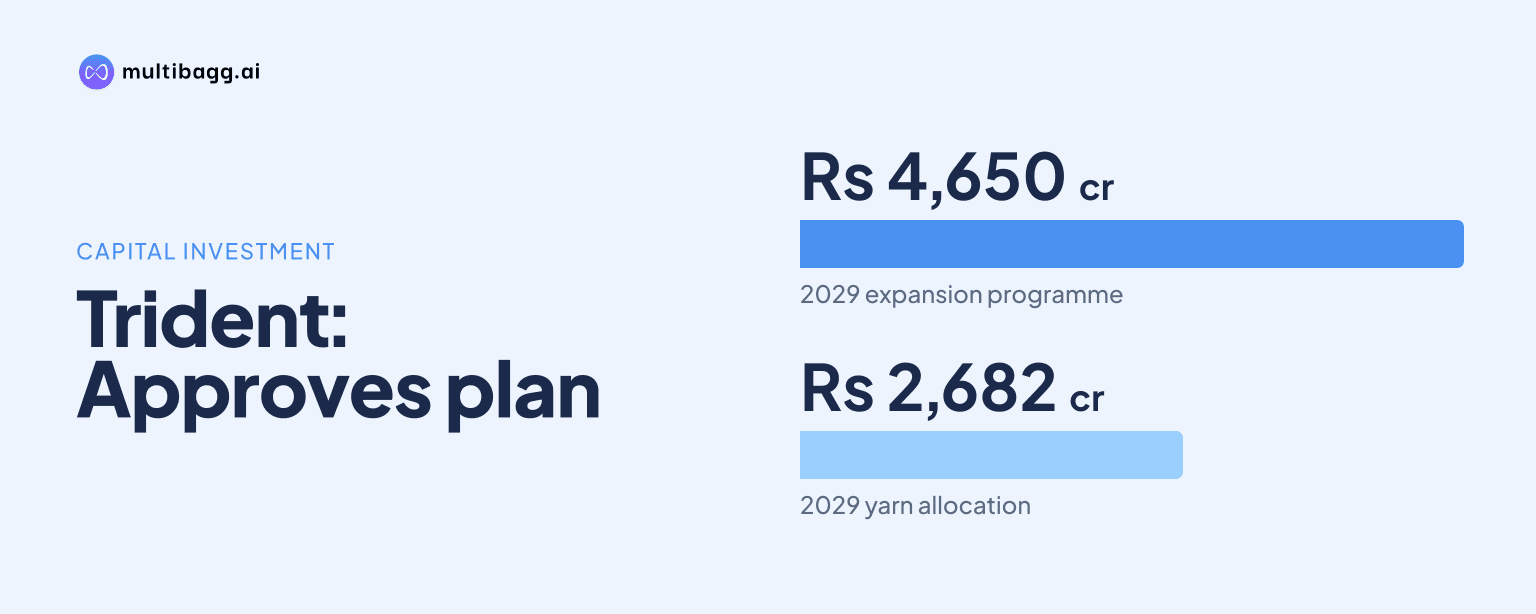
Trident approved a Rs 4,650 crore capacity-expansion and modernisation programme on November 2, 2026, led by a Rs 1,660 crore new yarn facility at Dhar, Madhya Pradesh, which is expected to be completed on or before September 30, 2029. The plan also covers yarn modernisation, sheeting, paper and hybrid power.
Know Trident inside out
Results, valuation, peers and who's buying, in one view.
How is Trident allocating its Rs 4,650 crore expansion plan?
Trident is allocating Rs 4,650 crore across five projects, with the two yarn projects receiving Rs 2,682 crore in total. This is larger than the Rs 1,968 crore combined allocation for sheeting, paper and hybrid power. The Dhar yarn facility has the largest individual outlay at Rs 1,660 crore, followed by Rs 1,022 crore for the existing yarn operations at Sanghera, Punjab and Budhni, Madhya Pradesh.
The Dhar project’s Rs 1,660 crore investment is Rs 638 crore higher than the Rs 1,022 crore assigned to the Sanghera and Budhni yarn project. Trident had already acquired 179.2 acres of leasehold land for the Dhar facility at an approximate cost of Rs 106.09 crore. The November 2, 2026 disclosure lists the Dhar project investment separately at Rs 1,660 crore.
What yarn capacity will Trident add and modernise?
Trident will add 99,840 spindles at its existing Budhni yarn facility and establish a new Dhar facility with 199,680 spindles. The Budhni expansion and modernisation is expected to be completed on or before December 31, 2027, while the Dhar project has a completion date of September 30, 2029.
At Budhni, the project includes machinery replacement as well as the 99,840-spindle addition. Trident will modernise 48,000 old spindles into 70,176 new spindles for finer counts and replace 960 old rotors with 2,400 new rotors. Existing yarn capacity across Sanghera and Budhni is 746,064 spindles, 5,424 rotors and 320 air-jet units; the filing reports Budhni capacity utilisation of 94%.
The new Dhar capacity of 199,680 spindles is twice the proposed 99,840-spindle addition at Budhni. Together, the two additions total 299,520 spindles, while the Budhni machinery programme separately changes the existing spindle and rotor base. Both yarn projects will be financed through internal accruals and debt, according to the board-approved disclosure.
Got a follow-up? Ask IRIS
What will change in Trident's sheeting, paper and power businesses?
Trident will add 336 looms in sheeting, increase paper capacity by 28 tonnes per day, or TPD, and set up a project described as 60 megawatts, or MW, of hybrid renewable power. These three projects require a combined Rs 1,968 crore and have scheduled completion dates between January 31, 2028 and October 31, 2028.
The Rs 1,018 crore sheeting project is the second-largest individual allocation after Dhar yarn. It will add 336 looms to an existing sheeting capacity of 504 looms, for which reported capacity utilisation is 58%. The addition equals two-thirds of the existing loom base, although the filing does not specify a post-project capacity total or a target utilisation level.
Paper capacity will rise by 28 TPD from an existing 479 TPD, with a Rs 296 crore investment and an expected completion date of March 31, 2028. Existing paper capacity utilisation is 81%. The filing does not provide a planned post-expansion paper utilisation rate, production estimate or revenue contribution from the additional 28 TPD.
The Rs 654 crore hybrid-power project is described as comprising 60 MW of wind power and 20 MW of solar power in alternating-current, or AC, terms, while the project is labelled 60 MW hybrid power in the filing. Trident reports existing solar capacity of 57.3 MW direct-current peak and 100% utilisation for the hybrid-power segment. The planned project is expected to be completed on or before October 31, 2028.
When will Trident complete the projects and how will it fund them?
Trident expects Budhni yarn to be the first project completed, on or before December 31, 2027, followed by sheeting on January 31, 2028 and paper on March 31, 2028. The hybrid-power project is scheduled for October 31, 2028, while Dhar yarn is the final disclosed project deadline at September 30, 2029.
All five projects will be financed through internal accruals and debt. The November 2, 2026 filing does not state the share of the Rs 4,650 crore that will be funded by borrowings, the amount sourced from internal accruals, the identity of lenders or any repayment schedule. It also does not disclose interim commissioning milestones before the listed completion dates.
Management said the projects are expected to strengthen Trident’s market position, enhance operational capabilities, support environmentally responsible operations, improve energy efficiency and augment its domestic and international presence. These are stated expected benefits rather than quantified targets: the filing provides no revenue, margin, export, power-cost saving or return estimate for the Rs 4,650 crore programme.
Conclusion
The November 2, 2026 approval puts Rs 2,682 crore into yarn, more than the Rs 1,968 crore allocated to sheeting, paper and hybrid power combined. The programme combines 299,520 proposed new yarn spindles at Budhni and Dhar with Budhni equipment modernisation, 336 additional looms, 28 TPD of paper capacity and the disclosed hybrid-power project.
The next stated milestone is the December 31, 2027 deadline for Budhni, followed by sheeting in January 2028, paper in March 2028 and hybrid power in October 2028. Trident has identified internal accruals and debt as the funding mechanism, but the split remains undisclosed ahead of the Dhar yarn project’s September 30, 2029 completion target.