










Trident cuts working-capital borrowings by Rs 331.22 crore
Key highlights
- Trident generated Rs 800.08 crore of standalone operating cash flow in the half year ended September 30, 2026, versus Rs 643.46 crore a year earlier.
- Trident reduced working-capital borrowings by Rs 331.22 crore, compared with a Rs 25.12 crore increase in the corresponding 2025 period.
- Trident paid Rs 254.78 crore in equity dividends and repaid Rs 69.78 crore of non-current borrowings during the half year.
- Trident ended September 30, 2026 with Rs 19.81 crore of cash and cash equivalents, down Rs 1.15 crore from the start of the year.
powered by IRIS
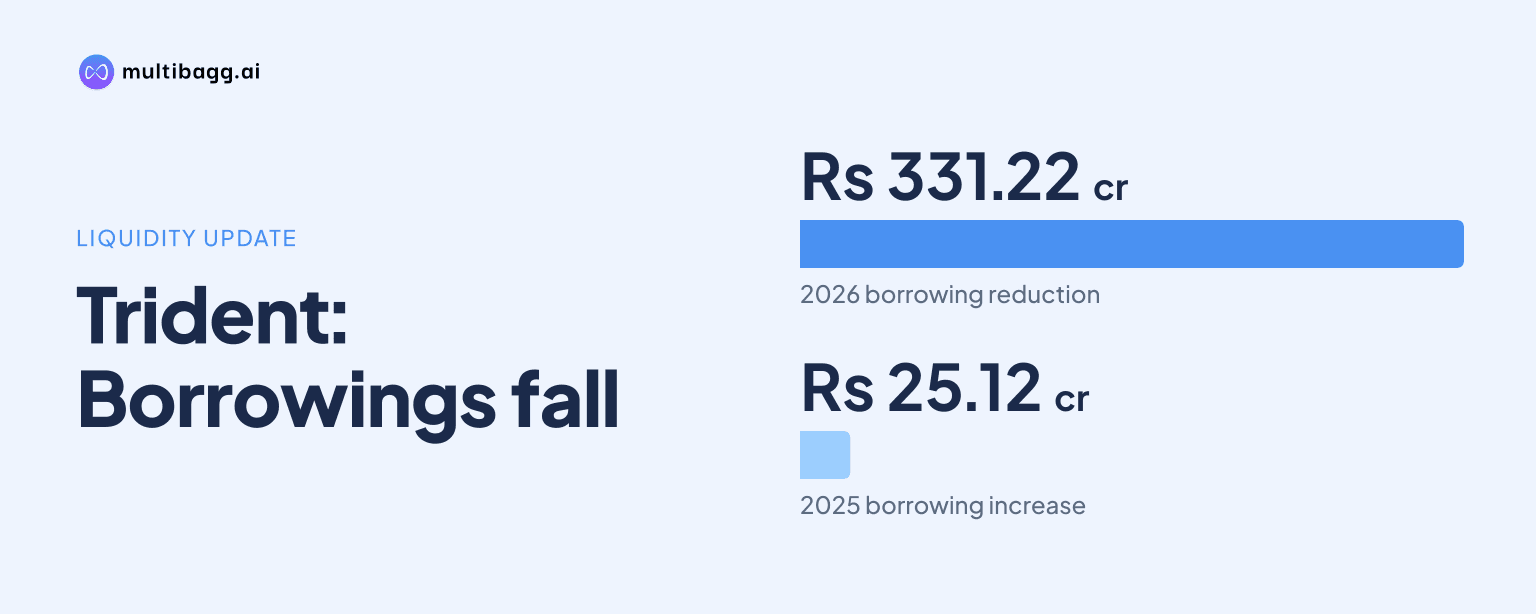
Trident Limited reduced working-capital borrowings by Rs 331.22 crore in the half year ended September 30, 2026, as standalone net operating cash flow increased to Rs 800.08 crore from Rs 643.46 crore a year earlier. The operating inflow funded dividends, interest, capital expenditure and repayment of non-current borrowings while cash and cash equivalents fell only Rs 1.15 crore.
Know Trident inside out
Results, valuation, peers and who's buying, in one view.
What drove Trident’s operating cash flow higher?
Trident generated Rs 800.08 crore of standalone net cash from operating activities in the half year ended September 30, 2026, an increase of Rs 156.62 crore from Rs 643.46 crore in the corresponding 2025 period. Profit before tax rose to Rs 436.42 crore from Rs 311.89 crore, and cash generated from operations before direct taxes increased to Rs 880.64 crore from Rs 669.77 crore.
Working-capital movements contributed Rs 268.30 crore in the latest half year, compared with Rs 159.55 crore in the prior-year period. Inventories fell by Rs 126.96 crore, trade payables rose by Rs 66.29 crore and other current assets released Rs 71.13 crore. In the 2025 half year, the inventory reduction was larger at Rs 279.94 crore, while other current assets used Rs 60.71 crore.
Direct taxes paid rose to Rs 80.56 crore from Rs 26.31 crore, partly offsetting the increase in cash generated from operations. Depreciation and amortisation added back in the cash-flow statement fell to Rs 139.19 crore from Rs 173.46 crore, while interest expense added back increased to Rs 62.17 crore from Rs 55.43 crore.
How did Trident deploy cash during the half year?
Trident used Rs 725.71 crore in financing activities in the half year ended September 30, 2026, compared with Rs 297.27 crore in the corresponding 2025 period. The latest outflow included a Rs 331.22 crore reduction in working-capital borrowings, Rs 254.78 crore of equity dividends and Rs 69.78 crore of non-current borrowing repayments.
Dividend payments were Rs 254.78 crore, marginally above Rs 254.01 crore a year earlier. Interest paid increased to Rs 60.01 crore from Rs 54.42 crore, while principal repayments on lease liabilities rose to Rs 8.53 crore from Rs 2.22 crore. Interest paid on lease liabilities was Rs 1.39 crore, compared with Rs 1.28 crore in the previous period.
Investing cash outflow narrowed to Rs 75.52 crore from Rs 391.80 crore. Payments for property, plant and equipment, capital work in progress, intangible assets and assets under development were Rs 99.83 crore, compared with Rs 96.81 crore. The prior-year investing outflow included Rs 250 crore for an investment in an associate company, a payment not recorded in the latest half year.
Got a follow-up? Ask IRIS
Why did Trident reduce working-capital borrowings?
Trident reduced working-capital borrowings by Rs 331.22 crore after generating Rs 800.08 crore from operations and limiting investing outflow to Rs 75.52 crore in the half year ended September 30, 2026. In the corresponding 2025 period, working-capital borrowings instead increased by Rs 25.12 crore, a Rs 356.34 crore year-on-year swing in the cash-flow movement.
The standalone cash-flow statement reports this borrowing movement on an aggregate basis and does not identify specific lending facilities or allocate it among the yarn, towel, bedsheets, or paper and chemicals segments. It therefore establishes the net reduction, but not the precise operational or facility-level source of the lower borrowing.
Cash and cash equivalents declined by Rs 1.15 crore to Rs 19.81 crore at September 30, 2026, from Rs 20.96 crore at the beginning of the year. That compares with a Rs 45.61 crore decline to Rs 22.69 crore during the corresponding 2025 half year. The September 2026 balance comprised Rs 16.48 crore in current accounts, Rs 1.82 crore in cash on hand and Rs 1.51 crore in cash-credit accounts.
How did earnings and segments support Trident’s cash generation?
Trident reported standalone profit after tax of Rs 323.56 crore for the half year ended September 30, 2026, up from Rs 231.77 crore a year earlier. Revenue from operations rose to Rs 3,498.67 crore from Rs 3,485.40 crore, while total expenses declined to Rs 3,095.46 crore from Rs 3,211.42 crore, lifting profit before tax by Rs 124.53 crore.
The yarn segment reported profit before finance costs, exceptional items and tax of Rs 337.02 crore, up from Rs 117.31 crore, while its revenue increased to Rs 1,973.12 crore from Rs 1,825.67 crore. This contrasted with towel segment profit, which declined to Rs 60.35 crore from Rs 124.72 crore as revenue decreased to Rs 1,202.99 crore from Rs 1,354.76 crore.
Bedsheets segment profit rose to Rs 87.19 crore from Rs 63.66 crore on revenue of Rs 612.85 crore, compared with Rs 569.58 crore. Paper and chemicals segment profit fell to Rs 86.66 crore from Rs 116.39 crore even as revenue increased to Rs 585.28 crore from Rs 506.72 crore. Aggregate segment profit increased to Rs 571.22 crore from Rs 422.08 crore before finance costs of Rs 62.17 crore and other unallocable expenditure of Rs 72.63 crore.
Conclusion
Trident’s half-year cash flow shows that higher operating cash generation of Rs 800.08 crore supported a Rs 331.22 crore reduction in working-capital borrowings alongside Rs 254.78 crore of dividends, Rs 60.01 crore of interest payments and Rs 69.78 crore of non-current borrowing repayments. The resulting decline in cash and cash equivalents was Rs 1.15 crore, compared with Rs 45.61 crore in the corresponding 2025 period.
What remains unresolved is whether the Rs 268.30 crore working-capital contribution can recur, particularly because it included a Rs 126.96 crore inventory reduction and a Rs 66.29 crore increase in trade payables. The filing does not disclose a borrowing target, a future capital-spending plan or facility-level details of the working-capital reduction, leaving subsequent financial disclosures to provide that evidence.