










Borana Weaves Limited Reports ₹16.16 Crore September Profit
Key highlights
- Borana Weaves Limited reported September-quarter net profit of ₹16.16 crore.
- Q1 FY27 revenue from operations rose 24.5% year-on-year to ₹100.84 crore.
- Q1 FY27 EBITDA increased 50.7% year-on-year to ₹25.84 crore, with margin reaching 25.63%.
- The proposed Unit 4 project includes 192 water-jet looms and 3 texturising machines.
powered by IRIS
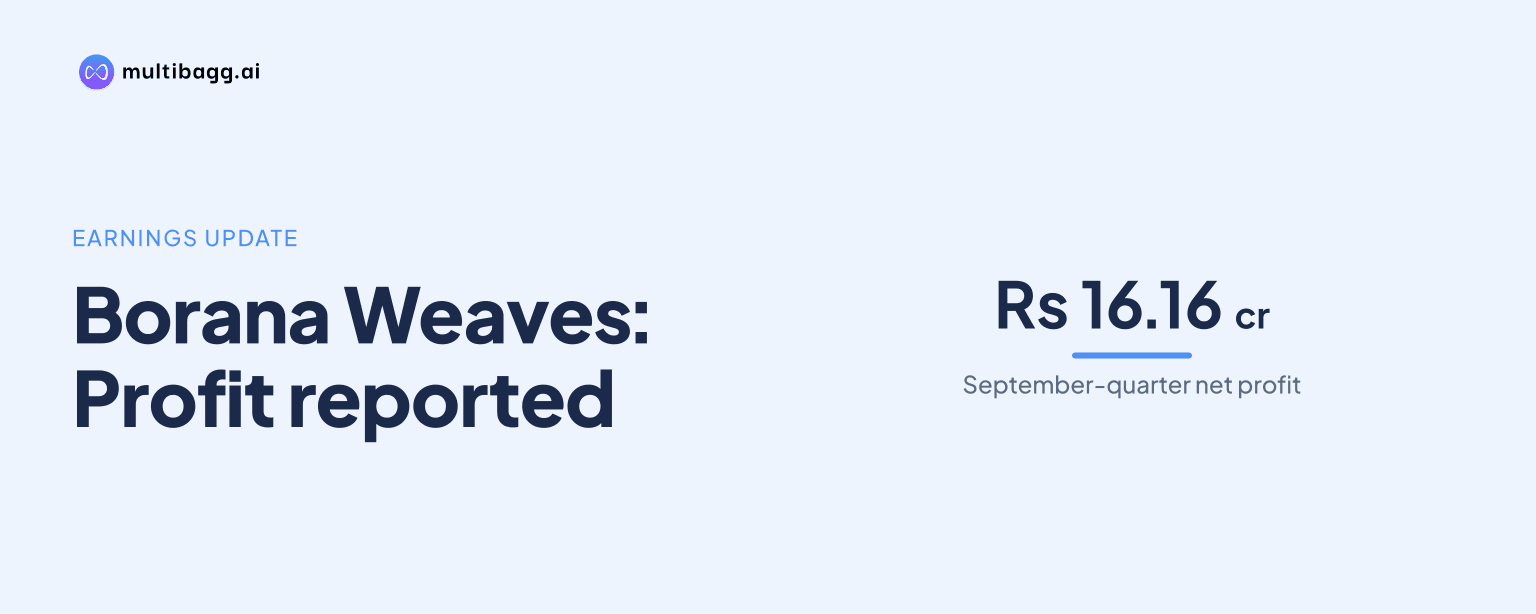
Borana Weaves Limited reported September-quarter profit of ₹16.16 crore, while a 2 November 2026 board meeting was scheduled to consider quarterly results and a proposed addition of 192 water-jet looms at Unit 4. The update matters because the proposed expansion would follow strong first-quarter FY27 growth and a broader plan to improve scale and operating efficiency.
Know Borana Weaves inside out
Results, valuation, peers and who's buying, in one view.
What did Borana Weaves Limited report for the September quarter?
Borana Weaves Limited reported net profit of ₹16.16 crore for the September quarter in the supplied update. The material does not provide the corresponding revenue, year-on-year comparison, EBITDA, or margin for that specific September-quarter profit figure.
The company had separately disclosed profit after tax of ₹16.48 crore for Q1 FY27, the quarter ended June 2026, compared with revenue from operations of ₹100.84 crore. Q1 FY27 revenue increased 24.5% year-on-year, while profit after tax rose 35.0% year-on-year. EBITDA increased 50.7% to ₹25.84 crore, and the EBITDA margin expanded by 445 basis points to 25.63%.
The supplied quarterly sales history shows sales of ₹100.84 crore for June 2026, versus ₹81 crore in June 2025. Operating profit for June 2026 was ₹25.84 crore, compared with ₹17 crore a year earlier. These figures point to stronger operating leverage during the June quarter, although they should not be treated as a like-for-like comparison for the separately stated September-quarter profit because the detailed September income statement is not included.
What was on Borana Weaves' 2 November board agenda?
Borana Weaves was scheduled to consider Q2 results and the addition of 192 water-jet looms at Unit 4 at its board meeting on 2 November 2026. A 27 October board-meeting intimation described the loom addition as a proposed agenda item, meaning approval had not yet been confirmed in that filing.
Other supplied company updates describe a Unit 4 project involving 192 water-jet looms and three texturising machines. Those updates state that the project would be funded entirely through internal accruals and would represent about a 27% increase in weaving capacity relative to an existing base of more than 700 looms.
The material gives differing production timelines for the project. The 27 October meeting notice referred to a March 2027 production target, while separate updates cited commercial production by December 2026. Investors should therefore rely on the formal board outcome or subsequent exchange filing to establish the approved scope and commissioning schedule.
How does the Unit 4 plan fit Borana Weaves' expansion strategy?
The Unit 4 proposal fits Borana Weaves' ongoing effort to raise fabric output and improve manufacturing efficiency. The company produces unbleached synthetic greige fabric and has been expanding its Surat operations through water-jet loom additions.
The supplied material contains several capacity references associated with different stages of expansion. One update said an earlier Unit 4 project costing ₹71.35 crore added 48 looms and lifted overall capacity to 346 million metres annually. Another stated that a completed expansion added 700 high-tech water-jet looms and took weaving capacity to 340 million metres per annum.
For Q1 FY27, the company cited a 1,212-loom capacity and annual fabric-production capability of 398 million metres. The same set of disclosures linked the proposed addition of 192 looms and three texturisers to the next phase of Unit 4. The varying figures appear to reflect different project stages and measurements, rather than a single directly comparable capacity base.
Got a follow-up? Ask IRIS
What are the efficiency initiatives alongside the capacity addition?
Borana Weaves is also building renewable-energy capacity to reduce power costs and support its manufacturing operations. Management identified the commissioning of a 19.79 MW hybrid renewable project during 2026 as a near-term milestone.
The company has referred to a renewable portfolio of about 23.30 MW. The supplied Q1 FY27 update connected the portfolio and higher manufacturing scale with efficiency gains, alongside the reported EBITDA-margin improvement to 25.63%.
Earlier disclosures also referred to a zero-liquid-discharge project that recycles 640 million litres of water annually. These measures are relevant for a water-jet weaving operation because power and water management can affect manufacturing costs and operating continuity. However, the supplied material does not quantify the financial savings from these initiatives.
How should investors read the latest Borana Weaves updates?
The latest updates show a company pursuing capacity growth after reporting higher Q1 FY27 revenue, EBITDA, and profit. The September-quarter profit figure of ₹16.16 crore adds a fresh earnings data point, but the source material does not include the detailed quarterly financial statement needed to assess revenue growth, margins, or comparison with the prior-year September quarter.
The proposed Unit 4 addition is important because it could increase the company's weaving and texturising capability without stated external funding, as the company has said internal accruals would finance the project. Its eventual effect on output and financial performance will depend on the final approved scope, project execution, commissioning date, demand conditions, and utilisation levels.
Conclusion
Borana Weaves has reported September-quarter profit of ₹16.16 crore against a backdrop of strong Q1 FY27 operating growth, when revenue reached ₹100.84 crore and EBITDA margin improved to 25.63%. Its planned Unit 4 investment indicates that management is seeking further scale while using internal accruals and renewable-energy projects to support operating efficiency.
The next item to watch is the formal outcome of the 2 November 2026 board meeting. That disclosure should clarify whether the 192 water-jet looms and three texturisers were approved, the final commercial-production target, and the detailed Q2 FY27 financial performance.