










Borosil says China duty would reduce inventory, not margins
Key highlights
- Borosil said a potential Chinese glassware duty would reduce inventory rather than directly lift prices or margins.
- The Ministry of Finance had about 90 days after final findings, with a decision window until 24 December.
- Borosil’s two Hydra double-wall lines were operating at more than 80% capacity utilisation.
- Borosil disclosed Rs 50 crore for BG 3 glassware expansion and about Rs 37 crore for solar phase 4.
powered by IRIS
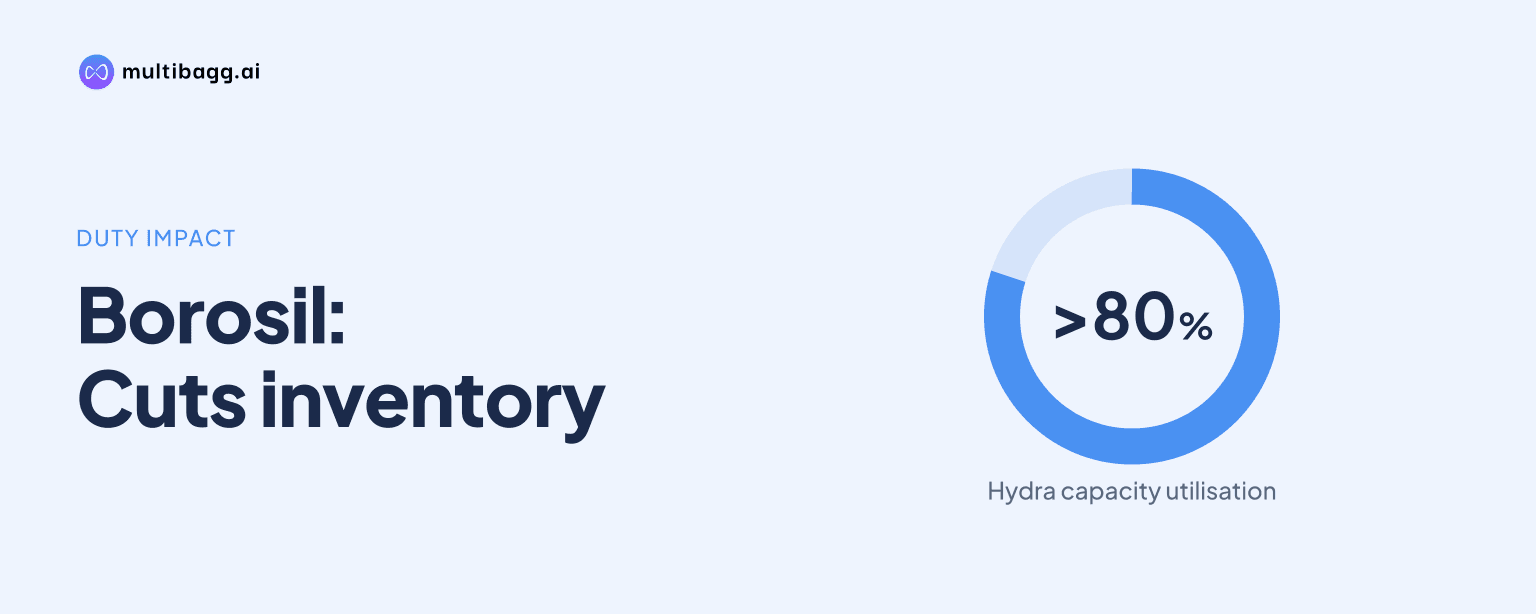
Borosil said a potential duty on Chinese glassware, subject to a Ministry of Finance decision by 24 December, would primarily reduce elevated inventory rather than raise prices or margins; its two local Hydra double-wall lines were operating at more than 80% utilisation as of the call.
Know Borosil inside out
Results, valuation, peers and who's buying, in one view.
How would a Chinese anti-dumping duty affect Borosil?
Borosil said a duty on Chinese glassware, if notified, would help it sell down accumulated inventory rather than directly lift profitability. Management said the DGTR had made its recommendation and the Ministry of Finance had about 90 days from the final findings to issue a final notification, giving it time until 24 December.
The company said it did not expect the potential action to increase prices or margins. Instead, reduced Chinese dumping could enable Borosil to sell more inventory and more of its production. Management agreed that lower competition from China could support growth, but did not quantify any prospective gain in revenue, volume or profit.
Why does Borosil have elevated inventory?
Borosil attributed the inventory build-up to the early scale-up of its opalware and glassware plants, Bureau of Indian Standards, or BIS, challenges, and disruption in Hydra. Management said it had installed 6,500 metric tonnes of capacity when the relevant market was only 2,000 metric tonnes, and that much of the sales recorded later came from stock produced in the first and second years.
The gap between 6,500 metric tonnes of capacity and a 2,000-metric-tonne market illustrates why inventory accumulated beyond a short-term demand fluctuation. Borosil said its efforts to build glass adoption and promote opalware had reduced those earlier challenges, but it did not disclose current inventory, excess stock or a date for normalisation.
Is Borosil’s local Hydra capacity already well used?
Yes. Borosil said its two operating Hydra double-wall lines were using more than 80% of capacity, so utilisation was not the main constraint. Management said the company had already sold traded products in the category; its current task is to expand the locally made range, designs and product assortment.
Local Hydra production has also helped Borosil mitigate BIS-related challenges to some extent. Management said it was on track to restore its earlier Hydra sales level, but did not disclose the prior sales base, current sales or a completion date. The company’s inventory plan relies on developing the market for products manufactured locally and increasing volumes across categories.
When will Borosil’s third Hydra line contribute?
Borosil expected the third Hydra double-wall line in January, compared with an earlier expectation of December. Management attributed the roughly one-month delay to supply-chain challenges, including port congestion, and said the line would require about a month of stabilisation after it becomes operational.
Management expects some effect from additional in-house manufacturing from the end of the fourth quarter. That timetable means the third line is a capacity and portfolio-building initiative rather than an immediate solution to existing inventory. Borosil said it would start developing the additional line’s range and assortment once it is available.
Got a follow-up? Ask IRIS
What will reduce Borosil inventory if no target was disclosed?
Borosil said volume growth, market development and higher sales of locally manufactured products should reduce inventory, but it declined to provide a numerical target for the next six or 12 months. Management said its immediate objective was to sustain current margins and post growth in both volume and value before pushing further volume growth across categories.
Management described October momentum as broad-based across products and channels. Trade and business-to-business, or B2B, sales had performed well, followed by e-commerce and large-format stores. Borosil also cited acceptance of premium products and new launches, and said cookware and glassware had done well after investors had raised softness in glassware during the first quarter.
What is Borosil saying about margins and spending?
Borosil said its priority is to sustain margins rather than promise improvement from a Chinese duty or inventory release. Management linked margins to premiumisation, previous price increases and a larger manufacturing footprint built over the last two to three years. It said product mix affects quarterly gross margins and that the end of the third quarter offers a more like-for-like comparison with the second quarter.
Borosil reiterated its long-term target of 15% to 20% compound annual growth rate, or CAGR, while declining to validate an analyst’s estimate based on combining the second and third quarters. It identified Rs 50 crore for BG 3 borosilicate glassware capacity expansion and about Rs 37 crore for solar phase 4. Management also said a Vision 2030 plan, potentially requiring reasonable capital expenditure, was expected by the end of the financial year after approvals.
Conclusion
Borosil’s message is that a potential Chinese glassware duty would address inventory built amid dumping, rather than create an automatic pricing or margin uplift. With two Hydra double-wall lines already above 80% utilisation, the company is depending on local production, a broader assortment and volume growth to convert stock into sales.
The next matters to watch are the Ministry of Finance decision window ending 24 December, the January arrival of the third Hydra line and its expected end-of-fourth-quarter contribution after stabilisation. Management also plans to announce its Vision 2030 plan by the end of the financial year, with further details possible over the next one or two quarters.