










Borosil says H1 FY27 margin gains can be sustained after pricing
Key highlights
- Borosil's H1 FY27 gross margin rose 390 basis points to 65.2%.
- H1 FY27 EBITDA excluding other income increased 20.5% to Rs 107.7 crore.
- Non-glassware turnover grew 10.9% to Rs 240.2 crore in H1 FY27.
- Management expects about Rs 42 crore of annual solar savings after phase four begins in Q4 FY27.
powered by IRIS
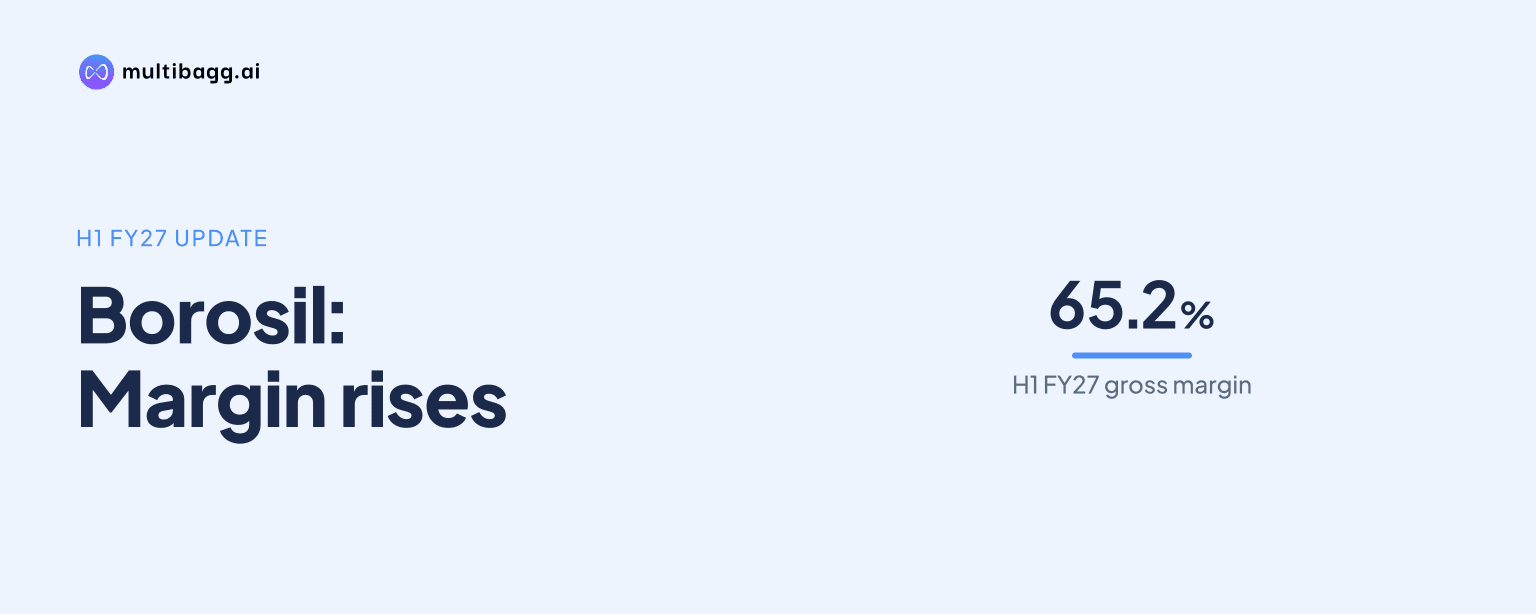
Borosil Limited said H1 FY27 gross margin rose 390 basis points to 65.2% and said current margins can be sustained, citing price increases, premiumisation, solar savings and captive manufacturing. Earnings before interest, tax, depreciation and amortisation (EBITDA), excluding other income, rose 20.5% year on year to Rs 107.7 crore.
Know Borosil inside out
Results, valuation, peers and who's buying, in one view.
What drove Borosil's H1 FY27 margin improvement?
Borosil's H1 FY27 margin improvement came from price increases, product mix, operating efficiencies and lower input-cost pressure in Q2 than in Q1. Gross profit rose 15.6% year on year to Rs 408.9 crore while revenue from operations increased 8.8% to Rs 627.4 crore, taking gross margin to 65.2% from 61.3% in H1 FY26.
Management said it raised prices across categories after fuel, raw-material and packaging costs increased amid the West Asia conflict. It said price pass-through improved in Q2 FY27 after being incomplete in Q1 FY27. In Opalware, Borosil cited price increases of about 3% to 5% in some ranges and 5% to 7% in others.
Operating profit grew faster than revenue during the half year. EBITDA excluding other income increased to Rs 107.7 crore from Rs 89.4 crore, while profit before tax rose to Rs 60.3 crore from Rs 53.9 crore. Profit after tax increased to Rs 44.7 crore from Rs 40.1 crore despite depreciation and finance costs rising to Rs 51.8 crore from Rs 47.2 crore.
Can Borosil sustain its current margins?
Borosil management said it believes the growth and EBITDA margin levels currently being seen are sustainable, rather than being driven only by festive timing. Chief Executive Officer Rituraj Sharma cited pricing, solar initiatives, product mix and in-house manufacturing, while Chief Financial Officer Anand Sultania said those factors should support more sustained margins.
The shifted Diwali calendar makes the quarterly comparison less direct. Management said Diwali fell earlier in the previous year, while maximum sales in FY27 were expected in October. Borosil therefore said Q2 FY27 and H1 FY27 sales and financial performance were not strictly comparable with the corresponding prior-year periods.
Management did not provide a numerical EBITDA-margin target for the second half. It said Borosil was seeing good traction and should be able to sustain the growth and EBITDA margins then visible, but said future pricing decisions would depend on geopolitical developments and input costs. The latest planned price actions were taken at the end of Q1 FY27 and during Q2 FY27.
Which businesses supported Borosil's improved mix?
Borosil's non-glassware business was the fastest-growing disclosed category in H1 FY27, with turnover rising 10.9% to Rs 240.2 crore from Rs 216.6 crore. The segment includes small appliances, insulated bottles and flasks, cookware and other kitchen products. Management said Q2 growth was broad-based across stainless steel, cookware and appliances rather than being primarily bottle restocking.
Larah Opalware sales rose 7.8% to Rs 210.7 crore in H1 FY27 from Rs 195.4 crore. Management said the increase included volume growth, pricing and premiumisation. However, higher liquefied petroleum gas, raw-material and packaging costs in Opalware were only partly recovered through price increases.
Glassware revenue increased 2.7% to Rs 152.6 crore from Rs 148.6 crore, below the non-glassware growth rate. Borosil linked the reported timing partly to the Diwali shift, while saying glassware adoption, tonnage and capacity utilisation had risen over the past two years. It also reported improved October momentum, including business-to-business gifting demand.
Got a follow-up? Ask IRIS
How will solar power and captive manufacturing affect Borosil margins?
Borosil said captive solar power and in-house flask production are mechanisms supporting margins. Its 35.8-megawatt peak solar plants at Bikaner, paired with a 16.9-megawatt-hour battery energy storage system, meet about 60% of its overall power requirements. Management said phase three, implemented in Q1 FY27, added savings from Q2 FY27.
Management put annual solar savings after phase three at about Rs 30 crore at the EBITDA level. Of that amount, about Rs 16 crore to Rs 17 crore had already been implemented in FY26 through phases one and two. It expects a further Rs 12 crore of annual savings after phase four begins from Q4 FY27, taking the total cited annual savings to about Rs 42 crore.
Stylenest India Limited, Borosil's wholly owned subsidiary, started commercial production from two double-wall lines for vacuum stainless-steel flasks, bottles and containers on June 30, 2026. Management said the lines were operating at more than 80% utilisation and had aided gross margins. A third line is expected in January 2027, about a month later than previously expected because of port congestion and supply-chain constraints.
What could challenge Borosil's margin outlook?
Borosil identified fuel, raw-material and packaging costs, particularly those associated with the West Asia conflict, as the main risks to its margin outlook. Management said liquefied petroleum gas and raw-material costs improved from Q1 FY27 to Q2 FY27. It also said Borosil had partly shifted to propane as a response to higher gas costs.
Borosil has not committed to further price increases. Management said planned increases had already been implemented, but future action would depend on how the geopolitical situation and gas prices develop. An analyst asked about gas-price increases after August or September, and management said a further decision had yet to be taken.
Inventory and working capital remain operational matters to monitor. Management attributed inventory build-up to regulatory challenges, earlier Opalware and glassware production, and the Hydra business. Borosil expects inventory to reduce as domestic manufacturing supports higher sales volumes, but did not give an absolute inventory-reduction target for the next six to 12 months.
Conclusion
Borosil's H1 FY27 results showed profitability increasing faster than revenue, with gross margin up 390 basis points to 65.2% and EBITDA excluding other income up 20.5% to Rs 107.7 crore. Management attributed the change to pricing, premiumisation, efficiencies, solar power and greater in-house manufacturing rather than festive timing alone.
The next developments to watch are phase-four solar savings expected from Q4 FY27, the planned January 2027 start of the third double-wall line and management's response to fuel-cost movements. Borosil also expects its Rs 50 crore Jaipur pressware furnace expansion to be commissioned by the end of Q4 FY28 and plans to announce its Vision 2030 plan by the end of FY27.