










Britannia adjacent bakery growth exceeds 20% in Q2'27
Key highlights
- Britannia said adjacent bakery businesses grew more than 20% in Q2'27.
- Cake, rusk, wafers and croissant make up Britannia's adjacent bakery group.
- Cheese, ghee and milk drinks led Britannia's dairy business into double-digit growth in Q2'27.
- Britannia said e-commerce contributed about 7% in Q2'27.
powered by IRIS
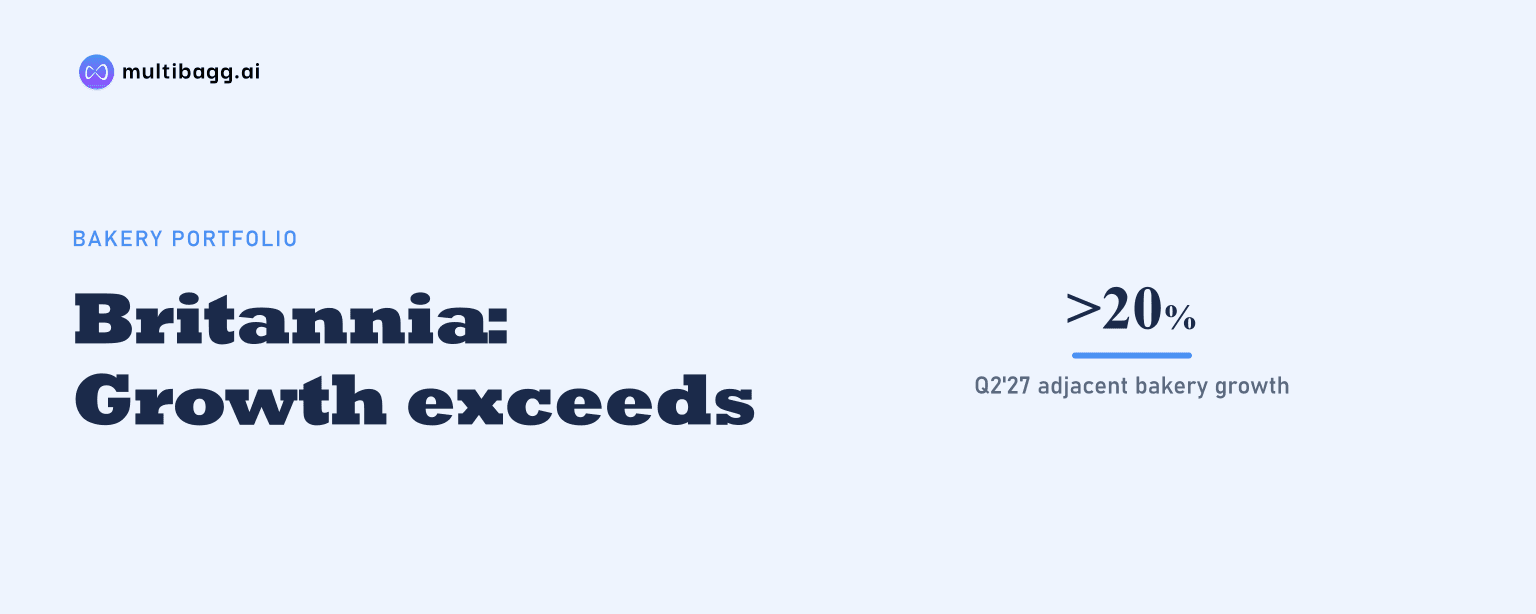
Britannia reported that its adjacent bakery businesses grew more than 20% during Q2'27, while cheese, ghee and milk drinks led its dairy business into double-digit growth. The company also said its international business rebounded to mid-teens growth across key geographies, extending the reported momentum beyond its core biscuit portfolio.
Know Britannia Industries inside out
Results, valuation, peers and who's buying, in one view.
How fast did Britannia's adjacent bakery businesses grow in Q2'27?
Britannia said its adjacent bakery businesses grew more than 20% during Q2'27. The disclosure is a growth-rate statement rather than a revenue disclosure: the company did not provide sales, volume, profit or market-share figures for this group on the adjacency-business slide. The reported threshold separates this group from the broader qualitative descriptions used for dairy and international operations.
The Q2'27 result is specifically described as growth “during the quarter,” rather than a half-year or full-year outcome. Britannia did not disclose a prior-quarter growth rate for adjacent bakery businesses, so the presentation does not establish whether the more-than-20% growth accelerated or decelerated from Q1'27. It also does not divide the growth between individual bakery categories.
The comparison in Britannia's presentation is therefore between disclosed growth bands, not reported sales values. Adjacent bakery was the only one of the three reported groups given a threshold above 20%, while international operations were described as being in the mid-teens and dairy as returning to double-digit growth. The presentation does not give a combined adjacency-business growth number.
Which products are included in Britannia's adjacent bakery businesses?
Britannia defines adjacent bakery businesses as cake, rusk, wafers and croissant. These four categories are explicitly included in the more-than-20% Q2'27 growth statement, meaning the presentation identifies the scope of the group even though it does not disclose category-level growth rates or sales contributions.
Cake, rusk, wafers and croissant are presented separately from the dairy business, which includes cheese, ghee and milk drinks. That distinction matters when reading the Q2'27 growth disclosures: the more-than-20% figure applies to the four adjacent bakery categories as a group and should not be read as a dairy or total-company growth figure.
Britannia's slide does not say which of cake, rusk, wafers or croissant contributed most to the quarter's growth. Nor does it give pricing, distribution, volume or product-launch data for those four categories. The disclosed conclusion is limited to the aggregate group growing more than 20% in Q2'27.
What drove Britannia's dairy growth in Q2'27?
Britannia said cheese, ghee and milk drinks led its dairy business into double-digit growth in Q2'27. The company identifies those three product areas as the drivers of the dairy result, but does not quantify the individual growth rates of cheese, ghee or milk drinks, or disclose their relative size within dairy.
Cheese also received a separate product-innovation focus in the presentation. Britannia displayed Korean Chilli Slices and Italian Herb Slices, each labelled as five cheese slices, alongside flavoured processed cheese spread under The Laughing Cow brand. The innovation page does not assign sales figures or a growth contribution to either cheese format.
The phrasing indicates a change in dairy's reported growth trajectory: Britannia described cheese, ghee and milk drinks as leading the business “into double-digit growth.” However, the presentation does not disclose the earlier dairy growth rate, so it does not quantify the size of the improvement before Q2'27. It also provides no dairy revenue, margin or volume data.
Got a follow-up? Ask IRIS
How did Britannia's international business perform in Q2'27?
Britannia said its international business made a resilient rebound into mid-teens growth across key geographies in Q2'27. The company identified America, Egypt, Africa, Kenya, the Middle East and Nepal as the international markets shown on the slide, without assigning a growth rate to any individual geography.
The word “rebound” signals that Britannia is describing a recovery in international growth, but the presentation does not state the preceding period's international growth rate. As a result, the disclosed comparison is directional rather than numerical: Q2'27 is described as mid-teens growth after an unspecified earlier period, not as a reported percentage-point change.
The international result is lower in the presentation's stated growth bands than adjacent bakery's more-than-20% outcome, but it is more specific than a generic positive-growth statement. Britannia does not disclose whether America, Egypt, Africa, Kenya, the Middle East or Nepal accounted for the largest part of the mid-teens growth, and it provides no international sales base.
What other Q2'27 growth indicators did Britannia disclose?
Britannia said general trade growth in Q2'27 was 2.6 times that of FY 25-26, while other channels continued to grow at 1.8 times the rate of general trade. The company also stated that e-commerce contributed about 7%, providing a channel-level indicator alongside the product-category growth disclosures.
Britannia separately reported that growth in key states in Q2'27 was 2.8 times that of FY 25-26. Key states contributed more than 50% of domestic revenue, while other states continued to outpace key states in growth. The presentation does not provide the underlying percentage growth rates for general trade, other channels, key states or other states.
These channel and geography statements use different measures from the adjacency-business slide. The 2.6-times and 2.8-times comparisons benchmark Q2'27 against FY 25-26 growth, whereas the adjacent bakery, dairy and international disclosures state growth bands for the quarter. Britannia does not link the more-than-20% bakery result to a specific channel, state group or e-commerce contribution.
Conclusion
Britannia's Q2'27 presentation shows reported growth across several non-biscuit areas, led by adjacent bakery businesses at more than 20%. Cake, rusk, wafers and croissant form that group, while cheese, ghee and milk drinks led dairy into double-digit growth and international operations reached mid-teens growth across six shown geographies.
What to watch next is whether Britannia resolves the category-level gaps in its disclosure by reporting sales, volume or individual growth rates for cake, rusk, wafers, croissant, cheese, ghee and milk drinks. The Q2'27 presentation also identifies Korean Chilli and Italian Herb cheese slices and an e-commerce contribution of about 7%, but does not quantify their revenue or contribution to dairy and channel growth.