










Burnpur Cement Debt Moves to CFM ARC as Operations Remain Shut
Key highlights
- Burnpur Cement’s debts and underlying securities moved from UV Asset Reconstruction to CFM Asset Reconstruction on November 10, 2026.
- Burnpur Cement stopped all operations in November 2023, and management has concluded it is not a going concern.
- The company was reported to have ₹563 crore of debt and negative net worth of ₹574 crore.
- A reported quarterly interest cost of ₹21.96 crore was cited against zero revenue.
powered by IRIS
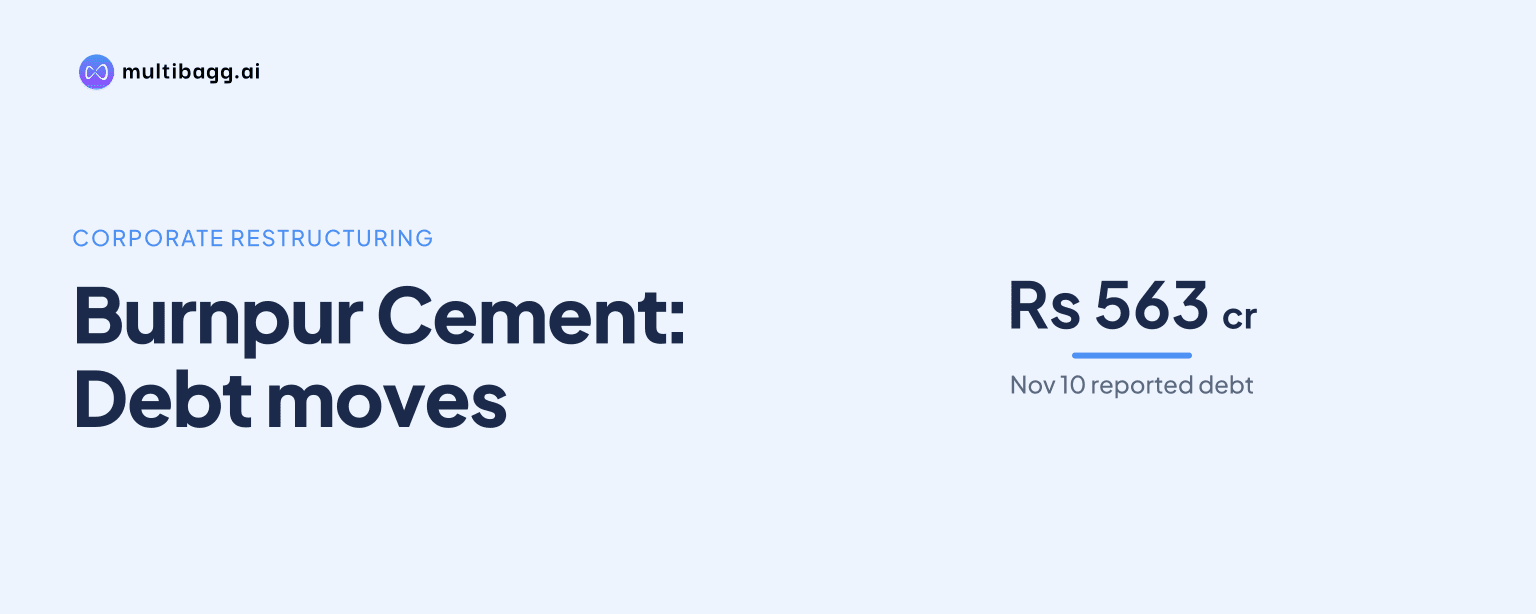
Burnpur Cement Limited’s debt and related securities were transferred to CFM Asset Reconstruction Private Limited on November 10, 2026, while the company remained non-operational with reported debt of ₹563 crore and negative net worth of ₹574 crore. The transfer changes the holder of the claims but does not disclose any settlement or reduction in liabilities.
Know Burnpur Cement inside out
Results, valuation, peers and who's buying, in one view.
What did Burnpur Cement announce in its November 2026 filing?
Burnpur Cement said its Board considered and approved unaudited standalone financial results for the quarter and half-year ended September 30, 2026, at its meeting on November 11, 2026. The Board also took note of an intimation that UV Asset Reconstruction Company Limited had reassigned the company’s debts, underlying securities and associated rights to CFM Asset Reconstruction on November 10, 2026.
The company said it would make the necessary consequential changes in its records and keep stock exchanges informed of further developments. The filing did not state the value of the transferred debt, the consideration paid between the two asset reconstruction companies, or any revised repayment terms for Burnpur Cement.
The disclosure is significant because an asset reconstruction company holds creditor rights over stressed loans and their linked security interests. In this case, the transfer means CFM Asset Reconstruction has taken over the position previously held by UV Asset Reconstruction in relation to Burnpur Cement’s outstanding debt claims.
Why are Burnpur Cement’s operations still shut?
Burnpur Cement discontinued all operations in November 2023 because of continuous losses, according to the statutory auditor’s limited review report for Q2 FY27. The auditor said this created significant doubt about the company’s ability to continue as a going concern, while management has ascertained that the company is not a going concern.
The company was incorporated in 1986 as a cement manufacturer with operations associated with West Bengal and Jharkhand. It was declared a non-performing asset in December 2016, after which debt recovery rather than production became the central issue for the business and its lenders.
Burnpur Cement has no subsidiaries, joint ventures or associate companies, based on the information provided. This leaves the listed entity without another operating group company that could support its finances or provide an alternative business platform following the shutdown of cement operations.
The available disclosures also state that all assets at the Patratu unit have been sold. The company has therefore reported no operating units, reinforcing the auditor’s observation that the basis for preparing accounts as a continuing operating business no longer exists.
What do the reported debt and cash figures show?
The reported financial position shows a substantial gap between liabilities and the company’s ability to generate operating cash flow. Burnpur Cement was reported to have debt of ₹563 crore and negative net worth of ₹574 crore, while operations have been fully discontinued since November 2023.
A separate debt-burden assessment in the supplied material cited quarterly interest costs of ₹21.96 crore against zero revenue. This comparison illustrates the core financial constraint: without production or sales, there is no operating income available to service finance costs or fund a restart.
The company also had ₹22.90 lakh of idle cash at its Asansol unit that had remained unused for more than three years amid ongoing tax litigations, according to the reported announcement summary. While this amount is small relative to the reported debt burden, it points to cash remaining constrained by unresolved matters rather than being freely deployable for operations.
Got a follow-up? Ask IRIS
How does the CFM Asset Reconstruction transfer affect shareholders?
The transfer gives CFM Asset Reconstruction the debt-related rights and securities previously held by UV Asset Reconstruction, but it does not by itself resolve Burnpur Cement’s liabilities. Shareholders have not been informed of a debt settlement, restructuring package, capital infusion or plan to restart operations.
For investors, the main immediate issue is that the creditor position has changed while the company’s operational position has not. Burnpur Cement remains a non-operating company, and the auditor’s limited review continues to flag the going-concern issue. The filing should therefore be read as a statutory update on the ownership of debt claims, rather than evidence of a recovery in the underlying business.
No share-price movement, new financial forecast or timeline for resolution was provided in the material. The market relevance instead comes from the possibility that the new debt holder may pursue legal, recovery, restructuring or other resolution steps within the rights transferred to it.
What background explains Burnpur Cement’s current position?
Burnpur Cement’s current position stems from a long period of financial stress that began before the complete operational shutdown. The company’s NPA classification in December 2016 placed its borrowing under a debt-recovery framework, and asset reconstruction companies subsequently became central to the handling of its lender claims.
Historically, Punjab National Bank had put the loss-making company’s account up for sale after reporting loan outstanding of more than ₹50 crore. The bank stated that the account carried ₹50.18 crore of loans and set a reserve price of ₹20 crore for sale to eligible asset reconstruction companies or transferees. That earlier process illustrates the longstanding lender effort to recover dues from the stressed account.
The supplied material also refers to the legal principle that an asset reconstruction company acquiring a non-performing asset is treated as the lender and obtains the rights of the originating bank. This context helps explain why the November 2026 reassignment includes not only debt but also the underlying securities and associated rights.
What should investors monitor after the debt transfer?
Investors should monitor whether CFM Asset Reconstruction discloses any recovery, legal, settlement or restructuring action related to Burnpur Cement’s liabilities. The company has stated that it will update its records and keep exchanges informed of further developments, making future exchange filings the primary source for confirmed changes.
The other important factors are any update on tax litigation, treatment of the idle Asansol cash balance, and disclosures relating to the company’s remaining assets and liabilities. Since Burnpur Cement has ceased operations and management has concluded that it is not a going concern, any material change would need to be supported by a specific corporate or creditor-led action rather than routine operating improvement.
Conclusion
The transfer of Burnpur Cement’s debt from UV Asset Reconstruction to CFM Asset Reconstruction changes the creditor holding the company’s debt claims, but it does not alter the disclosed operational facts. Cement production has been discontinued since November 2023, the auditor has flagged the going-concern position, and the company faces reported debt of ₹563 crore alongside negative net worth of ₹574 crore.
The next disclosures to watch are any action by CFM Asset Reconstruction on recovery or resolution, along with Burnpur Cement’s promised updates to exchange records. Investors should also track whether the company provides new information on unresolved tax litigation, remaining cash, liabilities, or any formal proposal affecting the non-operating listed entity.