










Park Medi World Limited Q2 Revenue Rises 25% as Profit Falls 31%
Key highlights
- Park Medi World reported Q2 FY27 revenue from operations of ₹511 crore, up 25% year-on-year.
- Q2 FY27 net profit declined 30.7% year-on-year to ₹54.5 crore.
- H1 FY27 revenue reached ₹987 crore, up 22%, while the company served 5.39 lakh patients.
- Park Medi World added 680 beds in H1 FY27 across Panchkula and Rudrapur.
powered by IRIS
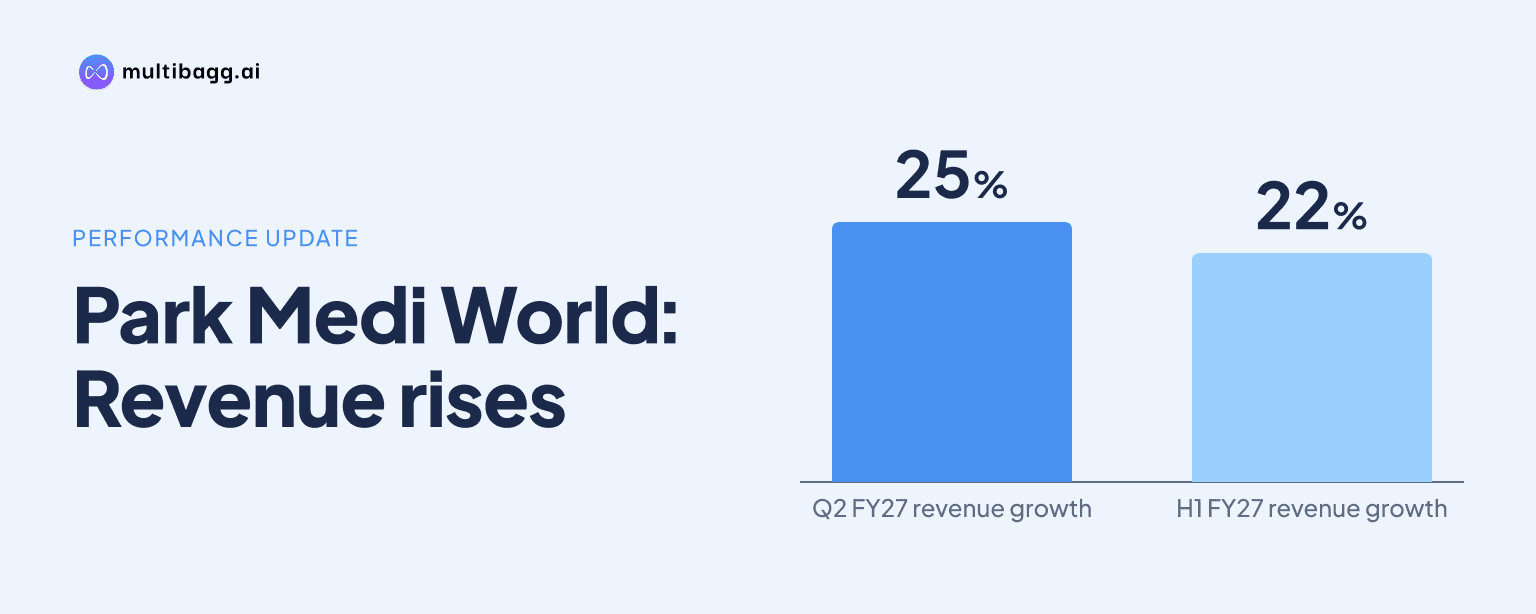
Park Medi World Limited reported Q2 FY27 revenue from operations of ₹511 crore, up 25% year-on-year, while net profit fell 31% to ₹54.5 crore as losses at new hospitals and higher consumable costs compressed margins. The company also recorded ₹987 crore of revenue in the first half of FY27.
Know Park Medi World inside out
Results, valuation, peers and who's buying, in one view.
What did Park Medi World report for Q2 FY27?
Park Medi World reported revenue from operations of ₹511 crore in Q2 FY27, compared with ₹410 crore in Q2 FY26. The 25% year-on-year rise was supported by higher patient volumes and the ramp-up of newer hospitals, according to management's earnings call commentary.
EBITDA excluding other income was ₹102 crore during the quarter, translating into an EBITDA margin of 19.9%. Net profit stood at ₹54.5 crore, with a net profit margin of 10.7%. While revenue expanded, profit declined 30.7% year-on-year, showing the effect of costs associated with the company's expansion phase.
Why did Park Medi World's margins decline during the quarter?
Park Medi World's Q2 EBITDA margin declined to 19.9% because three newly launched hospitals created an initial operating drag and consumable costs increased. New hospitals typically carry fixed staff, equipment and operating costs before patient volumes and occupancy reach mature levels, and management identified these factors as material to the quarter's blended margin.
The company said its established hospital assets delivered an EBITDA margin of 26%. This contrast between the mature portfolio and recently opened facilities explains why revenue growth did not translate into a similar rise in consolidated profit. The reported H1 FY27 EBITDA margin was 23.1%, above the Q2 level but below the margin generated by established assets.
Management also addressed the potential effect of price caps during the call and described the impact as negligible. It also discussed the impact related to the Central Government Health Scheme, or CGHS, but the supplied information does not provide a financial amount for that impact.
How did patient volumes and capacity expansion support growth?
Park Medi World served a record 5.39 lakh patients in H1 FY27, supporting its highest-ever half-yearly revenue from operations of ₹987 crore. H1 revenue was 22% higher year-on-year, compared with ₹809 crore in H1 FY26, extending the growth seen in the September quarter.
In Q2 FY27, inpatient department volume increased 31% year-on-year and outpatient department volume rose 29%. These operating indicators point to stronger demand across the network, although the company reported occupancy of 56%, compared with 68% in the referenced comparison. The lower occupancy figure is consistent with a network that has added capacity ahead of full utilisation.
The company added 680 beds in the first half across Panchkula and Rudrapur. Management said this commissioning advanced its wider network expansion plan. The additions increase the group’s available infrastructure, but they also contributed to the near-term margin pressure associated with opening and scaling new facilities.
Got a follow-up? Ask IRIS
What are Park Medi World's stated expansion and revenue targets?
Park Medi World has guided for FY27 revenue of about ₹2,050 crore. Its stated capacity plan is to reach 2,300 beds by December 2028, supported by approximately ₹750 crore of capital expenditure. These targets place the recent bed additions within a multi-year programme rather than an isolated quarter-specific initiative.
The company has also referred to a longer-term target of 6,590 beds by December 2028 in its earnings-call summary. The supplied material contains both the 2,300-bed plan and the 6,590-bed target, without further detail reconciling the two measures. Investors will need to refer to future company disclosures for clarity on whether these figures represent different scopes of capacity or stages of the expansion programme.
For the immediate period, the key financial consideration is the pace at which newly commissioned hospitals gain occupancy and approach the operating profile of established facilities. Management's disclosure that mature assets earned a 26% EBITDA margin provides a benchmark, but it did not provide a timetable for the new hospitals to reach that level.
How does the quarter affect investors and hospital operations?
The quarter presents two clear trends for investors. Revenue, patient volumes and bed capacity increased at a healthy rate, but profitability was weaker because the benefits of expansion have not yet fully offset the associated start-up costs. Revenue growth of 25% and a 31% decline in net profit therefore need to be assessed together rather than in isolation.
For hospital operations, the addition of beds in Panchkula and Rudrapur broadens access to the network's services and creates capacity for future patient intake. At the same time, the reported 56% occupancy level indicates that capacity utilisation remains an important operating metric. The company’s Q2 performance will be influenced by patient growth, occupancy, consumable costs and the operating trajectory of the newer hospitals.
Park Medi World conducted its Q2 and H1 FY27 earnings call on 14 November 2026 after reporting results for the quarter and half-year ended 30 September 2026. The company has made the call's audio recording available through its investor relations website in line with its exchange disclosure requirements.
Conclusion
Park Medi World's Q2 FY27 results show continued demand and network expansion, with revenue from operations reaching ₹511 crore and H1 revenue rising to ₹987 crore. However, the 30.7% decline in quarterly net profit and the 19.9% EBITDA margin show that new-hospital losses and higher consumable costs currently outweigh part of the benefit from higher volumes.
The next disclosures to watch are progress toward FY27 revenue guidance of about ₹2,050 crore, the operating ramp-up of the 680 beds added during H1, and any additional detail on the capacity targets for December 2028. Updates on occupancy, margins at newer facilities and capital expenditure will be relevant to evaluating how quickly expansion converts into profitability.