










Park sees CGHS rates adding Rs 58-60 crore to FY27 revenue
Key highlights
- Park estimates CGHS-linked rates will add Rs 58-60 crore to FY27 revenue over about seven months.
- Government insurance contributed approximately 76% of Park's Q2 FY27 revenue.
- Park said roughly 95%-98% of revised CGHS rates were in force by November 14, 2026.
- Park reported H1 FY27 revenue of Rs 987 crore, up 22% from Rs 809 crore a year earlier.
powered by IRIS
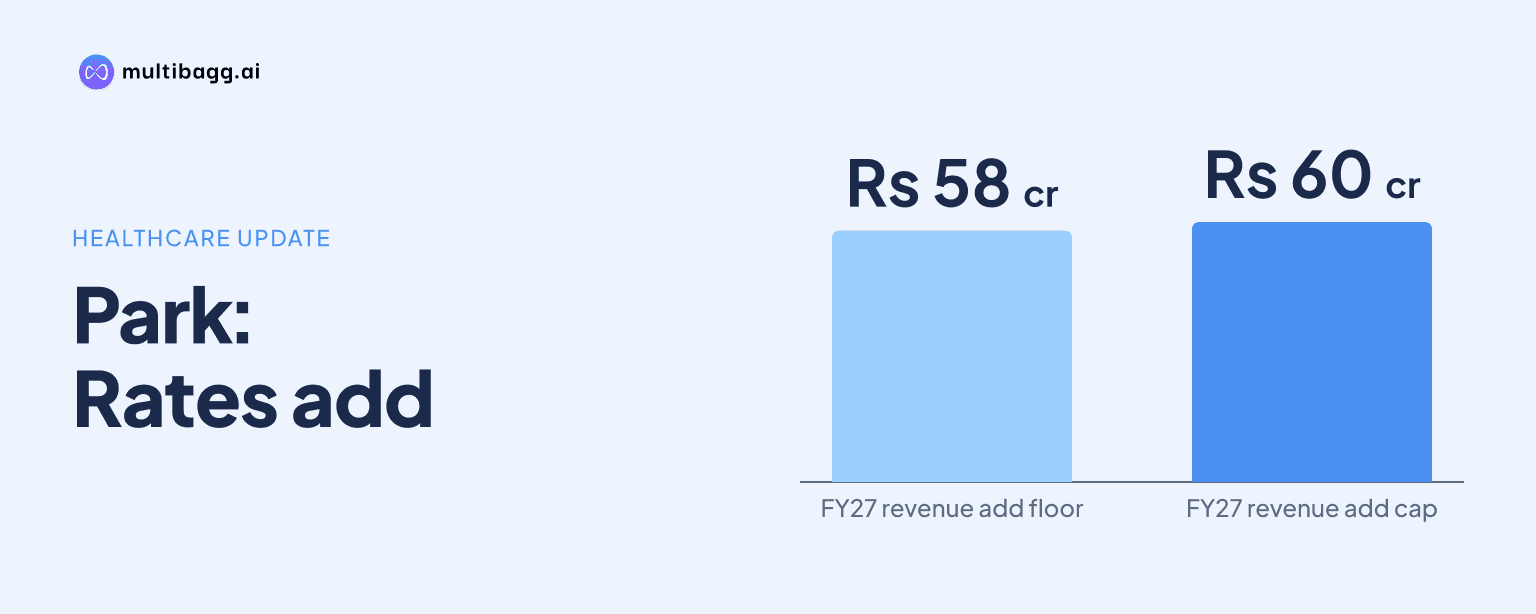
Park Medi World Limited estimates that CGHS-linked rate increases will add Rs 58-60 crore to FY27 revenue over a seven-month applicable period. Management based the calculation on government insurance contributing nearly 75% of FY27 revenue, with 92% of that payer revenue linked to rates benchmarked to CGHS.
Know Park Medi World inside out
Results, valuation, peers and who's buying, in one view.
How did Park calculate the CGHS rate benefit?
Park calculated the Rs 58-60 crore FY27 benefit by applying the rate rise only to revenue exposed to government payers benchmarked to CGHS, rather than to all revenue. Management said the CGHS rate hike announced in October 2025 covered about 5,500 to 6,000 line items and represented a ballpark 10% increase in the relevant revenue from operations and income.
The company used FY27 revenue guidance of about Rs 2,060 crore for this calculation. It estimated that government insurance companies would contribute nearly 75% of that amount and that 92% of government-insurance revenue would be tied to CGHS-benchmarked rates. Management said these inputs produced an effective rate increase of about 6% when measured against total revenue.
Management also offered a full-period illustration using FY26 revenue of about Rs 1,680 crore. Applying the effective 6% increase to that base implied Rs 85-90 crore, according to management. Limiting the application to about seven months of FY27 reduced the estimated impact to Rs 58-60 crore.
When will Park recognise the revised CGHS rates?
Park said roughly 95%-98% of the revised CGHS rates had been factored into hospital operations and government-payer payment mechanisms by its November 14, 2026 earnings call. Management had expected a three- to four-quarter lag after the October 2025 announcement before revised rates became embedded in day-to-day billing and payment processes.
For FY27, management said the 95%-97% implemented portion would apply for around seven months. This was the stated reason it did not use the Rs 85-90 crore full-period illustration for the entire financial year. The Rs 58-60 crore figure is therefore management's timing-based revenue estimate, not a reported benefit already booked across all FY27 months.
The payer mix reported for Q2 FY27 was close to the assumption used in the calculation. Government insurance schemes contributed approximately 76% of quarterly revenue, while self-pay and private insurance or third-party administrators contributed 24%. Management said it was working towards a 70/30 payer mix over the next 12 to 18 months.
Got a follow-up? Ask IRIS
How much of Park revenue is linked to government payers?
Park has significant government-payer exposure because government insurance represented approximately 76% of Q2 FY27 revenue and management used a nearly 75% FY27 share in its CGHS calculation. Within that government-insurance pool, management said 92% was covered by rates benchmarked to CGHS, making this exposure central to the projected tariff benefit.
Revenue was also rising from patient activity and recently added hospitals. Revenue from operations increased 25% year on year to Rs 511 crore in Q2 FY27 from Rs 410 crore in Q2 FY26. In H1 FY27, revenue rose 22% to Rs 987 crore from Rs 809 crore, which management attributed mainly to patient volumes and ramp-up at new and recently acquired hospitals.
Inpatient department volume grew 23% year on year to 57,000 patients in H1 FY27, while outpatient department volume also rose 23% to 482,000 patients. Average revenue per occupied bed increased 13% to Rs 30,548, while average length of stay declined to 5.6 days from 6.4 days in H1 FY26.
Higher-end specialties contributed about 63% of H1 FY27 revenue, up 640 basis points year on year. A basis point equals one-hundredth of a percentage point. Management cited transplant, interventional cardiology and robot-assisted joint replacement programmes as areas scaling in Q2 FY27, but did not allocate a specific share of the CGHS benefit to any specialty.
What could affect the CGHS benefit in FY27 results?
The CGHS estimate measures incremental revenue, while FY27 profitability will also reflect ramp-up costs at Agra, Panchkula and Rudrapur. These three newer hospitals generated Rs 72 crore of H1 FY27 revenue but recorded a negative earnings before interest, tax, depreciation and amortisation, or EBITDA, margin of 8%, resulting in an EBITDA loss of Rs 6 crore, management said.
The 14 established hospitals generated Rs 915 crore of H1 FY27 revenue and Rs 234 crore of EBITDA, equivalent to a 26% EBITDA margin. Including the three new units reduced consolidated H1 EBITDA to Rs 228 crore and the margin to 23%. Management said brownfield hospitals typically take four to six months to reach breakeven, compared with 12 to 15 months for a greenfield hospital.
Costs also rose during the first half. Management said food and beverage costs at 14 hospitals were about Rs 15 crore over six months, while a nearly 50% rise in meal costs implied an additional Rs 7.5 crore. It also cited increased use of medicines, antibiotics and implants for advanced procedures as contributing to higher material costs.
Management said it expected cost and revenue effects to streamline in Q3 and Q4 FY27 as average revenue per occupied bed rises. It retained an expectation of revenue close to Rs 2,050 crore for the current year, while separately using around Rs 2,060 crore as the base for the CGHS calculation. The call did not reconcile the Rs 10 crore difference between those two FY27 revenue references.
Conclusion
Park's calculation indicates that the CGHS-linked revision could make a measurable contribution to FY27 revenue because government insurance accounts for about three-quarters of its business and management says most of that revenue follows CGHS benchmarks. The Rs 58-60 crore estimate applies to seven months and does not quantify the effect on EBITDA, profit after tax, cash flow or collections.
The next disclosures to watch are management's expected Q3 and Q4 FY27 cost normalisation, the path to breakeven at Agra, Panchkula and Rudrapur, and progress towards a 70/30 payer mix over 12 to 18 months. Park also has 2,300 beds under execution, expected to become operational by December 2028 and lift capacity to 6,590 beds from 4,290 beds as of September 30, 2026.