










Park Medi World Limited’s new hospitals cut H1 EBITDA by ₹6 crore
Key highlights
- Park Medi World’s Agra, Panchkula and Rudrapur hospitals generated Rs 72 crore of H1 FY27 revenue.
- The three new hospitals reduced Park Medi World’s H1 FY27 EBITDA by Rs 6 crore.
- Park Medi World’s established hospitals reported a 26% H1 FY27 EBITDA margin, versus 23.1% consolidated.
- Network occupancy was 56% in H1 FY27, compared with 68% in H1 FY26 after 1,040 beds were added.
powered by IRIS
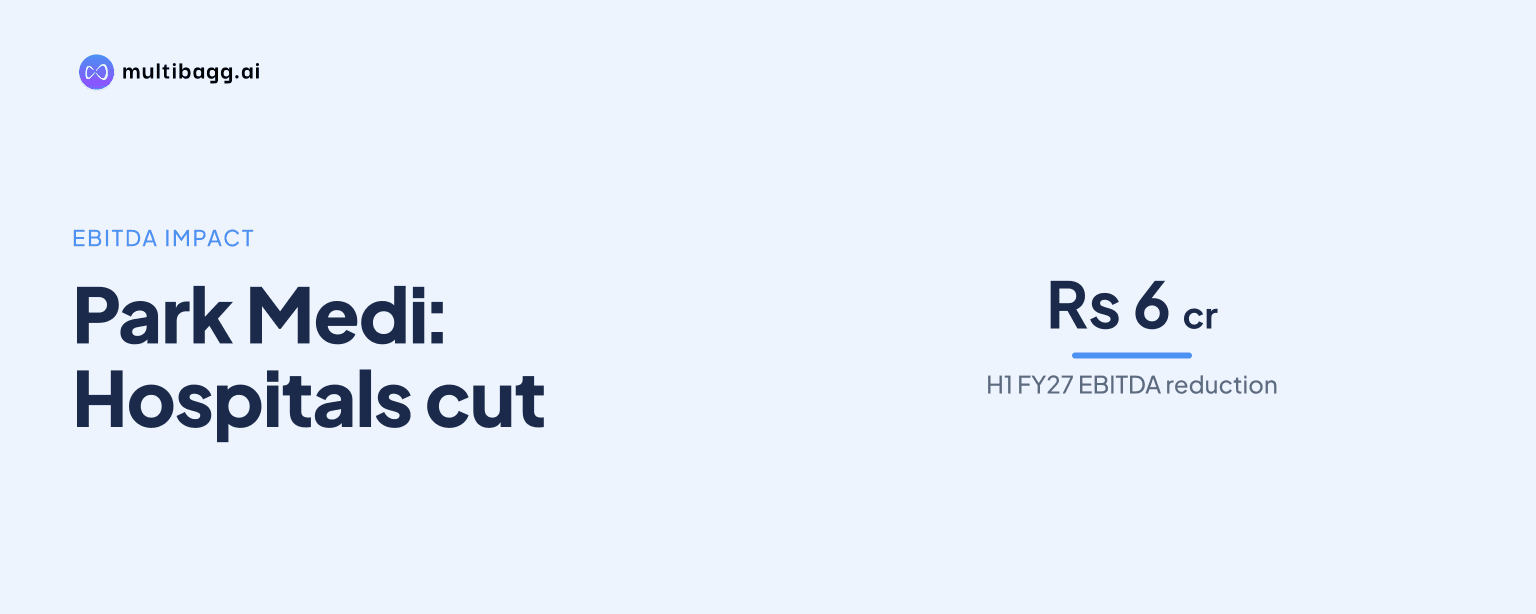
Park Medi World’s Agra, Panchkula and Rudrapur hospitals generated Rs 72 crore of revenue in H1 FY27 but reduced consolidated EBITDA by Rs 6 crore, producing a negative 8% EBITDA margin. The three units lowered the group’s H1 EBITDA margin to 23.1%, compared with 26% for its 14 established hospitals.
Know Park Medi World inside out
Results, valuation, peers and who's buying, in one view.
How did Park Medi World’s new hospitals affect H1 FY27 EBITDA?
Park Medi World’s three new hospitals generated Rs 72 crore in H1 FY27 revenue and created an EBITDA loss of Rs 6 crore. Its 14 established hospitals delivered Rs 915 crore of revenue and Rs 234 crore of EBITDA, while the three newer facilities took total revenue to Rs 987 crore and reduced consolidated EBITDA to Rs 228 crore.
The new facilities reported a negative 8% EBITDA margin for the half year ended September 30, 2026. Their loss created a 300-basis-point difference between the 26% EBITDA margin of the established portfolio and Park Medi World’s reported consolidated margin of 23.1%; 100 basis points equal one percentage point.
H1 FY27 revenue increased 22% from Rs 809 crore in H1 FY26, but EBITDA increased 5% to Rs 228 crore. Park Medi World reported profit after tax of Rs 143 crore, or a 14.5% margin, while management said the established hospitals delivered a 17% profit-after-tax margin.
Which Park Medi World hospitals are still ramping up?
Park Medi World identified Agra, Panchkula and Rudrapur as the three hospitals behind the H1 FY27 EBITDA loss. Management said Agra started in February, Panchkula in the fourth week of April 2026, and Rudrapur from August 1, 2026, leaving the first two sites with about 5.5 months of operating time and Rudrapur with about 1.5 months in H1.
Two of the three additions are brownfield hospitals and one is greenfield, although management did not identify the category of each location. Management said brownfield hospitals historically take about four to six months to break even, while greenfield hospitals take 12 to 15 months.
Management also said a new hospital usually enters positive EBITDA territory within about 12 months and gradually approaches the operating-hospital margin over roughly three to 3.5 years. That timeline is management’s historical expectation, rather than a disclosed target for each of Agra, Panchkula and Rudrapur.
Got a follow-up? Ask IRIS
Why are Park Medi World’s newer hospitals initially loss-making?
Park Medi World said insurer onboarding delays constrain the early revenue mix at new hospitals. Private and government insurers take time to enrol a new facility, so early collections are more dependent on self-paying patients than at an established hospital.
Management said this pattern can leave results below the mature network for the first six months to three quarters. The company added 1,040 beds across Agra, Panchkula and Rudrapur over the preceding 12 months, and network occupancy was 56% in both Q2 and H1 FY27, versus 68% in the respective FY26 periods.
Patient volumes still increased across the network in H1 FY27. Inpatient department volume rose 23% year on year to 57,000 patients, outpatient department volume rose 23% to 482,000 patients, and average revenue per occupied bed increased 13% to Rs 30,548.
Average length of stay declined 11% to 5.6 days in H1 FY27 from 6.4 days in H1 FY26. Management attributed the occupancy reduction primarily to capacity additions, while the volume and average-revenue metrics indicate that activity continued to rise as the network expanded.
What else influenced Park Medi World’s H1 FY27 margins?
Park Medi World said the new-hospital loss was accompanied by higher consumable and medicine costs. Management cited a roughly 50% increase in food and beverage costs, with the cost of a patient meal rising to Rs 400 from Rs 270, creating an estimated Rs 7.5 crore impact across 14 hospitals over six months.
Management also attributed medicine, antibiotic and implant costs to its push into advanced tertiary and quaternary procedures. High-end specialties contributed about 63% of H1 FY27 revenue, up 640 basis points year on year, and management said these procedures initially yielded lower realised margins on medicines and implants.
In Q2 FY27, revenue from operations increased 25% year on year to Rs 511 crore, while EBITDA excluding other income was Rs 102 crore at a 19.9% margin. Management expected the higher costs to align with revenue in Q3 and Q4 through higher average revenue per occupied bed.
Government insurance schemes accounted for about 76% of Q2 revenue, while self-pay and private insurance or third-party administrator revenue accounted for 24%. Management reiterated its objective of moving toward a 70% government-insurance and 30% self-pay/private-insurance revenue mix over the next 12 to 18 months.
Conclusion
Park Medi World’s H1 FY27 expansion produced a defined trade-off: the three newer hospitals added Rs 72 crore of revenue but reduced EBITDA by Rs 6 crore. The established portfolio’s 26% EBITDA margin remained above the consolidated 23.1% margin, while total revenue grew 22% and inpatient and outpatient volumes each rose 23%.
The next measure to watch is the ramp-up of Agra, Panchkula and Rudrapur against management’s stated four-to-six-month brownfield and 12-to-15-month greenfield breakeven experience. Park Medi World expects to add a further 750 beds in the remainder of FY27 and has 2,300 beds under execution for operation by December 2028.