










Can Fin Homes H1 profit rises 14% as loan book grows 10%
Key highlights
- Can Fin Homes reported H1 FY27 profit after tax of Rs 542 crore, up 14% year on year.
- Can Fin Homes' outstanding loan book grew 10% year on year to Rs 43,539 crore at September 2026.
- September 2026 quarter disbursements were Rs 2,373 crore, down from Rs 2,545 crore a year earlier and Rs 2,609 crore in June 2026.
- Can Fin Homes' September 2026 net interest margin was 3.89%, compared with 4.02% a year earlier.
powered by IRIS
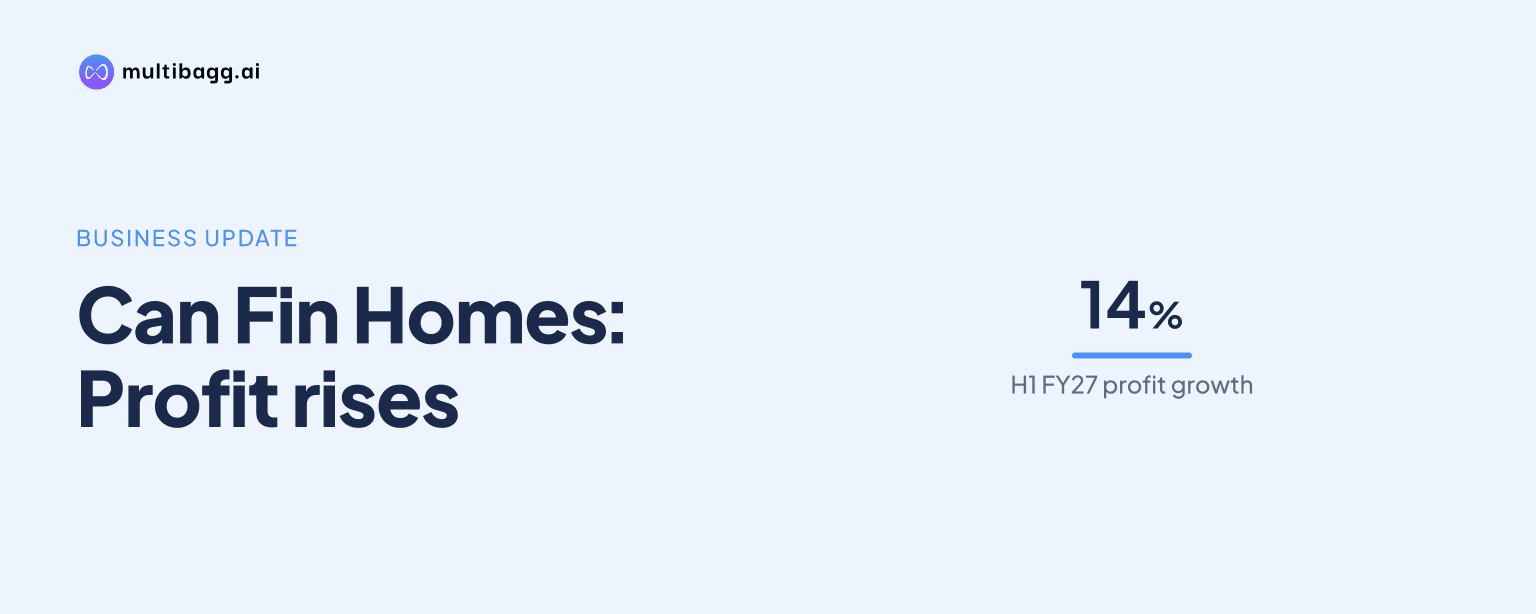
Can Fin Homes Limited reported H1 FY27 profit after tax of Rs 542 crore, up 14% year on year, while its outstanding loan book grew 10% to Rs 43,539 crore at September 2026. Net interest income rose 12% to Rs 859 crore, although September-quarter disbursements declined to Rs 2,373 crore.
Know Can Fin Homes inside out
Results, valuation, peers and who's buying, in one view.
How did Can Fin Homes grow H1 FY27 earnings?
Can Fin Homes increased profit after tax by 14% to Rs 542 crore in the six months ended September 2026, from Rs 475 crore in H1 FY26. Profit before tax rose 13% to Rs 686 crore from Rs 609 crore, while operating profit increased 10% to Rs 706 crore from Rs 639 crore.
Net interest income, or interest earned less interest paid, grew 12% to Rs 859 crore from Rs 767 crore. New approvals rose 14% to Rs 5,399 crore from Rs 4,739 crore, ahead of the 9% increase in disbursements to Rs 4,982 crore from Rs 4,560 crore. The loan book expanded 10% to Rs 43,539 crore from Rs 39,657 crore.
The difference between approval growth and disbursement growth was visible in the H1 FY27 totals, with approvals increasing Rs 660 crore and disbursements increasing Rs 422 crore. The presentation does not explain the difference, but the reported figures show that sanction activity rose faster than loan releases during the six-month period.
What happened to Can Fin Homes' September-quarter lending momentum?
Can Fin Homes' September 2026 lending flows were below both the year-earlier and preceding-quarter levels. New approvals were Rs 2,604 crore, compared with Rs 2,680 crore in September 2025 and Rs 2,795 crore in June 2026. This represented calculated declines of about 3% year on year and 7% sequentially.
Disbursements were Rs 2,373 crore in the September 2026 quarter, down from Rs 2,545 crore in September 2025 and Rs 2,609 crore in June 2026. That equates to calculated declines of about 7% year on year and 9% from the June 2026 quarter, despite the 9% increase in H1 FY27 disbursements.
The outstanding loan book increased by Rs 578 crore during the September quarter, reaching Rs 43,539 crore from Rs 42,961 crore in June 2026. This quarterly increase occurred alongside lower approvals and disbursements, while the presentation does not identify the product or borrower segments responsible for the loan-book movement.
Did Can Fin Homes' September-quarter earnings continue to increase?
Can Fin Homes' detailed three-month table reports September 2026 profit after tax of Rs 275 crore, compared with Rs 251 crore in September 2025 and Rs 268 crore in June 2026. Profit before tax was Rs 347 crore, up from Rs 332 crore a year earlier and Rs 339 crore in the preceding quarter.
September-quarter operating profit reached Rs 355 crore, versus Rs 335 crore in September 2025 and Rs 352 crore in June 2026. Net interest income was Rs 431 crore, compared with Rs 404 crore a year earlier and Rs 427 crore sequentially, showing growth in both comparisons despite lower disbursement flows.
Expected credit loss, or ECL, provision was Rs 8 crore in September 2026, against Rs 3 crore in September 2025 and Rs 13 crore in June 2026. Earnings per share was Rs 20.62, up from Rs 18.88 a year earlier and Rs 20.12 in June 2026. A separate Q2 FY27 chart lists profit after tax at Rs 271 crore, while the detailed period-ended table lists Rs 275 crore.
Got a follow-up? Ask IRIS
What changed in Can Fin Homes' margins, returns and costs?
Can Fin Homes reported a net interest margin of 3.89% in the September 2026 quarter, below 4.02% in September 2025 but above 3.81% in June 2026. Yield on the loan portfolio was 9.84%, compared with 10.08% a year earlier and 9.81% in the previous quarter, while cost of borrowing was 7.03% against 7.17% and 6.98%.
The reported spread was 2.81% in September 2026, versus 2.91% in September 2025 and 2.83% in June 2026. Return on average assets was 2.42%, compared with 2.46% a year earlier and 2.39% sequentially. Return on average equity was 17.12%, below both 18.41% in September 2025 and 17.15% in June 2026.
The cost-to-income ratio increased to 19.59% from 18.55% a year earlier and 19.52% in June 2026. Average business per branch was Rs 159 crore, compared with Rs 160 crore in September 2025 and Rs 172 crore in June 2026, while average business per employee was Rs 29 crore against Rs 30 crore and Rs 31 crore respectively.
How did Can Fin Homes' asset quality and portfolio mix change?
Can Fin Homes reported gross non-performing assets, or gross NPA, of Rs 392 crore at September 2026, with a gross NPA ratio of 0.90%. The balance was higher than Rs 373 crore a year earlier, but the ratio was lower than 0.94% because the outstanding loan book rose to Rs 43,539 crore.
Net NPA excluding management overlay was Rs 185 crore at September 2026, compared with Rs 191 crore in September 2025. The detailed quarterly table reports a net NPA ratio of 0.42%, against 0.48% a year earlier and 0.40% in June 2026; the H1 table reports the September 2026 ratio as 0.43%.
Private salaried borrowers remained the largest assets-under-management, or AUM, segment at 53% in Q2 FY27, down from 54% in Q2 FY26, while self-employed non-professionals rose to 32% from 30%. Housing loans accounted for 72% of AUM, down from 74%, while housing commercial real estate rose to 12% from 11% and loan against property and mortgage loans rose to 9% from 7%.
Conclusion
Can Fin Homes combined double-digit H1 FY27 growth in profit, net interest income and its loan book with a softer September-quarter lending flow. Profit after tax reached Rs 542 crore and the outstanding loan book reached Rs 43,539 crore, while margins and return on equity remained below their year-earlier levels and the cost-to-income ratio increased.
The next disclosed operating development is Project Tejas, under which the company listed 95 branches for October 2026 after 77 branches in September 2026. Investors can monitor subsequent approval and disbursement figures, following September 2026 approvals of Rs 2,604 crore and disbursements of Rs 2,373 crore, as well as movement in the 3.89% net interest margin.