










Can Fin Homes completes Tejas rollout, all systems live
Key highlights
- Can Fin Homes marked all listed Project Tejas business, infrastructure and security systems as live.
- Reports, LOS and LMS were fully implemented in Q2 FY27.
- The rollout table reports Rs 357.82 crore of disbursement impact across 252 branches.
- Can Fin Homes reported a Q2 FY27 loan book of Rs 43,353 crore, versus Rs 39,965 crore in Q2 FY26.
powered by IRIS
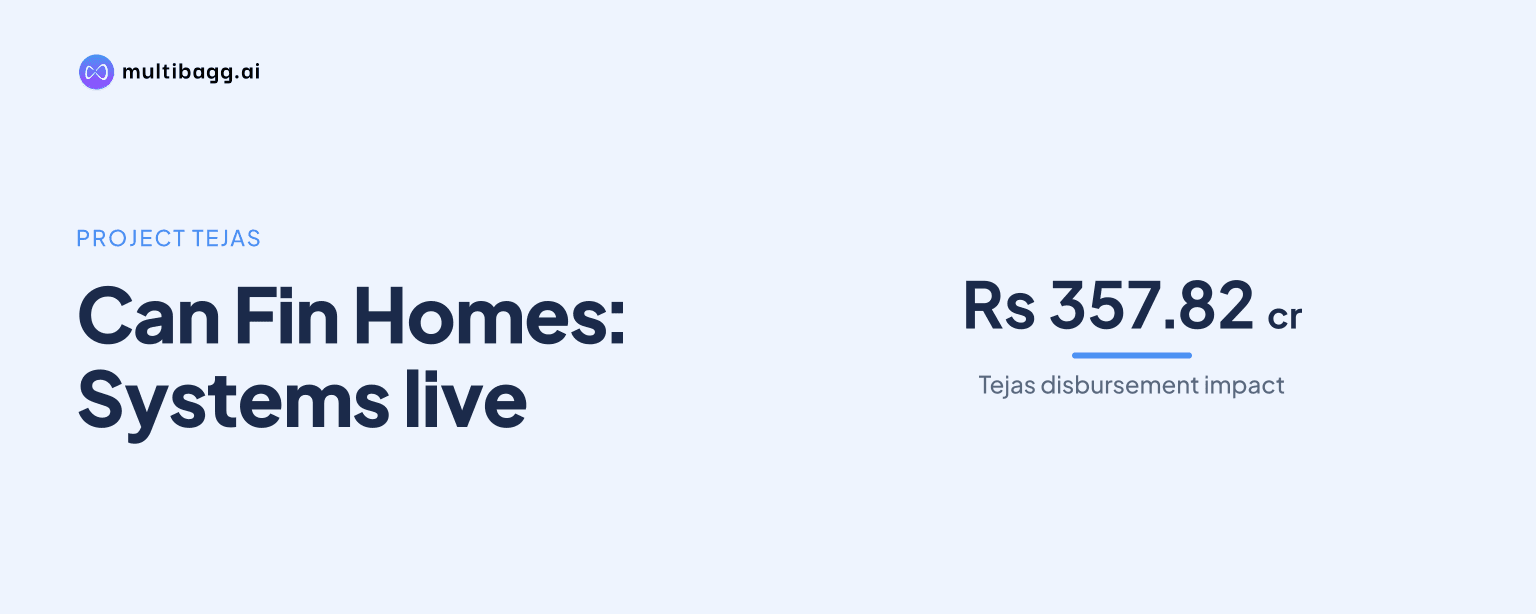
Can Fin Homes Limited says Project Tejas is complete, with all listed business modules, infrastructure services and security solutions live after reporting, loan origination and loan management systems were fully implemented in Q2 FY27. The rollout across 252 branches had a reported Rs 357.82 crore impact on disbursements in the July to September 2026 rows.
Know Can Fin Homes inside out
Results, valuation, peers and who's buying, in one view.
What systems are live under Can Fin Homes Project Tejas?
Can Fin Homes lists every Project Tejas business application, infrastructure service and security solution as live, covering lending, finance, cloud operations and cyber controls. Its business applications include risk management and asset-liability management (ALM), treasury, finance and accounting, human resource management system (HRMS), Aadhaar Data Vault, document management system (DMS), deposits, reporting, loan origination system (LOS) and loan management system (LMS).
Can Fin Homes also lists Amazon Web Services (AWS) cloud infrastructure, an application programming interface manager, software-defined wide area network (SD-WAN), desktop migration, Azure Active Directory on AWS, email and collaboration, artificial-intelligence operations monitoring and an information-technology service-management platform as live. The security layer includes endpoint management, data-loss prevention, database activity monitoring, security information and event management with a security operations centre, network security, and identity and access management.
The live systems sit alongside lending controls already described by Can Fin Homes, including Central Know Your Customer Registry and Unique Identification Authority of India-linked checks at onboarding. The company also lists bank-account verification through Perfios, online Permanent Account Number and Central Registry of Securitisation Asset Reconstruction and Security Interest of India checks, and centralised document verification before disbursement.
When did Can Fin Homes complete the Project Tejas rollout?
Can Fin Homes began the stated implementation in Q2 FY26 and completed its final listed business platforms in Q2 FY27, a rollout spanning five disclosed quarters. Risk management and ALM, treasury, Finance and Accounting Sprint-1, cloud setup, Active Directory, mailing and collaboration, and SD-WAN were marked implemented in Q2 FY26.
In Q3 FY26, Can Fin Homes implemented HRMS, Aadhaar Data Vault and DMS, as well as the network operations centre, security operations centre and IT service-management platform. Finance and Accounting Sprint-2 and deposits followed in Q4 FY26, before reports, LOS and LMS were marked fully implemented in Q2 FY27.
Can Fin Homes identifies IBM as system integrator, PwC as consulting-services provider and KPMG as implementation-support provider. Its application and technical vendors include Knight FinTech for risk management, ALM and treasury; Infor (India) for finance and accounting; Newgen for DMS; AWS and Microsoft for cloud-related services; and Pennant Technologies for LOS and LMS.
Got a follow-up? Ask IRIS
How did Project Tejas affect Can Fin Homes disbursements?
Can Fin Homes reported Rs 357.82 crore of disbursement impact across 252 branches in the Project Tejas rollout table, with reported impact figures for July, August and September 2026. August showed the largest stated impact, at Rs 177.91 crore across 75 branches, followed by Rs 146.76 crore in September across 77 branches and Rs 33.14 crore in July across five branches.
October 2026 covered the largest monthly branch count, 95, but its row does not show an impact amount. The presentation does not explain its method for calculating the impact figures or state whether factors apart from the technology rollout affected the reported disbursement outcome.
The rollout table also shows disbursement totals of Rs 903.15 crore in July 2026, Rs 738.04 crore in August and Rs 728.55 crore in September, against the Rs 869.56 crore Q1 FY27 average shown in its total row. July was above that average by Rs 33.59 crore, while August and September were below it by Rs 131.52 crore and Rs 141.01 crore respectively; Can Fin Homes does not attribute these differences solely to Project Tejas.
How did Can Fin Homes perform while the rollout was completed?
Can Fin Homes reported a Q2 FY27 loan book of Rs 43,353 crore, compared with Rs 39,965 crore in Q2 FY26, while net interest income increased to Rs 443 crore from Rs 400 crore. Profit before tax rose to Rs 344 crore from Rs 333 crore and profit after tax rose to Rs 271 crore from Rs 255 crore, but the presentation does not link these results to Project Tejas.
Some reported ratios declined year on year in Q2 FY27. Net interest margin was 3.89, versus 4.02 in Q2 FY26; return on average assets was 2.42, versus 2.46; and return on equity was 17.12, versus 18.41. The cost-to-income ratio increased to 19.59 from 18.55, while debt-equity ratio declined to 6.0 from 6.6 and net non-performing assets declined to 0.42 from 0.48.
The quarterly comparison shows that the final Q2 FY27 LOS, LMS and reporting implementation coincided with higher loan-book, income and profit figures than a year earlier. It does not establish a causal link because Can Fin Homes provides no Project Tejas spending figure, processing-time measure, customer-adoption measure or operating-cost attribution in the disclosed pages.
Conclusion
Project Tejas gives Can Fin Homes a live set of listed systems spanning core lending, finance, documents, deposits, cloud infrastructure and security. The programme moved from technical foundations in Q2 FY26 through operational and finance applications in Q3 and Q4 FY26, with reporting, LOS and LMS completed in Q2 FY27. The reported rollout also coincided with Rs 357.82 crore of stated disbursement impact across 252 branches.
The next issue to watch is the post-rollout disbursement pattern after October 2026, when 95 branches were included but no impact amount was disclosed. Can Fin Homes has also left unresolved how it calculated the Rs 357.82 crore impact and has not disclosed a target for loan-processing times, digital usage, technology costs or risk outcomes following the completed rollout.