










Can Fin Homes Ltd Files Revised Q2 FY27 ESG Ratings Deck
Key highlights
- Can Fin Homes Ltd filed a revised Q2 FY27 investor presentation incorporating ESG ratings received during the quarter.
- Can Fin Homes reported Q2 FY27 profit after tax of ₹275 crore, up 9.6% year-on-year from ₹251 crore.
- The loan book rose 9.8% year-on-year to ₹43,539 crore, while gross NPA improved to 0.90%.
- Q2 FY27 disbursements fell 6.8% year-on-year to ₹2,373 crore during Project Tejas implementation.
powered by IRIS
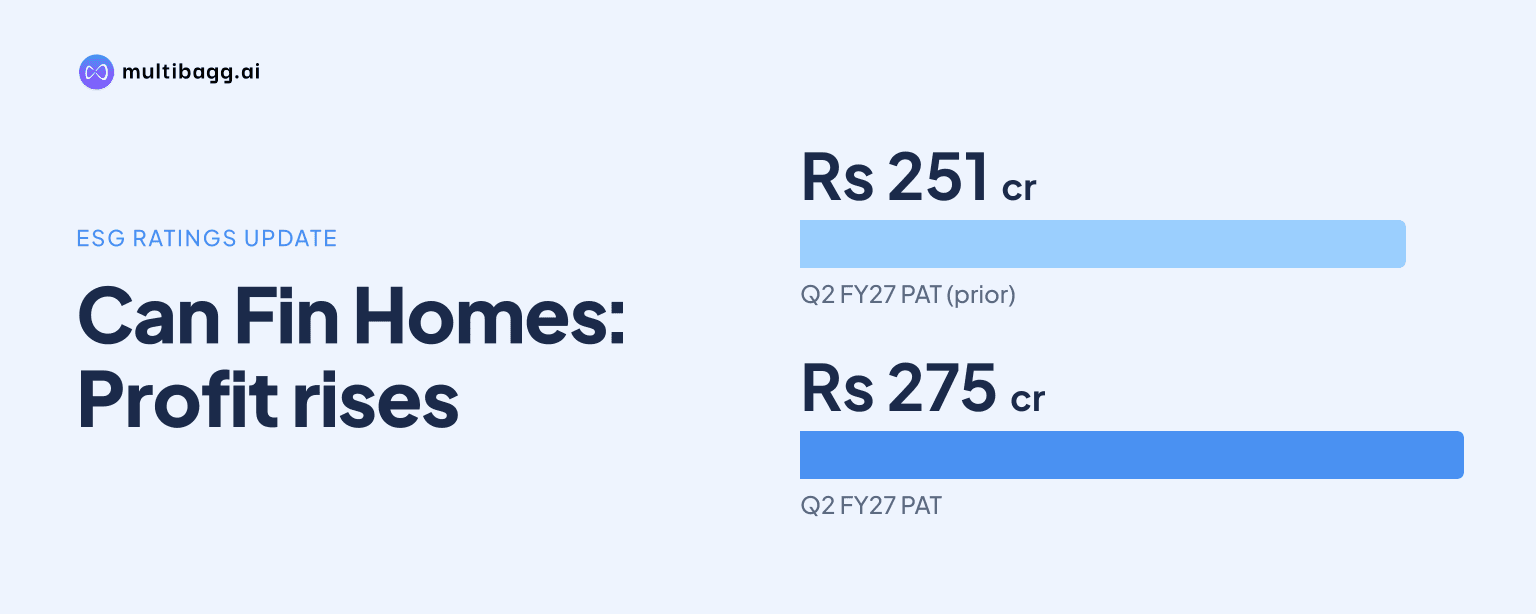
Can Fin Homes Ltd filed a revised Q2 FY27 investor presentation incorporating ESG ratings received during the quarter, while the presentation reported profit after tax of ₹275 crore for the September 2026 quarter. The filing updates the company’s investor communication after its Q2 FY27 results and adds ESG-related disclosures to the presentation.
Know Can Fin Homes inside out
Results, valuation, peers and who's buying, in one view.
What did Can Fin Homes file with the exchanges?
Can Fin Homes filed a revised investor presentation for Q2 FY27 under Regulation 30 of the SEBI Listing Obligations and Disclosure Requirements Regulations. The company’s announcement said the revised presentation was enclosed, and the stated update was the incorporation of ESG ratings received during the quarter.
The revised presentation follows the original post-results investor presentation filed on 9 October 2026. A revised presentation was also announced on 14 October 2026, while the filing record states that Can Fin Homes submitted the document to the NSE on 19 November 2026 at 18:45 IST. The filing date provided for this announcement is 23 November 2026.
The company did not state in the supplied filing summary that its Q2 financial results, business guidance or operating data had been restated. The disclosed purpose of the revision was to update the presentation with ESG ratings. Investors should therefore distinguish the presentation update from a new quarterly-results announcement.
What were Can Fin Homes' Q2 FY27 financial results?
Can Fin Homes reported Q2 FY27 profit after tax of ₹275 crore, up 9.6% year-on-year from ₹251 crore. Its outstanding loan book rose 9.8% year-on-year to ₹43,539 crore as of September 2026, supporting growth in net interest income and profit during the quarter.
Net interest income increased to ₹431 crore from ₹404 crore a year earlier. Operating profit was ₹355 crore, compared with ₹335 crore, while profit before tax rose to ₹347 crore from ₹332 crore. These figures were part of the financial information carried in the Q2 presentation.
However, quarterly disbursements declined during the period. Can Fin Homes reported Q2 disbursements of ₹2,373 crore, down 6.8% year-on-year, while management separately cited ₹2,375 crore of disbursements net of ₹29 crore of cancellations. The difference reflects the way cancellations were described in the related disclosures.
Why did Can Fin Homes' quarterly disbursements decline?
Can Fin Homes said Q2 disbursements were affected by the phased implementation of Project Tejas, its IT transformation programme. The company migrated branches to new loan origination system and loan management system platforms during the quarter, which disrupted normal disbursement activity in each branch’s go-live period.
Management said disbursements at branches in their go-live month fell by about 70% to 75%, before recovering to 80% to 90%. The company said the migration had been fully completed across its branch network by the end of the process. The presentation described the implementation of the loan origination system and loan management system as complete.
For the first half of FY27, disbursements still increased 9% year-on-year to ₹4,982 crore. Can Fin Homes retained its FY27 disbursement guidance of ₹13,000 crore and its AUM growth guidance of 13% to 14%, with management indicating a Q3 disbursement target of about ₹3,500 crore. These are management targets, not reported outcomes.
Got a follow-up? Ask IRIS
How did asset quality and margins change in Q2 FY27?
Can Fin Homes reported gross non-performing assets of 0.90% in Q2 FY27, compared with 0.94% a year earlier. The decline indicates an improvement in the reported gross NPA ratio even as the loan book expanded by nearly 10% year-on-year.
Net interest margin was 3.89%, compared with 4.02% in Q2 FY26. The margin movement is relevant because housing finance companies depend on the difference between lending yields and borrowing costs to generate interest income. Despite the lower reported margin, net interest income increased by ₹27 crore year-on-year to ₹431 crore.
The Q2 presentation also reported return on average assets of 2.42% and return on average equity of 17.12%. These profitability measures, together with the loan-book growth, asset-quality ratio and margin trend, provide the main financial context for the revised investor deck.
Why does the ESG presentation update matter to investors?
The ESG ratings update matters because it adds external ESG assessment information to Can Fin Homes’ investor material. The supplied filing description says the revised presentation incorporates ratings received during Q2 FY27, but it does not provide the individual rating scores, the rating providers or any change from earlier ratings.
The presentation also places ESG disclosures alongside information on responsible lending, governance and Project Tejas. The company has referred to environmental measures such as solar power, e-waste recycling and LED lighting, as well as social and governance initiatives. The revised filing does not, however, announce a separate financial target or quantified ESG operating outcome.
For shareholders, the immediate event is a disclosure update rather than a change in reported earnings. The broader context remains Can Fin Homes’ effort to resume normal disbursement momentum after the technology migration while maintaining loan growth, margins and asset quality. The company’s retained FY27 guidance and Q3 disbursement target are the next disclosed operating benchmarks.
Conclusion
Can Fin Homes’ revised Q2 FY27 presentation formally updates its investor disclosures with ESG ratings received during the quarter. The underlying Q2 data showed a 9.6% rise in profit after tax to ₹275 crore, a 9.8% increase in the loan book to ₹43,539 crore and gross NPA improvement to 0.90%, although Q2 disbursements fell during the Project Tejas rollout.
The next figures to watch are the company’s Q3 FY27 disbursements against its stated target of about ₹3,500 crore, progress toward its ₹13,000 crore full-year disbursement guidance and whether the completed technology migration supports the targeted 13% to 14% AUM growth.