










Capillary aiRA adds campaign analytics with $8-9m pipeline
Key highlights
- Capillary disclosed an aiRA pipeline of about US$8 million to US$9 million that management said is not all closed.
- Typical aiRA deal sizes are roughly US$100,000 to US$200,000, mainly among existing customers.
- Trailing-12-month new ACV rose to Rs 93 crore in Q2 FY27 from Rs 52 crore in Q2 FY26.
- H1 FY27 organic revenue rose 23% to Rs 318 crore, while inorganic revenue increased to Rs 210 crore from Rs 101 crore.
powered by IRIS
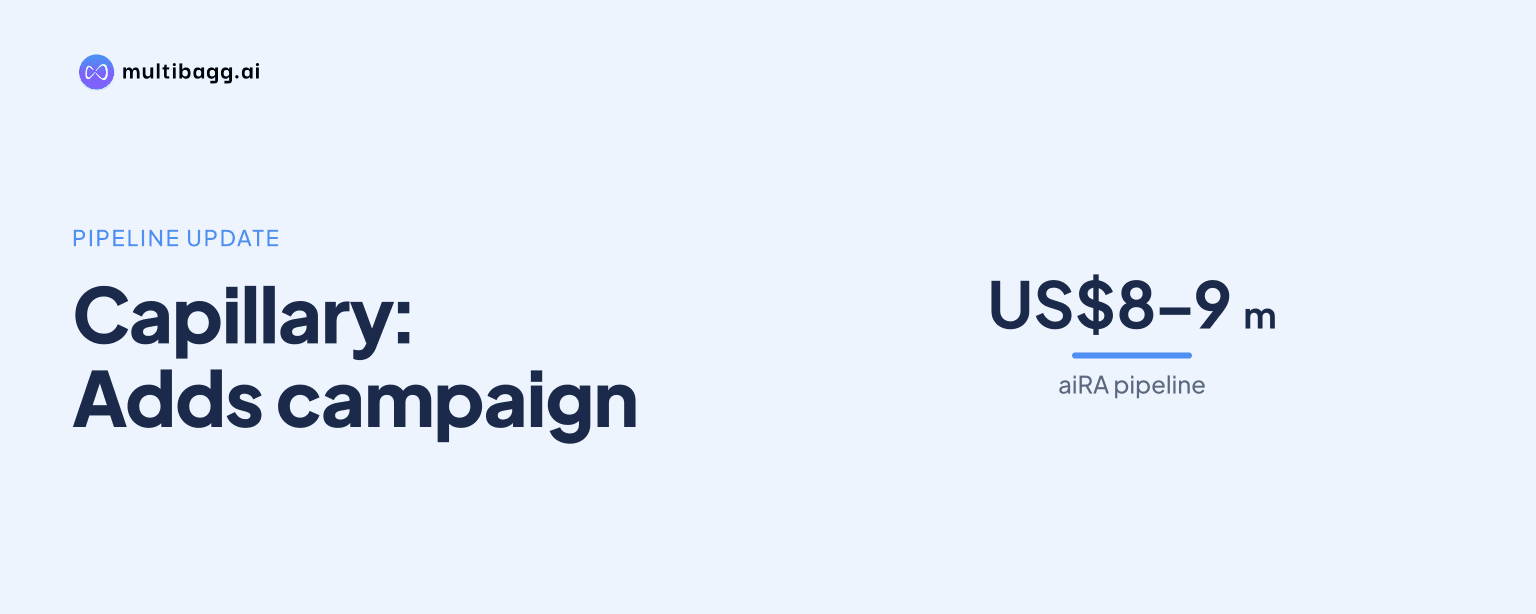
Capillary said during its Q2 FY27 call that aiRA is extending from post-acquisition loyalty activity into customer-acquisition campaign analytics, with an US$8 million to US$9 million pipeline that has not all converted or closed. Management said typical aiRA deals are US$100,000 to US$200,000, mainly among existing customers.
Know Capillary Technologies India inside out
Results, valuation, peers and who's buying, in one view.
What does Capillary aiRA now do for customer acquisition?
Capillary aiRA now analyses and helps manage campaigns used to acquire customers, expanding beyond its earlier focus on activity after a customer entered a brand’s database. Aneesh Reddy described aiRA as an analytics and campaign-management agent for consumer brands that spend on channels including Google Ads, Meta and TikTok. Management said existing customers had asked for the same analytical capability on the channels where they deploy acquisition budgets.
aiRA can pull historical campaign information spanning six or eight months, or two to three years, depending on the available data, according to Reddy. A marketer can ask in plain English how campaigns performed in the prior week, and the product is intended to identify what worked, what did not work and where a campaign could be modified. The stated mechanism is to combine data from separate acquisition channels into one view.
Capillary’s call identified Google Ads, Meta and TikTok as examples of the connected channels. It did not name Amazon in the discussion of aiRA’s new campaign-analysis capability. Reddy said a marketer looking only at Google would otherwise see Google data, while a user of Meta or TikTok would see data from those platforms separately; aiRA is designed to compare campaign outcomes across them.
Is Capillary aiRA an advertising technology platform?
Capillary aiRA is not an advertising technology platform, according to management; it is positioned as a system of intelligence operating on top of acquisition channels. That means Capillary is not presenting aiRA as a replacement for platforms where brands purchase advertisements. Instead, its stated role is to consolidate campaign information, analyse historical results and support modifications to campaigns.
Reddy compared the product’s function with work previously performed by an analyst gathering information from several systems. The plain-English query feature is intended to return an analysis after a user asks a question such as how campaigns ran in the previous week. Capillary did not disclose a separate revenue figure for this acquisition-analytics feature in Q2 FY27.
The product expansion also remains linked to Capillary’s established post-acquisition use case. Management said aiRA had previously supported brands once customer data was already in their databases, covering retention-oriented activity. The new feature applies the analytics layer before that stage, to acquisition spending, while retaining the same campaign-management and data-analysis positioning.
How large is Capillary aiRA’s sales opportunity?
Capillary disclosed an aiRA pipeline of about US$8 million to US$9 million, but Reddy said explicitly that not all of it has been converted or closed. Management put the average aiRA deal size at roughly US$100,000 to US$200,000. It said sales have mainly been to existing customers, where the selling process has been easier because those customers already use Capillary’s platform.
For new customers, management said aiRA is typically priced at about 10% of the total contract value, even when the feature helps support a broader platform sale. Reddy’s view was that aiRA can differentiate Capillary in enterprise sales and contribute to winning the larger contract, rather than being assessed solely as a standalone subscription. This commercial explanation is management’s view and is not a forecast that the stated pipeline will close.
Management referred on the preceding call to an aiRA annual run rate of about US$2 million to US$2.5 million, according to the analyst’s question in Q2 FY27. Reddy did not provide an updated run-rate figure in his response, instead citing the US$8 million to US$9 million pipeline and average deal sizes. The disclosed pipeline therefore indicates sales activity, but not recognised revenue or bookings.
Got a follow-up? Ask IRIS
How does aiRA fit Capillary’s wider sales growth?
Management linked aiRA’s differentiating capabilities to a higher win rate and growth in new annual contract value, or ACV. Trailing-12-month new ACV reached Rs 93 crore in Q2 FY27, compared with Rs 52 crore in Q2 FY26, an increase of Rs 41 crore. Reddy attributed the faster momentum over recent quarters to having a more differentiated product, while not quantifying aiRA’s direct contribution to ACV.
Capillary reported annual recurring revenue, or ARR, of Rs 1,085 crore in Q2 FY27, up from Rs 717 crore in Q2 FY26 and Rs 765 crore in FY26. Management cited the Session M acquisition, net revenue retention and new ACV as contributors. The figures show that aiRA’s sales effort is occurring within a business whose recurring-revenue base has expanded through both organic activity and acquisitions.
Capillary’s organic revenue increased 23% year on year to Rs 318 crore in H1 FY27, while inorganic revenue more than doubled to Rs 210 crore from Rs 101 crore. Adjusted earnings before interest, tax, depreciation and amortisation, or adjusted EBITDA, rose to Rs 89 crore from Rs 41 crore, and the margin increased to 17% from 11%. Management attributed the margin movement to net revenue retention, operating leverage in costs outside cost of goods sold, and merger-and-acquisition synergies from Cognition and Session M.
Why is Capillary discussing AI agents and loyalty?
Capillary expects AI shopping agents could make purchase decisions more price-sensitive and bring payments, promotions and loyalty information earlier in the buying process. Reddy said an agent could compare even a Rs 5 or Rs 10 difference when other attributes were equal, unlike consumers who may use habitual preferences for a particular brand or airline. He contrasted this with loyalty offers commonly worth 4%, 5% or, at most, 8% in points.
Management’s response is to build more capabilities that provide data and information to agents while consumers shop. Reddy argued that software platforms may become more relevant where agents require faster throughput and more complex processing than agency-led competitors can handle. This is management’s strategic assessment; Capillary disclosed neither a separate investment amount nor a timetable for agent-focused product development.
The relevance to aiRA is the same data-and-decision layer described for acquisition campaigns. aiRA brings campaign history from multiple channels into a single analytical view, while the agent plan concerns information presented during shopping decisions. The Q2 FY27 call did not state that either initiative had generated a separate revenue target or customer-adoption metric.
Conclusion
Capillary is broadening aiRA from post-acquisition loyalty and retention activity into analytics for customer-acquisition campaigns across Google Ads, Meta and TikTok. The US$8 million to US$9 million unclosed pipeline and US$100,000 to US$200,000 typical deal size provide the clearest disclosed measures of early commercial activity, while new ACV rose Rs 41 crore year on year to Rs 93 crore.
The next disclosed issue to watch is conversion of the aiRA pipeline into closed contracts, particularly in new-customer sales where management said aiRA typically represents about 10% of total deal value. Capillary has also said it is building more data and information capabilities for shopping agents, but management gave no timetable, investment figure or revenue target for that work.