










Capillary says rival purchases can match organic customer costs
Key highlights
- Capillary said organic customer-acquisition cost pays back in 16 to 17 months.
- Management said competitor purchases at 0.5 to 1 times revenue can have similar customer-acquisition economics.
- Session M migrations are expected to start next year, with most activity in FY28 and FY29.
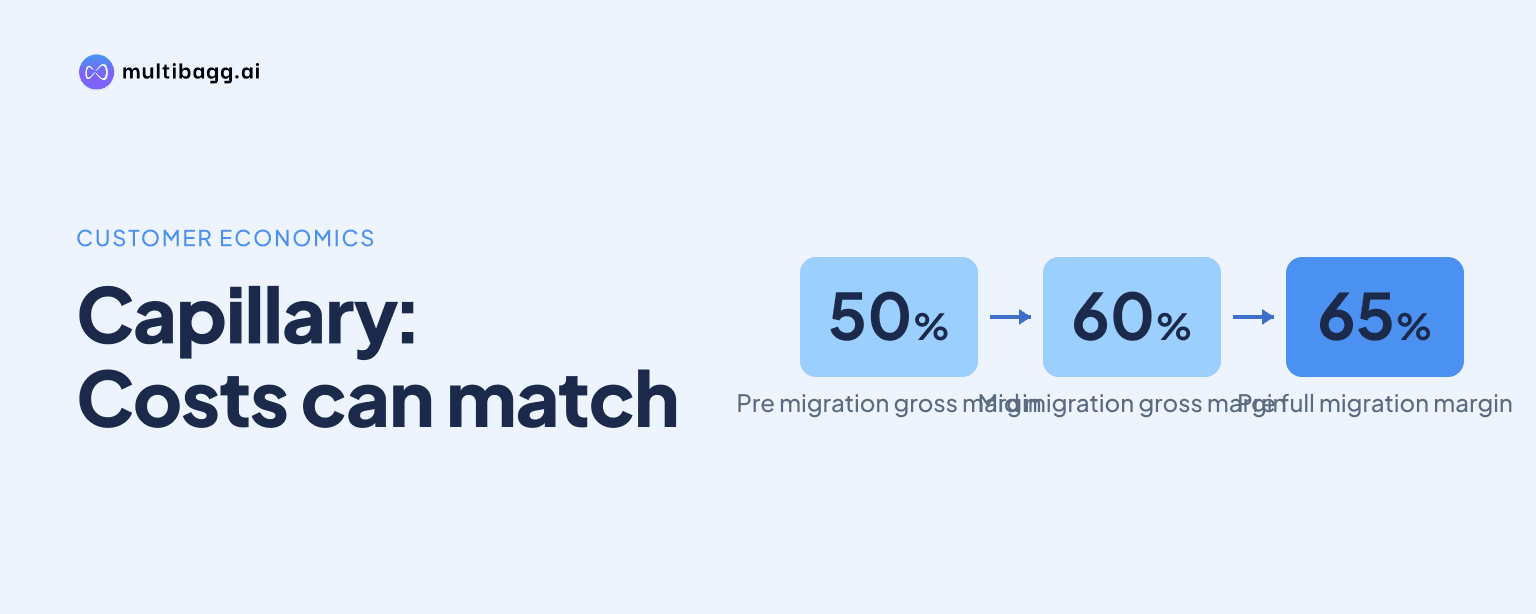
- Capillary said Session M gross margin could rise from about 50% to 60% to 65% before full migration.
powered by IRIS
On the earnings call, Capillary said buying competitors for 0.5 to 1 times revenue can cost about the same as winning customers organically, whose acquisition cost pays back in 16 to 17 months. Management’s case depends on reusable migration technology that reduces the acquired customer’s implementation work.
Know Capillary Technologies India inside out
Results, valuation, peers and who's buying, in one view.
How does Capillary compare acquisitions with organic customer wins?
Capillary’s answer is that an acquired customer base can have economics similar to an organically won one when the purchase price stays at 0.5 to 1 times revenue. Management said its organic customer-acquisition cost takes 16 to 17 months to pay back, while an acquisition entails the purchase price and migration spending. It described M&A as buying competitors and moving their customers to Capillary’s platform, rather than buying new products.
An organic deployment is customer initiated and requires Capillary to configure its software and integrate with the customer’s systems. Management said a typical customer may have eight or nine integration points, including point of sale, mobile applications, e-commerce applications, net promoter score systems and enterprise resource planning systems. It said a chief information officer may need to run seven or eight internal projects to take Capillary live.
The company distinguished that workload from an acquired-platform migration. Customers on an acquired platform already have integrations in place, and Capillary said it can use an application programming interface, or API, gateway to route existing customer API calls to Capillary’s platform and return the responses. Management said this can reduce a go-live process from a seven- or nine-month project to a two- or three-week user acceptance testing, or UAT, exercise.
Why does Capillary expect migration to reduce customer effort?
Capillary said the migration is initiated by the company, so it aims to carry most of the work itself. Its AI product is intended to use the integrations already operating on the acquired platform, leaving the customer to perform lightweight UAT over a couple of weeks instead of contributing hundreds of person-months. That approach differs from an organic change of provider, where the customer must commit resources to multiple integrations.
Management said the API gateway can be built once for a platform and its cost amortised across the customer migrations from that platform. In its simplified example, a Session M customer would continue calling Session M APIs while the gateway sends requests to Capillary’s routes and returns the response. Capillary said this reusable layer is why migration spending should not materially change the economics when acquisition prices remain at or below one times revenue.
The comparison is a management thesis, not a disclosed calculation showing identical realised paybacks. Management said it would not want to undertake a transaction with a payback longer than four to five years or one without good retention. The 16-to-17-month figure applies to organic customer-acquisition cost, while the four-to-five-year measure is the stated screening limit for acquisitions.
Got a follow-up? Ask IRIS
When will Capillary migrate Session M customers?
Capillary said Session M migrations will start next year, with the bulk expected in FY28 and FY29. Management said no Session M revenue had moved to the organic category in the quarter under discussion because migrations had not begun. It expects benefits to arise as individual customers move, even though the full programme will extend over the next year and the year after.
The timeline arose after an analyst noted that inorganic revenue had risen from about Rs 102 crore in the prior quarter to about Rs 109 crore in the current quarter, despite the latter including three months of Session M revenue rather than two. Management gave a Session M run-rate estimate of about Rs 300 crore for a full 12-month period. It did not disclose a separate quarterly Session M revenue number or a migration-related revenue contribution.
Capillary said cost benefits may precede full customer migration. Management described acquired platforms as having gross margins of about 50%, reflecting high server costs and support staffing, and said Session M’s gross margin could rise to 60% to 65% without a complete move to Capillary’s stack. It cited a potential move from Windows servers to Linux and better server packing as possible cost mechanisms.
What will determine whether Capillary pursues more acquisitions?
Capillary said it has an M&A team that is as active as its sales team, but management said it will seek deals that meet valuation and retention criteria. Its stated limit is a payback of no more than four to five years. Management did not identify a pending acquisition, a target company or a timetable for another transaction.
Management said the M&A and customer-acquisition costs are “very similar” when Capillary pays no more than one times revenue. That assessment depends on retention, the operation of the API gateway and the ability to spread migration costs across enough customers on an acquired platform. It is not a reported return metric for a completed set of acquisitions.
Organic momentum remains relevant to that comparison. Capillary said new-deal velocity was up 79% on a trailing-12-month basis, with Europe, Southeast Asia and India performing better, while the United States was similar to the prior year. Management retained guidance of about 20% organic growth for the next few quarters, although it said organic growth in the previous year was about 23% to 24%.
Conclusion
Capillary’s stated M&A strategy treats competitor acquisitions priced at 0.5 to 1 times revenue as another way to obtain customers. The company’s rationale combines its 16-to-17-month organic acquisition-cost payback with a migration process designed to cut customer involvement to two or three weeks of UAT and to reduce acquired-platform operating costs.
The next disclosed milestones are the start of Session M migrations next year and the larger migration workload expected in FY28 and FY29. Investors can also watch whether Session M’s roughly 50% gross margin moves toward management’s 60% to 65% range, and whether Capillary continues to apply its stated four-to-five-year acquisition-payback limit.