










Session M targets server costs at 25% after 50% cut
Key highlights
- Session M targets a 50% server-cost reduction, from roughly 50% to about 25% of revenue, by March.
- Management said prior acquired-platform migrations retained 66% to 70% of revenue over about 30 months.
- Session M has roughly 40 customers, and management expects full migration to take two to three years.
- Session M gross margin was about 51% to 52%, versus above 70% for core Capillary platform customers.
powered by IRIS
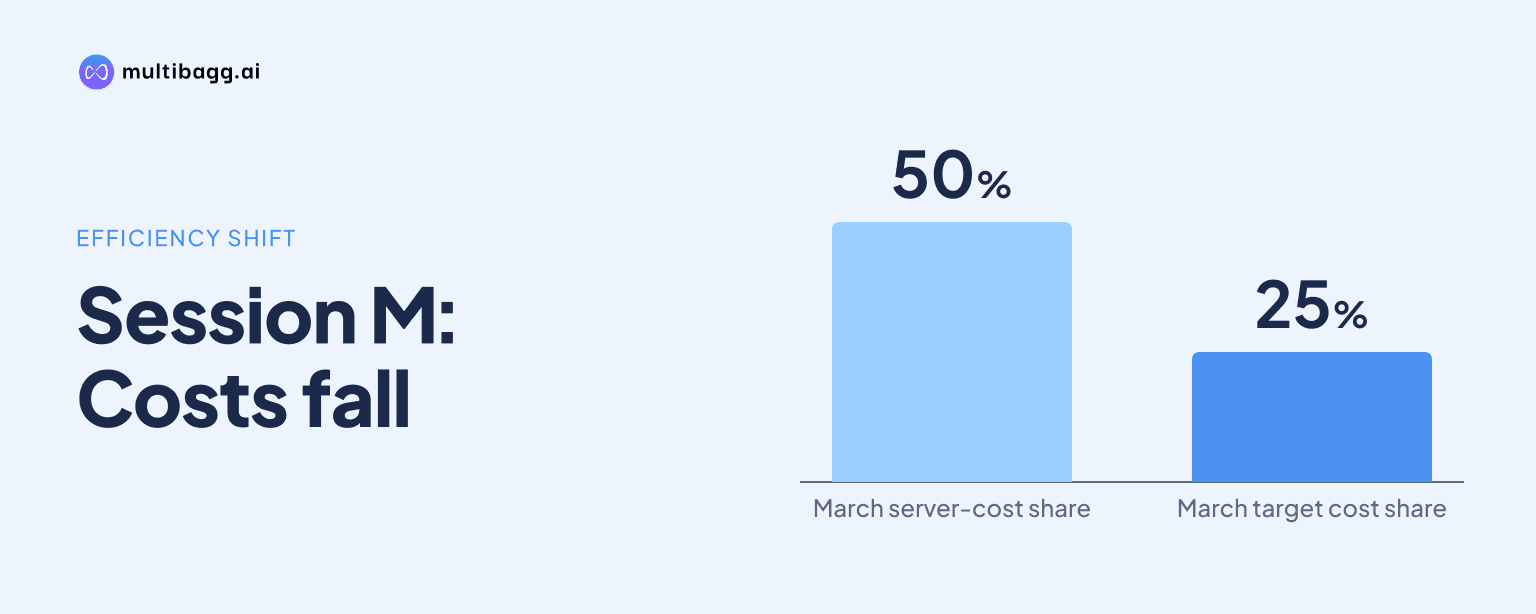
Session M expects server costs to fall to about 25% of revenue by March from roughly 50%, while management said acquired-platform migrations have historically retained 66% to 70% of revenue. The cost programme is designed to produce savings before Session M’s roughly 40 customers complete a platform migration expected to take two to three years.
Know Capillary Technologies India inside out
Results, valuation, peers and who's buying, in one view.
Why does Session M retain 66% to 70% of revenue after migration?
Session M’s historical migration-retention range is 66% to 70% because acquired customer bases have higher churn and some customers receive discounts when they move. Management said prior acquisitions generally took about two years to begin migrating and about 30 months to complete fully.
Management contrasted Capillary’s annual churn rate of about 6% to 7% with approximately 10% for the acquired platforms. At a 10% annual churn rate, management said about 20% of revenue can be lost over two years, before considering the effect of migration discounts offered to selected customers.
The discounts are not applied to all customers when an acquisition closes. Management said Session M customers generally receive a discount only when they agree to migrate, usually later in the process as Capillary seeks to sunset the old platform; it also said implementation is not charged for these moves.
Not all churn reflects a customer rejecting the new platform. Management said bankruptcies accounted for a meaningful part of the roughly 20% churn in the first three acquisitions, naming The Children’s Place and Express as retail customers in acquired books that went bankrupt. Excluding bankruptcies, management estimated that 80% to 85% of customers would be willing to migrate.
How will Session M reduce server costs by March?
Session M plans to cut server costs by about 50% by March, taking them from roughly 50% of revenue to approximately 25% of revenue. Management said projects were under way to improve server utilisation and move workloads from Windows servers to Linux servers, also referring to a March-April timeframe.
The initial savings plan does not require all roughly 40 Session M customers to migrate. Management said infrastructure work on the existing Session M environment can reduce costs before customer moves are complete, allowing benefits to emerge during the two-to-three-year integration period.
Management’s longer-term target is to reach the 8% to 10% server-cost model of the Capillary platform. It said Session M has a single-instance design, in which each customer has its own colocation deployment, while Capillary operates a multi-tenant platform across four or five global colocation facilities.
Capillary already supports customers in the United States, Asia-Pacific, Southeast Asia and India. Management said those existing locations should mean that moving Session M’s global customer base does not create a material increase in server costs, although customer migration schedules will vary.
Got a follow-up? Ask IRIS
When will Session M complete the platform migration?
Session M’s full platform migration is expected to take two to three years because roughly 40 customers cannot all be transferred within six months. Management said individual customers will move on different schedules, reflecting their preferences and the time needed for each implementation.
Management expects savings before the full migration is complete. It said Session M’s single-instance structure means costs can improve as each customer moves from separate colocation infrastructure onto the shared Capillary platform, unlike earlier acquired platforms that were already multi-tenant.
The company therefore expects quarterly benefits from two separate actions: server-utilisation and operating-system projects on the existing Session M platform, and customer migrations to the multi-tenant platform. The first supports the March target of about 25% of revenue, while the second supports the eventual 8% to 10% cost model.
The distinction matters because revenue retention and cost reduction operate on different timelines. Management’s 66% to 70% retention benchmark reflects churn and discounts over migrations lasting about 30 months, whereas the 50% server-cost reduction is an operational target that can be pursued before most migrations finish.
What could the Session M migration mean for margins?
Session M’s current gross margin was about 51% to 52%, compared with more than 70% for core Capillary platform customers, management said. The overall subscription gross margin was about 67%, showing that Session M’s infrastructure costs remain below the economics of the core platform.
Management said revenue retained through acquired-platform migrations can carry gross margins of 65% to 70%. It compared that with an older platform where every 100 of revenue generated about 30 of gross margin before technology costs, a broad illustration rather than reported Session M financial results.
The same illustration suggested free cash could move from a loss or about 5% on an older platform to about 45% after migration. Management did not provide a Session M-specific free-cash target, but said the March infrastructure programme and later customer migrations should allow value to emerge before the full two-to-three-year process ends.
Conclusion
Session M’s integration involves both a revenue trade-off and a cost-reduction plan. Management expects 66% to 70% revenue retention in acquired-platform migrations, affected by roughly 10% annual churn, bankruptcies in earlier acquired books and selected discounts, while targeting a reduction in Session M server costs from about 50% to 25% of revenue.
The next disclosed milestone is the March target for a 50% reduction in Session M server costs. Investors can then assess whether savings from utilisation work and the Windows-to-Linux transition appear as planned, while the pace of migrations among roughly 40 customers and progress toward the 8% to 10% Capillary server-cost model remain unresolved.