










Captain Polyplast Limited Q2 Income Rises 32.89% to ₹106.43 Crore
Key highlights
- Captain Polyplast reported Q2 FY27 consolidated total income of ₹106.43 crore, up 32.89% year on year.
- Q2 FY27 EBITDA rose 24.75% to ₹10.28 crore, while EBITDA margin declined 63 basis points to 9.66%.
- Q2 FY27 net profit increased 5.55% to ₹4.48 crore and diluted EPS rose to ₹0.75.
- FY27 solar-pump order intake stood at ₹82.40 crore for 3,500 pumps as of the 2 November 2026 earnings call.
powered by IRIS
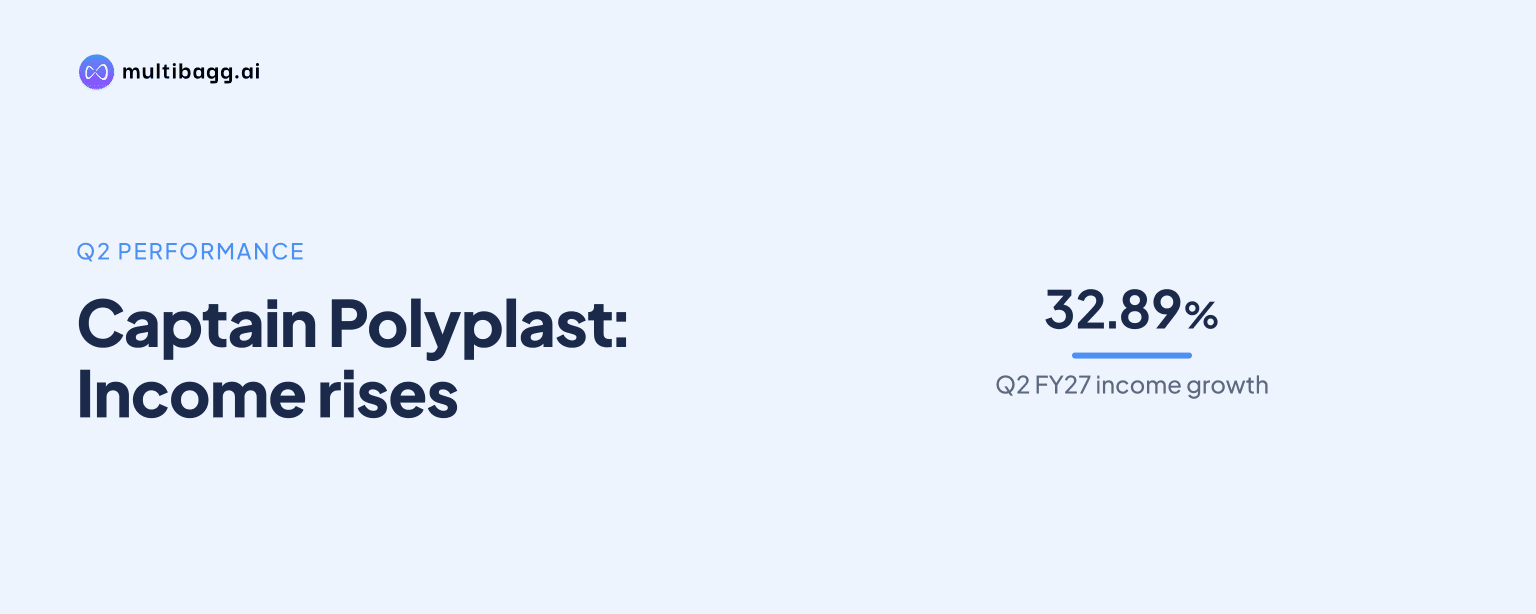
Captain Polyplast Limited reported consolidated total income of ₹106.43 crore in Q2 FY27, a 32.89% year-on-year increase, while EBITDA rose 24.75% to ₹10.28 crore and net profit increased 5.55% to ₹4.48 crore. Management linked the quarter's operating progress to solar EPC order wins and outlined execution priorities for the second half.
Know Captain Polyplast inside out
Results, valuation, peers and who's buying, in one view.
What did Captain Polyplast report for Q2 FY27?
Captain Polyplast reported higher consolidated income and profit for the quarter ended 30 September 2026. Total income rose to ₹106.43 crore from ₹80.09 crore a year earlier. EBITDA increased to ₹10.28 crore from ₹8.24 crore, while net profit rose to ₹4.48 crore from ₹4.24 crore.
The growth in income exceeded the increase in EBITDA and net profit. As a result, EBITDA margin declined by 63 basis points to 9.66% from 10.29% in Q2 FY26. Net profit margin fell by 109 basis points to 4.21% from 5.30%. Diluted earnings per share increased to ₹0.75 from ₹0.71.
For the first half of FY27, Captain Polyplast recorded consolidated total income of ₹188.09 crore, compared with ₹150.31 crore in H1 FY26, an increase of 25.14%. H1 EBITDA rose 25.70% to ₹20.14 crore from ₹16.02 crore. These figures were discussed by Whole Time Director Ritesh Khichadia during the company's 2 November 2026 earnings call.
Why did margins decline despite income growth?
Captain Polyplast said the decline in Q2 EBITDA margin was primarily caused by a sharp year-on-year rise in raw-material costs, particularly high-density polyethylene, or HDPE, and linear low-density polyethylene, or LLDPE. These materials are relevant to the company's micro-irrigation operations.
Management said it expects to pass through part of the higher raw-material cost in H2 FY27 if benchmark costs for micro-irrigation are revised by central and state governments in the coming months. This was presented as a management expectation rather than a confirmed price revision. The timing and extent of any benchmark revision were not specified during the call.
The difference between income growth and profit growth is therefore important for investors assessing the quarter. Income rose 32.89%, while EBITDA rose 24.75% and net profit rose 5.55%. The reported margin movement shows that cost inflation remained a material factor in the quarter even as the company expanded its business activity.
What solar EPC orders did Captain Polyplast secure?
Captain Polyplast secured two repeat orders from Maharashtra State Electricity Distribution Company Limited, or MSEDCL, under the PM-KUSUM scheme during the quarter. The company received an order worth ₹23.60 crore for 1,000 solar pumps in July and a ₹47.00 crore order for 2,000 pumps in September.
Management described the September order as its largest single solar EPC order win. Including orders received during FY27, Captain Polyplast's solar order intake stood at ₹82.40 crore for 3,500 pumps at the time of the call. The company said it had received orders for a total of 5,000 pumps since its empanelment in Maharashtra in August 2025.
The solar pumping segment operates within the policy setting of PM-KUSUM, which management said continues to drive demand because its timeline has been extended. Captain Polyplast also said the government was proposing a second phase of the scheme and that it was exploring opportunities outside Maharashtra as new tenders were expected in H2 FY27.
Got a follow-up? Ask IRIS
How is Captain Polyplast planning for H2 FY27?
Captain Polyplast identified timely execution of the solar-pump orders already won as its first H2 FY27 priority. Execution will determine how the contracted work translates into operations and financial performance during the remaining months of the financial year.
The second stated priority is to ramp up the Ahmedabad manufacturing facility. Management said higher production at the facility would progressively enable more components to be manufactured in-house. The company expects this greater backward integration to support margins, although it did not provide a capacity figure, investment amount, or financial target for the facility.
The third priority is changing the business mix within micro-irrigation. Captain Polyplast is seeking to increase non-MIS, or non-subsidy, business through commercial sales, exports and expansion of its dealer network in untapped markets. The company also reiterated that water conservation and efficient irrigation remain long-term drivers for drip and sprinkler adoption in Indian agriculture.
Why do the Q2 results matter to investors?
Captain Polyplast's Q2 performance shows that the company is growing income through its micro-irrigation and solar EPC activities while managing pressure from polymer input costs. The ₹82.40 crore solar-pump order intake reported for FY27 gives visibility on work management intends to execute, but order intake and reported income are different measures.
For investors, the key operational issues are the execution of MSEDCL solar-pump orders, the progress of Ahmedabad manufacturing, and whether micro-irrigation benchmark-cost revisions occur. Each is linked to management's H2 comments on revenue conversion, in-house manufacturing and margins. No revised financial guidance was disclosed in the earnings call.
The results also highlight Captain Polyplast's exposure to government-supported irrigation and solar-pump programmes. Per Drop More Crop was cited by management as an initiative supporting micro-irrigation adoption, while PM-KUSUM was identified as a demand driver in solar pumping. Policy implementation, tender availability and the pace of order execution are therefore relevant to the company's operating environment.
Conclusion
Captain Polyplast delivered 32.89% growth in Q2 FY27 consolidated total income to ₹106.43 crore, with EBITDA and net profit also increasing. However, higher HDPE and LLDPE costs reduced EBITDA margin by 63 basis points, making cost recovery and manufacturing efficiency central issues alongside revenue growth.
The next disclosures to watch are the execution progress on the 3,500 solar-pump orders received in FY27, the ramp-up of the Ahmedabad facility and any announced revision to micro-irrigation benchmark costs. Management has also indicated that it is evaluating solar-pump opportunities beyond Maharashtra as potential H2 tenders emerge.