










Captain Polyplast targets 1.5-point EBITDA-margin recovery
Key highlights
- Captain Polyplast's Q2 FY27 EBITDA margin was 9.66%, down from 10.29% a year earlier.
- Management expects at least 1 percentage point of margin improvement from revised micro-irrigation benchmark costs by March.
- The Ahmedabad ramp-up is expected to add 0.5 percentage point to EBITDA margin by March.
- FY27 solar-pump order intake reached Rs 82.40 crore for 3,500 pumps.
powered by IRIS
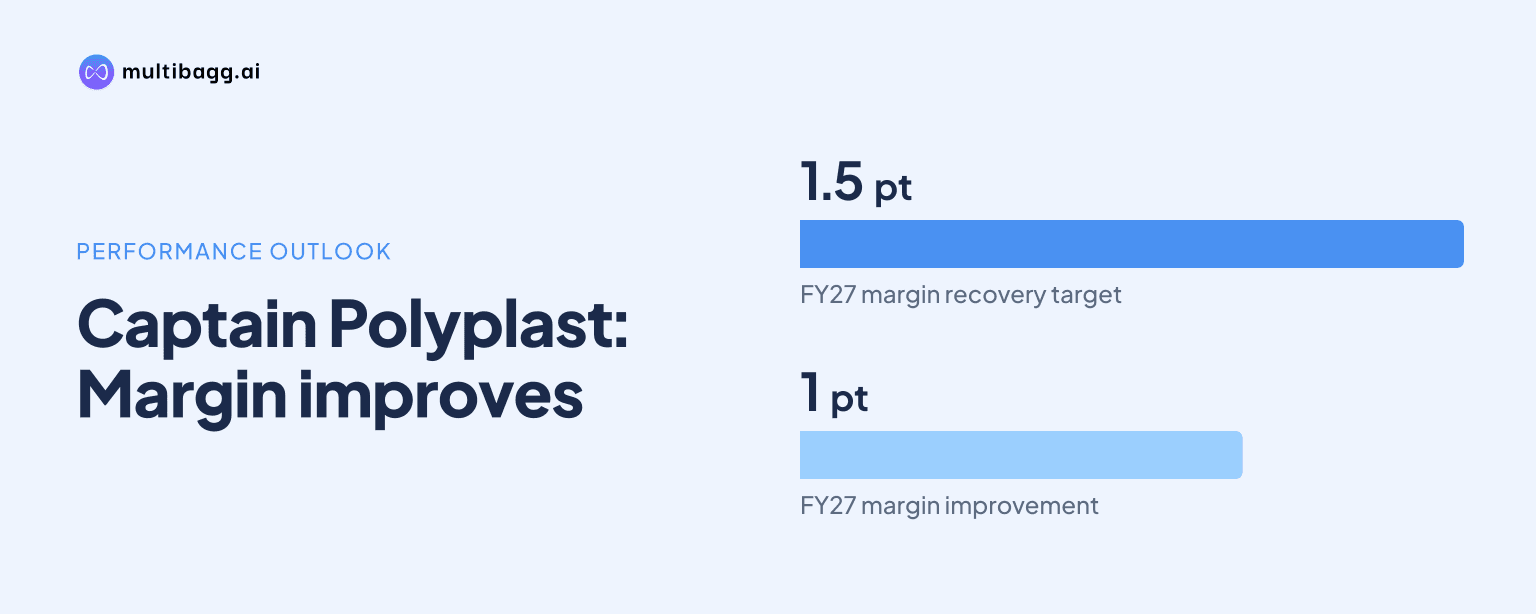
Captain Polyplast Limited expects up to 1.5 percentage points of EBITDA-margin recovery by March, comprising at least 1 percentage point from a possible micro-irrigation benchmark-cost revision and 0.5 percentage point from Ahmedabad production ramp-up. Its Q2 FY27 EBITDA margin fell to 9.66% from 10.29% a year earlier as HDPE and LLDPE costs increased.
Know Captain Polyplast inside out
Results, valuation, peers and who's buying, in one view.
Why did Captain Polyplast's EBITDA margin decline in Q2 FY27?
Captain Polyplast's Q2 FY27 EBITDA margin declined by 0.63 percentage point year on year to 9.66% from 10.29%, primarily because high-density polyethylene, or HDPE, and linear low-density polyethylene, or LLDPE, costs rose sharply. These petrochemical derivatives are key inputs for micro-irrigation products, where management put the current EBITDA margin at 7% to 8%.
Captain Polyplast reported consolidated Q2 FY27 total income of Rs 106.43 crore, up 32.89% year on year, while EBITDA rose 24.75% to Rs 10.28 crore and net profit rose 5.55% to Rs 4.48 crore. Management attributed the slower net-profit growth to raw-material inflation and higher interest costs as working-capital needs increased with business scale.
In H1 FY27, revenue grew 25.14% while profit after tax, or PAT, grew 7%, according to an analyst question addressed by management. Management said H1 EBITDA margin was almost flat, but Q2 margin declined because of raw-material costs, while higher interest expense also limited profit growth.
How could benchmark-price revisions improve Captain Polyplast's margin?
Captain Polyplast expects revised central and state government benchmark costs for micro-irrigation to support H2 FY27 margin, with management estimating at least 1 percentage point of EBITDA-margin improvement by March. The eventual effect remains uncertain because management cannot yet calculate the price increase governments will approve.
The potential revision matters because management said about 90% of the micro-irrigation industry market is subsidy-driven. A higher benchmark could enable Captain Polyplast to pass through part of the HDPE and LLDPE cost increase that reduced Q2 FY27 micro-irrigation profitability.
Management said the benchmark revision was in process and close to final conclusion, but stressed that the decision rests with government authorities. It said the effect could start in Q3 FY27 if the revision is completed, without disclosing a revised benchmark, implementation date or a formal margin target beyond the at-least-1-percentage-point expectation.
The revision would address the current margin difference between the company's main segments. Management put solar water-pump EBITDA margin at 10% to 11%, compared with 7% to 8% in micro-irrigation, whereas the two businesses had broadly similar margins in the prior year.
What will the Ahmedabad plant contribute by March?
Captain Polyplast expects the Ahmedabad facility to add 0.5 percentage point to EBITDA margin by March as H2 FY27 production rises and more outsourced components are made in-house. Manufacturing at the facility began in the quarter preceding the call, making the near-term benefit dependent on the pace of ramp-up.
The Ahmedabad contribution is separate from the proposed government benchmark revision. Management identified factory production as the lever within its control, saying that bringing components in-house should reduce the cost base of the micro-irrigation segment, although it did not disclose capacity, utilisation, capital spending or the components being transferred.
Management said the 0.5-percentage-point benefit expected by March is an initial phase rather than the full facility contribution. The broader 1% to 1.5% EBITDA-margin benefit previously associated with Ahmedabad is expected over three years because products will be added gradually.
Captain Polyplast is also pursuing a greater non-subsidy share in micro-irrigation, with commercial domestic sales and exports together contributing about 10% of the segment. Management identified replacement and expansion demand from farmers who previously received a subsidy, alongside export-market expansion, as the main channels.
Got a follow-up? Ask IRIS
How does the solar-pump business affect Captain Polyplast's outlook?
Captain Polyplast's solar-pump business currently has a 10% to 11% EBITDA margin, above the 7% to 8% range in micro-irrigation, and management expects its larger share to shorten the consolidated working-capital cycle. Solar-pump working capital is three to four months, compared with about eight months currently in micro-irrigation.
During Q2 FY27, Captain Polyplast secured repeat Maharashtra State Electricity Distribution Company Limited, or MSEDCL, orders worth Rs 23.60 crore for 1,000 pumps in July and Rs 47 crore for 2,000 pumps in September. Management described the September order as its largest single solar engineering, procurement and construction, or EPC, order, while FY27 solar-pump order intake reached Rs 82.40 crore for 3,500 pumps.
Management said execution of the 3,500-pump orders was under way and that most related revenue should be recognised by the end of Q3 FY27, with some already recognised in Q1 and Q2. It is also pursuing another tender and anticipates one more, with any resulting orders potentially contributing in Q4.
The solar opportunity is linked to the PM-KUSUM scheme, whose first-phase deadline was extended from March 2026, according to management. Fresh tenders in Rajasthan, Jharkhand, Karnataka and Haryana have not emerged this year, and management expects possible empanelment in those states only after a second phase is announced.
What are Captain Polyplast's working-capital and collection plans?
Captain Polyplast expects its consolidated working-capital cycle to reach five to six months by the end of FY27, from about eight months in micro-irrigation, through a higher solar-pump mix and improved subsidy-linked collections. Management said the micro-irrigation cycle typically ranges from six to eight months, while the solar-pump cycle should remain at three to four months.
Most micro-irrigation receivables are due from government agencies, and management said collections are typically concentrated in Q4, particularly February and March. It said H1 receivables are usually higher because revenue booked in the first half is generally collected in H2, and cited minimal short-recovery risk based on collections once state-government funds are available.
Management said most debt is revolving working-capital finance classified as short-term borrowing and renewed annually. In response to an analyst's reference to approximately Rs 89 crore of FY26 consolidated borrowings, including Rs 77.72 crore due within one year, management said actual annual repayment was below Rs 10 crore and could be met through existing accruals.
Conclusion
Captain Polyplast's proposed March margin recovery rests on two distinct levers: at least 1 percentage point from a government benchmark-cost revision and 0.5 percentage point from Ahmedabad in-house production. The plan follows a 0.63-percentage-point Q2 FY27 margin decline driven by higher polymer costs, while solar pumps currently carry a higher reported margin range than micro-irrigation.
The next disclosures to watch are the outcome and timing of the benchmark revision, Ahmedabad's H2 FY27 production ramp-up, and execution of the Rs 82.40 crore solar-pump order intake by Q3 FY27. Management also expects the consolidated working-capital cycle to reach five to six months by FY27-end, with collection progress most visible in February and March.