










Fujiyama defers growth revision as policy uncertainty persists
Key highlights
- Fujiyama’s H1 FY27 revenue increased 127% to Rs 2,652 crore.
- More than 50% of Fujiyama’s H1 revenue came from on-grid and DCR-based sales.
- Fujiyama reported H1 FY27 EBITDA of Rs 478 crore and an 18.0% EBITDA margin.
- Inventory was Rs 1,230 crore in September 2026, while inventory days declined to 99 from 123.
powered by IRIS
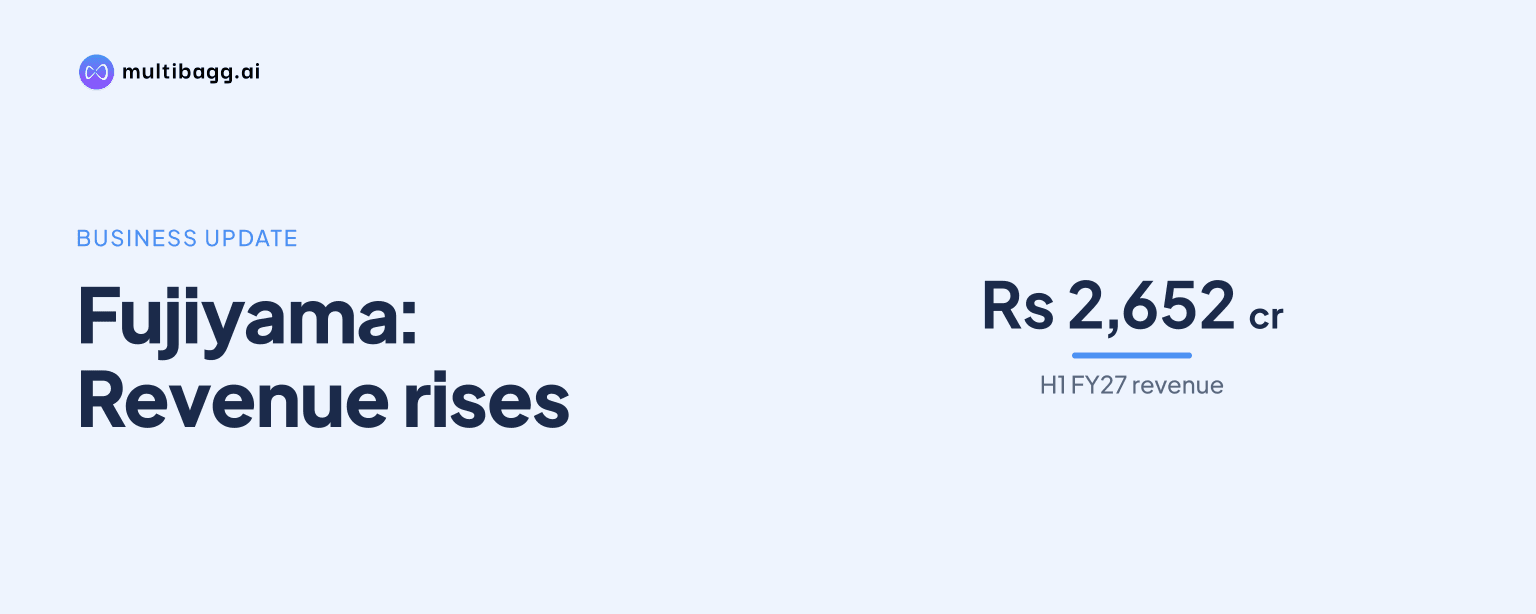
Fujiyama Power Systems deferred a revision to its 70% full-year growth guidance despite H1 FY27 revenue increasing 127% to Rs 2,652 crore, because management wants clarity after Q3 on ALMM List-II implementation, domestic-content-requirement cell shortages and PM Surya Ghar 2.0.
Know Fujiyama Power Systems inside out
Results, valuation, peers and who's buying, in one view.
Why did Fujiyama defer its growth-guidance revision?
Fujiyama will review guidance when it reports Q3 results rather than revise it after H1 FY27. An analyst asked whether the company’s full-year growth could exceed its stated 70% guidance after first-half revenue growth of 127%, but Pawan Kumar Garg said Fujiyama had decided not to revise guidance at this stage.
Management identified three unresolved variables: the timing of Approved List of Models and Manufacturers List-II, or ALMM List-II; continuing shortages of domestic-content-requirement, or DCR, solar cells; and the design and timing of PM Surya Ghar 2.0. Prashant Gupta said the company expected greater clarity in the coming quarter, including on any deferment of ALMM List-II.
The decision followed substantial first-half growth. H1 FY27 revenue reached Rs 2,652 crore and earnings before interest, tax, depreciation and amortisation, or EBITDA, rose 128% to Rs 478 crore. EBITDA margin was 18.0%, compared with 17.9% in H1 FY26, but management did not use that result to provide a second-half revenue range.
How exposed is Fujiyama to DCR demand and subsidy customers?
More than 50% of Fujiyama’s H1 revenue came from the on-grid and DCR-based market. Management agreed with an analyst that this broadly represented sales to subsidy customers, making domestic-cell rules and the future of rooftop-solar support relevant to a substantial part of its revenue mix.
Fujiyama has 1 gigawatt, or GW, of in-house Mono PERC cell capacity and has announced a further 1.2 GW TOPCon cell line. Management estimated that 70% to 80% of the DCR panels sold in H1 used in-house supply, while 20% to 30% was externally sourced because of demand for TOPCon products.
Management said the monthly DCR-cell production run rate was 2.2 GW in the preceding month and demand was higher. If ALMM List-II begins from January 1, 2027 as indicated, DCR-cell prices could rise because domestic supply may not meet demand, management said. A deferral, however, could lead to a different market outcome.
Fujiyama separates this DCR supply issue from broader module overcapacity. Management said non-DCR module markets remained under pressure, while domestic cells could be constrained under ALMM List-II. It cited prospective FY 2027-28 panel capacity of 3.5 GW and combined Dadri and Ratlam cell capacity of 2.2 GW, with output intended partly for captive system sales.
Got a follow-up? Ask IRIS
What could PM Surya Ghar 2.0 mean for Fujiyama?
PM Surya Ghar 2.0 remains under government consideration, so Fujiyama cannot quantify its revenue or margin impact. Management referred to reported proposals for battery-storage support, incentives linked to actual power generation and shared rooftop solar, while stressing that no final policy clarity had been issued.
The current PM Surya Ghar Muft Bijli Yojana had covered more than 60 lakh households, installed more than 19 GW and released more than Rs 36,000 crore of subsidy as of October 31, 2026, according to management’s cited national-portal data. About 5 lakh households remained to be covered in the current phase, which runs until March 2027.
Management said battery support would suit Fujiyama because it sells panels, hybrid inverters and batteries, and has operated battery-based systems for 30 years. Its expectation of gaining a better market share under such a policy is management’s view, rather than a disclosed government commitment or company sales target.
Fujiyama also cited demand drivers beyond subsidy. Management said India’s rooftop solar capacity rose from about 12 GW in March 2024 to about 26 GW in March 2026, against estimated potential of 67 GW. It also cited more than 20 lakh PM Surya Ghar households reporting zero electricity bills, alongside tariff increases in Madhya Pradesh, Jharkhand and Chhattisgarh for FY2027.
What do these uncertainties mean for Fujiyama’s margins and cash needs?
Fujiyama maintained its prior 18% to 19% EBITDA-margin guidance rather than setting a higher target from additional cell integration. Q2 FY27 EBITDA margin was 17.1%, compared with 18.1% in Q2 FY26 and 18.9% in Q1 FY27, while Q2 revenue rose 130% year on year to Rs 1,307 crore and EBITDA increased 116% to Rs 223 crore.
Management attributed the quarter-on-quarter margin decline to seasonal softness in rooftop solar, Ratlam overheads incurred before full production ramp-up, and spending on sales, marketing and service expansion. It also cited higher freight costs and purchases of tubular batteries from outside suppliers after the Bawal fire, pending the start of the Hathras operation.
Working-capital investment rose alongside sales and stock positioning for the domestic-cell transition. Inventory increased to Rs 1,230 crore in September 2026 from Rs 910 crore in March 2026, but inventory days fell to 99 from 123 and net working-capital days declined to 59 from 83. Operating cash flow before working-capital changes was about Rs 490 crore in H1 FY27, while working-capital investment was about Rs 661 crore.
Total debt was Rs 851 crore and cash and cash equivalents were Rs 52 crore as of September 30, 2026, resulting in net debt of Rs 800 crore. Management said about Rs 100 crore of higher debt related to Ratlam expansion and said an approved qualified institutional placement, or QIP, could potentially support debt repayment. It also expects the Bawal insurance claim to be resolved in the current financial year.
Conclusion
Fujiyama’s H1 FY27 performance showed rapid growth in revenue and EBITDA, but it did not remove the uncertainty surrounding the company’s on-grid and DCR-linked sales. With more than half of H1 revenue coming from that market, ALMM List-II timing, the availability and price of DCR cells, and the next phase of PM Surya Ghar could affect product mix, demand and input costs.
The next disclosed checkpoint is the Q3-results announcement, when management plans to review guidance. Investors will also be watching whether ALMM List-II proceeds from January 1, 2027, whether PM Surya Ghar 2.0 receives a defined framework, the ramp-up at Ratlam and the expected FY27 resolution of the Bawal insurance claim.