










Fujiyama Q2 revenue rises 130% as net debt reaches Rs 799.8 crore
Key highlights
- Fujiyama’s Q2 FY27 revenue rose 130.1% year on year to Rs 1,306.8 crore.
- Fujiyama’s net debt increased to Rs 799.8 crore at September 30, 2026 from Rs 322 crore at March 31, 2026.
- Fujiyama recorded a Rs 661.4 crore working-capital outflow in H1 FY27.
- Fujiyama commissioned 2,000 megawatts of power-electronics capacity at Ratlam in Q2 FY27.
powered by IRIS
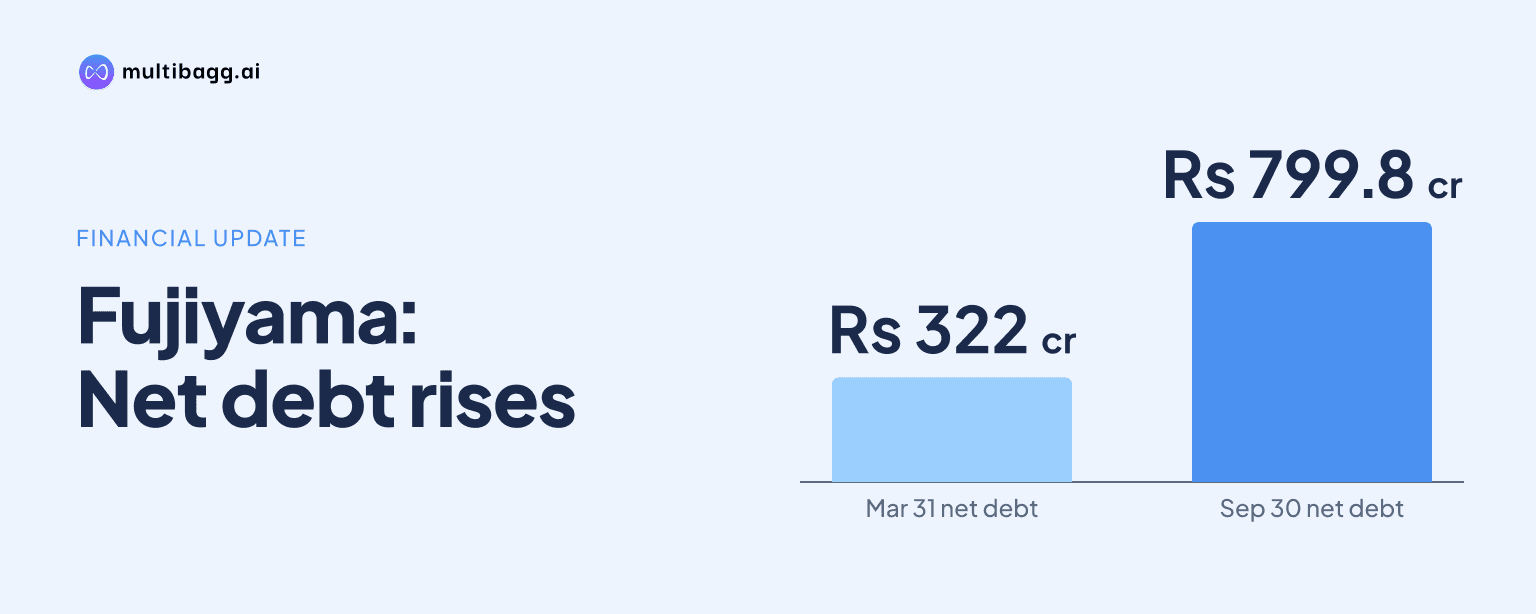
Fujiyama Power Systems Ltd reported Q2 FY27 revenue from operations of Rs 1,306.8 crore, up 130.1% year on year, while net debt rose to Rs 799.8 crore at September 30, 2026 from Rs 322 crore at March 31, 2026. The increase followed a Rs 661.4 crore H1 FY27 working-capital outflow alongside manufacturing expansion.
Know Fujiyama Power Systems inside out
Results, valuation, peers and who's buying, in one view.
How fast did Fujiyama’s Q2 FY27 revenue and profit grow?
Fujiyama’s Q2 FY27 revenue from operations increased 130.1% year on year to Rs 1,306.8 crore, and reported profit after tax rose 111.2% to Rs 132.9 crore. Revenue was 2.9% lower than Rs 1,345.7 crore in Q1 FY27, indicating that the year-on-year increase was accompanied by a modest sequential decline.
Earnings before interest, tax, depreciation and amortisation, or EBITDA, grew 116.4% year on year to Rs 222.9 crore, but its margin declined to 17.1% from 18.1% in Q2 FY26 and 18.9% in Q1 FY27. Management attributed the Q2 margin moderation to overheads at Ratlam incurred before production ramp-up of its recently commissioned panel and inverter division.
Earnings before interest and tax, or EBIT, rose 105.3% year on year to Rs 195.4 crore, while the EBIT margin decreased to 14.9% from 16.8%. Depreciation and amortisation increased to Rs 27.5 crore from Rs 7.8 crore, and finance costs rose to Rs 17.4 crore from Rs 12.4 crore, both of which affected the movement from operating profit to reported profit.
Why did Fujiyama’s net debt rise in H1 FY27?
Fujiyama’s net debt rose by Rs 477.8 crore in the six months to September 30, 2026, reaching Rs 799.8 crore as total debt increased and cash balances fell. Total debt was Rs 851.6 crore at September 2026, compared with Rs 461.5 crore at March 2026, while cash and cash equivalents declined to Rs 51.8 crore from Rs 139.5 crore.
Short-term debt accounted for most of the borrowing increase, rising to Rs 661.4 crore at September 2026 from Rs 325.4 crore at March 2026. Long-term debt increased to Rs 190.2 crore from Rs 136.1 crore, and net debt-to-equity rose to 0.55 times from 0.25 times, although total equity increased to Rs 1,465.7 crore from Rs 1,273.4 crore.
Fujiyama recorded operating cash flow of Rs 490.1 crore in H1 FY27, but working capital absorbed Rs 661.4 crore over the period. Tax paid totalled Rs 92.1 crore and investing activity used Rs 184 crore; the cash-flow statement also records financing activity of Rs 359.8 crore, ending the half year with net debt of Rs 799.8 crore.
Got a follow-up? Ask IRIS
What changed in Fujiyama’s working capital and balance sheet?
Fujiyama’s net working-capital cycle improved to 59 days in H1 FY27 from 83 days in FY26, based on annualised standalone financials. Receivable days declined to 10 from 15, while inventory days decreased to 99 from 123; payable days also fell to 50 from 55.
The lower inventory-days ratio coincided with a higher absolute inventory balance as business volumes and capacity expanded. Inventories rose by Rs 319.7 crore in six months to Rs 1,229.5 crore at September 30, 2026, while other current assets increased by Rs 245.1 crore to Rs 423.6 crore.
Trade receivables were broadly stable at Rs 140 crore at September 2026, compared with Rs 140.3 crore at March 2026, whereas trade payables fell by Rs 11.6 crore to Rs 348.8 crore. Total assets increased to Rs 2,906.7 crore from Rs 2,343.6 crore, with property, plant and equipment rising to Rs 706.2 crore from Rs 535.2 crore and capital work in progress declining to Rs 49.6 crore from Rs 201.3 crore.
Which expansion projects are raising Fujiyama’s cash requirements?
Fujiyama commissioned a 2,000-megawatt power-electronics facility at Ratlam during Q2 FY27, taking total power-electronics capacity to 4,180 megawatts. Management said the facility manufactures solar inverters, uninterruptible power supply systems and related power-electronics products, and its pre-ramp-up overheads affected the quarter’s EBITDA margin.
The company expects 3,000 megawatt-hours of lithium-ion battery capacity at Ratlam to come online in the coming quarter. It is also building a 1,000-megawatt-hour tubular-battery facility at Hathras, Uttar Pradesh, to replace the 1,300-megawatt-hour Bawal, Haryana capacity damaged in a fire in May 2026; management expects Hathras to be commissioned by Q3 FY2027.
Fujiyama has 1,000 megawatts of Mono PERC solar-cell capacity at Dadri and plans to commission a 1,200-megawatt TOPCon solar-cell facility at Ratlam by Q1 FY2028. Management said the planned cell line is intended to support participation in the Domestic Content Requirement segment, while Fujiyama added more than 30 distributors and 100 dealers in Q2, taking channel partners to more than 10,200 at September 30, 2026.
Conclusion
Fujiyama’s Q2 FY27 results combine substantially higher revenue and EBITDA with greater balance-sheet funding needs. Revenue increased to Rs 1,306.8 crore and EBITDA reached Rs 222.9 crore, but inventory rose to Rs 1,229.5 crore, H1 working capital used Rs 661.4 crore and net debt increased to Rs 799.8 crore.
The disclosed milestones to watch are the Ratlam lithium-ion battery capacity expected in the coming quarter, the 1,000-megawatt-hour Hathras tubular-battery facility targeted for Q3 FY2027, and the 1,200-megawatt Ratlam TOPCon solar-cell line expected by Q1 FY2028. Management’s ability to ramp these facilities while managing working capital and debt remains an unresolved execution matter.