










Fujiyama Q2 revenue rises 130.1% as Ratlam capacity expands
Key highlights
- Fujiyama reported Q2 FY27 revenue from operations of Rs 1,306.8 crore, up 130.1% year on year.
- Q2 FY27 EBITDA rose 116.4% to Rs 222.9 crore, while EBITDA margin declined to 17.1% from 18.1%.
- Fujiyama commissioned 2 GW of power-electronics capacity at Ratlam, taking total capacity to 4.1 GW.
- Fujiyama plans to commission a 1 GWh Hathras tubular-battery facility by Q3 FY27 and a 1.2 GW Ratlam solar-cell plant by Q1 FY28.
powered by IRIS
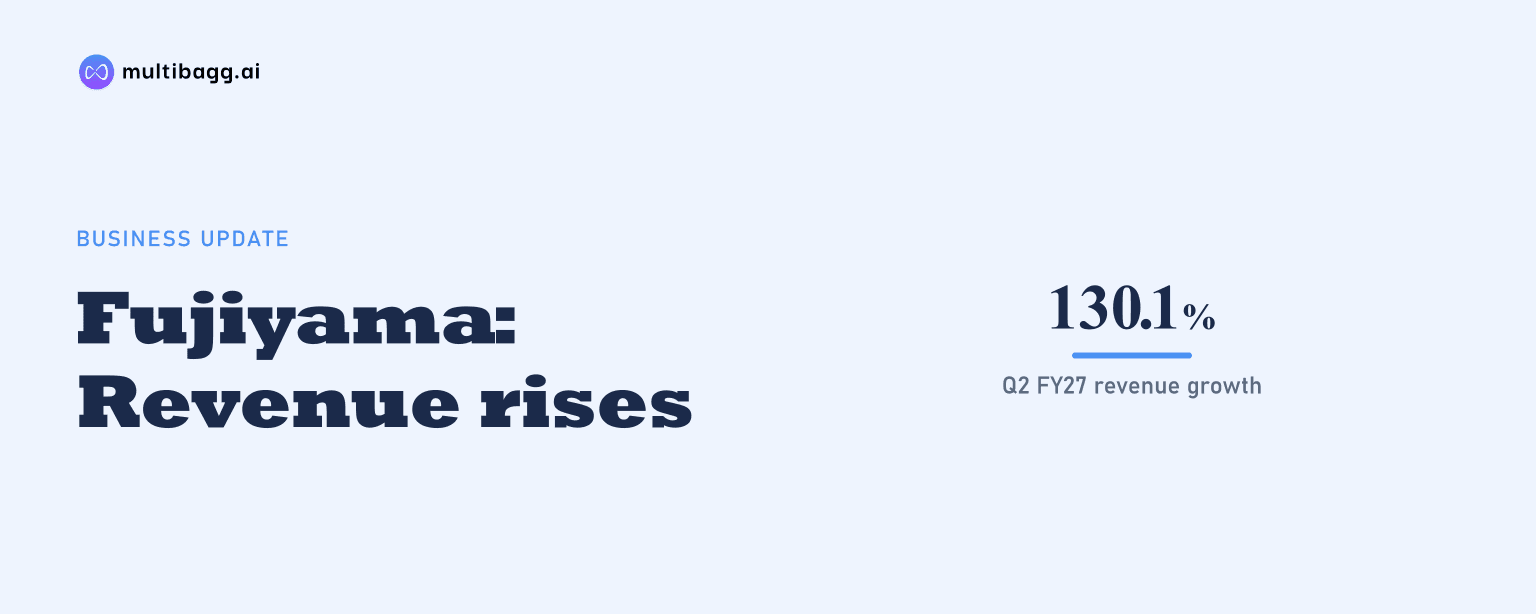
Fujiyama Power Systems Limited reported Q2 FY27 revenue from operations of Rs 1,306.8 crore, up 130.1% year on year, while commissioning 2 GW of power-electronics manufacturing capacity at Ratlam. Fujiyama’s EBITDA rose 116.4% to Rs 222.9 crore, although lower sales realisations reduced quarterly operating and profit margins from the previous year.
Know Fujiyama Power Systems inside out
Results, valuation, peers and who's buying, in one view.
How did Fujiyama perform in Q2 FY27?
Fujiyama recorded revenue from operations of Rs 1,306.8 crore in Q2 FY27, compared with Rs 567.9 crore in Q2 FY26, an increase of 130.1%. Revenue was 2.9% lower than Rs 1,345.7 crore in Q1 FY27. The company reported the unaudited results on November 6, 2026, for the quarter ended September 30, 2026.
Earnings before interest, tax, depreciation and amortisation, or EBITDA, rose 116.4% year on year to Rs 222.9 crore from Rs 103 crore. Reported profit after tax, or PAT, increased 111.2% to Rs 132.9 crore from Rs 62.9 crore. Both profit measures rose by a lower percentage than revenue in Q2 FY27.
For H1 FY27, Fujiyama’s revenue from operations reached Rs 2,652.5 crore, up 127.6% from Rs 1,165.3 crore in H1 FY26. EBITDA for the six-month period grew 128.7% to Rs 477.7 crore from Rs 208.9 crore. The H1 comparison shows revenue and EBITDA growth above 127% despite the sequential reduction in Q2 revenue from Q1.
Why did Fujiyama’s margins decline in Q2 FY27?
Fujiyama’s EBITDA margin declined to 17.1% in Q2 FY27 from 18.1% in Q2 FY26, while reported PAT margin fell to 10.2% from 11.1%. Management attributed the moderation primarily to lower sales realisations adopted to increase sales volumes and gain market share. EBITDA margin was also lower than 18.9% in Q1 FY27.
The sequential comparison was affected by a fire-loss provision in Q1 FY27. Q2 reported PAT was Rs 132.9 crore, compared with Rs 57.8 crore in Q1 FY27, but the Q1 result included a Rs 107.4 crore net-of-tax provision related to the Bawal fire loss. Excluding that exceptional item, Fujiyama calculated normalised Q1 PAT at Rs 165.2 crore, making Q2 normalised PAT 19.6% lower sequentially.
For H1 FY27, normalised PAT was Rs 298.1 crore, compared with Rs 130.5 crore in H1 FY26, an increase of 128.4%. Its normalised PAT margin was 11.2%, unchanged from H1 FY26. Reported H1 PAT was Rs 190.7 crore, up 46.1% from Rs 130.5 crore, with the difference from normalised profit reflecting the Bawal fire-loss provision recorded in Q1.
Got a follow-up? Ask IRIS
What manufacturing capacity did Fujiyama add at Ratlam?
Fujiyama commissioned 2 GW of power-electronics manufacturing capacity at Ratlam during Q2 FY27, increasing total power-electronics capacity to 4.1 GW. The Ratlam facility manufactures solar inverters, uninterruptible power supply, or UPS, systems and related power-electronics products. This was the completed capacity addition disclosed for the September quarter.
Fujiyama is also developing a 3 GWh lithium-ion battery manufacturing facility at Ratlam, which it expects to commission in the coming quarters. Management said the project is intended to strengthen in-house manufacturing for energy-storage products and integration across the solar and power-backup portfolio. The filing did not specify either a commissioning quarter or an investment amount for the 3 GWh project.
Fujiyama is separately setting up a 1.2 GW solar-cell facility at Ratlam with an investment of around Rs 350 crore. Management said the project remains on track for commissioning by Q1 FY28. The facility would supplement Fujiyama’s existing 1 GW solar-cell capacity and support participation in the Domestic Content Requirement, or DCR, segment.
How is Fujiyama replacing the Bawal battery capacity?
Fujiyama plans to establish a 1 GWh tubular-battery manufacturing facility at Hathras, Uttar Pradesh, with an investment of around Rs 20 crore and expected commissioning by Q3 FY27. Management described the project as a replacement for the earlier 1.3 GWh tubular-battery capacity at Bawal, Haryana, which was damaged in a fire incident in May 2026.
The planned Hathras capacity is 0.3 GWh lower than the 1.3 GWh Bawal capacity it replaces. Management said the facility would provide a dedicated manufacturing base for tubular batteries, strengthen its North India manufacturing presence and support supply to its distribution network. The Bawal event also led to the Rs 107.4 crore net-of-tax fire-loss provision included in Q1 FY27 results.
Fujiyama added more than 100 dealers and more than 30 distributors in Q2 FY27, taking total channel partners to more than 10,200 as of September 30, 2026. The company said its business is predominantly business-to-consumer, serving households through distributors, dealers, exclusive Shoppes and service engineers. The channel additions occurred alongside the Ratlam power-electronics commissioning.
Conclusion
Fujiyama combined a 130.1% year-on-year increase in Q2 FY27 revenue to Rs 1,306.8 crore with the commissioning of 2 GW of Ratlam power-electronics capacity, lifting total capacity in that category to 4.1 GW. However, EBITDA margin declined by 1 percentage point year on year to 17.1%, and management linked the movement to lower realisations intended to increase sales volumes and market share.
The next disclosed milestones are the expected Q3 FY27 commissioning of the 1 GWh Hathras tubular-battery facility and the Q1 FY28 target for the 1.2 GW Ratlam solar-cell plant. Fujiyama also expects its 3 GWh Ratlam lithium-ion battery capacity to come online in the coming quarters, while its earnings conference call was scheduled for November 10, 2026.