










Fujiyama adds 2 GW electronics, targets 1.2 GW cells
Key highlights
- Fujiyama commissioned 2,000 MW of Ratlam power-electronics capacity in Q2 FY2027.
- Fujiyama targets 1,200 MW of TOPCon solar-cell capacity at Ratlam by Q1 FY2028.
- Fujiyama expects 3,000 MWh of Ratlam lithium-ion battery capacity in the coming quarter.
- Q2 FY2027 revenue from operations rose 130.1% year on year to Rs 1,306.8 crore.
powered by IRIS
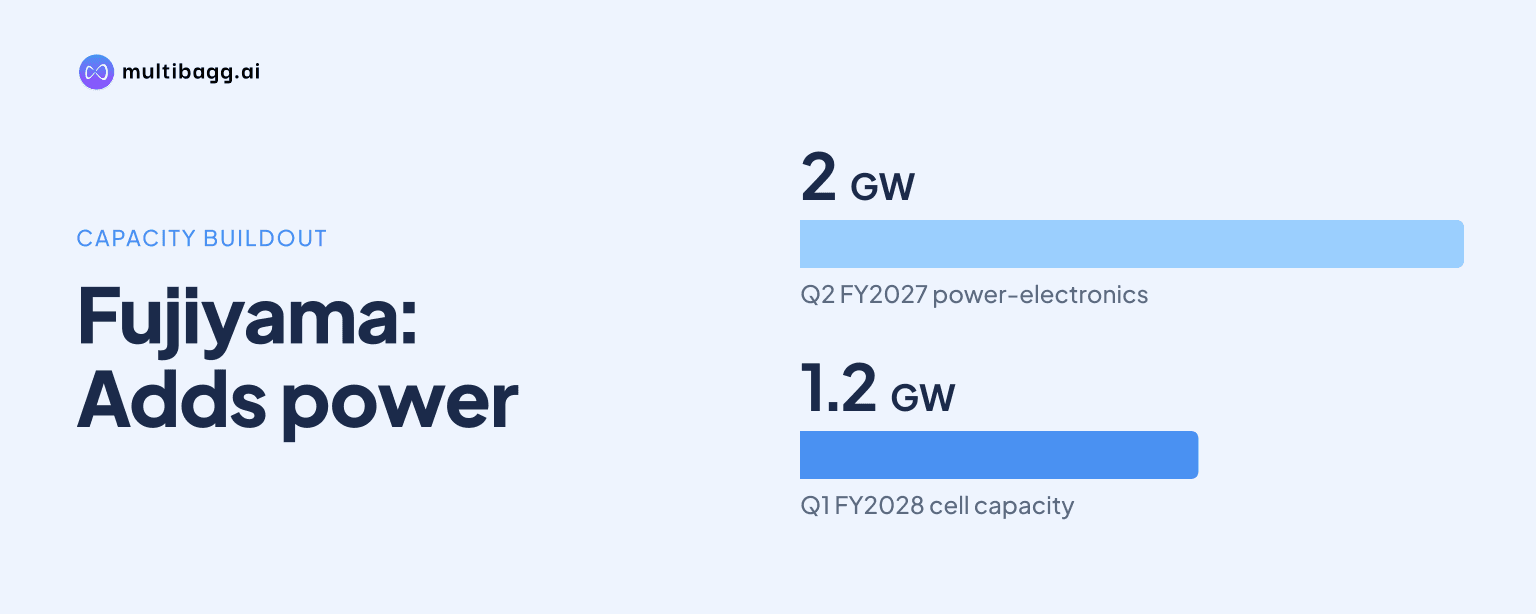
Fujiyama Power Systems Limited commissioned 2 GW of power-electronics capacity in Q2 FY2027 and targets a further 1.2 GW TOPCon solar-cell line by Q1 FY2028, while 3,000 MWh of lithium-ion battery capacity is expected in the coming quarter. The expansion supports Fujiyama’s domestic manufacturing platform for Domestic Content Requirement, or DCR, rooftop systems.
Know Fujiyama Power Systems inside out
Results, valuation, peers and who's buying, in one view.
What manufacturing capacity is Fujiyama adding?
Fujiyama is adding capacity across power electronics, solar cells and batteries, although these products use different capacity measures and should not be added together. Its 2,000 MW Ratlam power-electronics plant was commissioned during Q2 FY2027, taking total power-electronics capacity to 4.1 GW in management commentary. The facility table gives the more precise total of 4,180 MW, including 1,780 MW at Greater Noida and 400 MW at Parwanoo.
Fujiyama’s Dadri facility in Uttar Pradesh already has 1,000 MW of Mono PERC solar-cell capacity and 1,200 MW of solar-panel capacity. Mono PERC means monocrystalline passivated emitter and rear cell technology. The planned 1,200 MW TOPCon line at Ratlam would lift total solar-cell capacity to 2,200 MW if commissioned on management’s Q1 FY2028 schedule, while total solar-panel capacity is listed at 3,568 MW.
Why does DCR demand matter to Fujiyama?
DCR demand matters because Fujiyama says a DCR-compliant solar panel and an on-grid or hybrid inverter are the two main subsidy conditions under the PM Surya Ghar Muft Bijli Yojana. The company’s 1,000 MW Dadri cell plant and proposed 1,200 MW Ratlam TOPCon plant are intended to provide domestic cell manufacturing for this on-grid residential market.
The presentation cites more than 6 million households covered, more than 19 GW installed and more than Rs 36,000 crore of subsidy released directly to end customers under the programme. As of October 31, 2026, it cites more than 3.5 million households still to be covered and an incremental opportunity of more than 10 GW. These are programme-level measures cited by Fujiyama, rather than company sales guidance.
Management says the Ratlam TOPCon facility is on track for commissioning by Q1 FY2028 and will complement the existing Dadri Mono PERC line. TOPCon means tunnel oxide passivated contact technology. The company says the cell expansion is intended to reduce import dependence, support supply reliability and improve cost control, but it does not provide a sales forecast or utilisation target for either cell plant.
What components does Fujiyama manufacture in house?
Fujiyama manufactures selected inverter and lithium-ion battery components in house as part of its backward-integration programme. For inverters, it lists sheet-metal cabinets, heat-sink fabrication, transformers and inductors, printed circuit board mounting through electronics manufacturing services, or EMS, and wire harnesses. Its 4,180 MW power-electronics capacity covers inverters, solar power conditioning units, uninterruptible power supply systems and chargers.
For lithium-ion batteries, Fujiyama lists battery management system cards, Modbus communication boards, cabinets, busbars, displays, wire harnesses and critical assembly components. The company says these capabilities are intended to reduce reliance on outside suppliers and support quality control and customisation. The existing lithium-ion base is 545 MWh at Greater Noida, compared with the 3,000 MWh Ratlam facility expected in the coming quarter.
The Ratlam expansion also includes 2,000 MW of solar-panel capacity, alongside the 2,000 MW power-electronics plant and planned 1,200 MW TOPCon cell line. Management said Q2 FY2027 profitability absorbed Ratlam overheads ahead of the production ramp-up of its recently commissioned panel and inverter division. The presentation does not give separate revenue, utilisation or production figures for Ratlam’s individual product lines.
Got a follow-up? Ask IRIS
How is Fujiyama replacing Bawal battery capacity?
Fujiyama is replacing tubular-battery capacity damaged by a May 2026 fire at Bawal, Haryana, with a proposed 1,000 MWh facility at Hathras, Uttar Pradesh. Management expects the Hathras plant to be commissioned by Q3 FY2027 and says it will provide a North India manufacturing base for supplies to the company’s distribution network.
The proposed Hathras capacity is 300 MWh lower than the 1,300 MWh Bawal capacity cited by management. Fujiyama has not stated whether it plans a later addition to close that gap, nor has it quantified lost output following the fire. The facility overview describes the 1,000 MWh Hathras plant as expected in the coming quarter, while management specifies Q3 FY2027.
The Bawal incident also affects profit comparability. Fujiyama says Q1 FY2027 and H1 FY2027 profit after tax exclude an exceptional item, net of tax, of Rs 107.4 crore relating to the provision for the Bawal fire loss. The presentation does not disclose a final insurance recovery, settlement amount or the final financial effect of the fire provision.
How did Fujiyama perform while expanding capacity?
Fujiyama reported Q2 FY2027 revenue from operations of Rs 1,306.8 crore, up 130.1% from Rs 567.9 crore in Q2 FY2026. Earnings before interest, tax, depreciation and amortisation, or EBITDA, rose 116.4% to Rs 222.9 crore from Rs 103 crore. Management attributed the revenue growth to higher sales volumes, its service-engineer network and competitive pricing intended to increase market share.
Q2 FY2027 revenue was Rs 38.9 crore below Q1 FY2027, while EBITDA was Rs 31.9 crore lower and the EBITDA margin declined 1.8 percentage points from 18.9% to 17.1%. Management said the Q2 margin included Ratlam overheads before the panel and inverter operations ramped up. Year on year, the Q2 margin was also 1 percentage point below the 18.1% reported in Q2 FY2026.
Fujiyama added more than 30 distributors and 100 dealers during Q2 FY2027, taking channel partners above 10,200 as of September 30, 2026. The company says more than 85% of its revenue is business-to-consumer and it sold more than 1.4 million inverters over the past five financial years, including 4.5 lakh in FY2026.
Conclusion
Fujiyama is building a wider manufacturing base spanning cells, panels, power electronics and batteries, with the clearest completed addition being the 2,000 MW Ratlam power-electronics facility. Its DCR positioning rests on the 1,000 MW Dadri Mono PERC cell plant and the proposed 1,200 MW Ratlam TOPCon line, while battery plans combine 3,000 MWh of lithium-ion capacity with a 1,000 MWh tubular-battery replacement plant.
The next disclosed milestones are commissioning of Ratlam’s 3,000 MWh lithium-ion battery facility in the coming quarter, Hathras tubular-battery capacity by Q3 FY2027 and the Ratlam TOPCon line by Q1 FY2028. Investors can also watch Ratlam’s production ramp-up and the unresolved Bawal fire recovery, including whether future tubular-battery capacity addresses the 300 MWh difference from the former Bawal plant.