










Fujiyama Power Systems Limited Reports 125.3% Q1 Revenue Growth
Key highlights
- Fujiyama reported Q1 FY27 revenue from operations of ₹1,345.69 crore, up 125.3% year-on-year.
- Q1 FY27 EBITDA rose 140.6% year-on-year to ₹254.8 crore, with margin improving to 18.9%.
- A ₹143.58 crore Bawal fire loss reduced reported consolidated Q1 FY27 profit to ₹57.79 crore.
- Fujiyama plans to commission a 2,000 MWh lithium-ion battery facility at Ratlam by Q2 FY27.
powered by IRIS
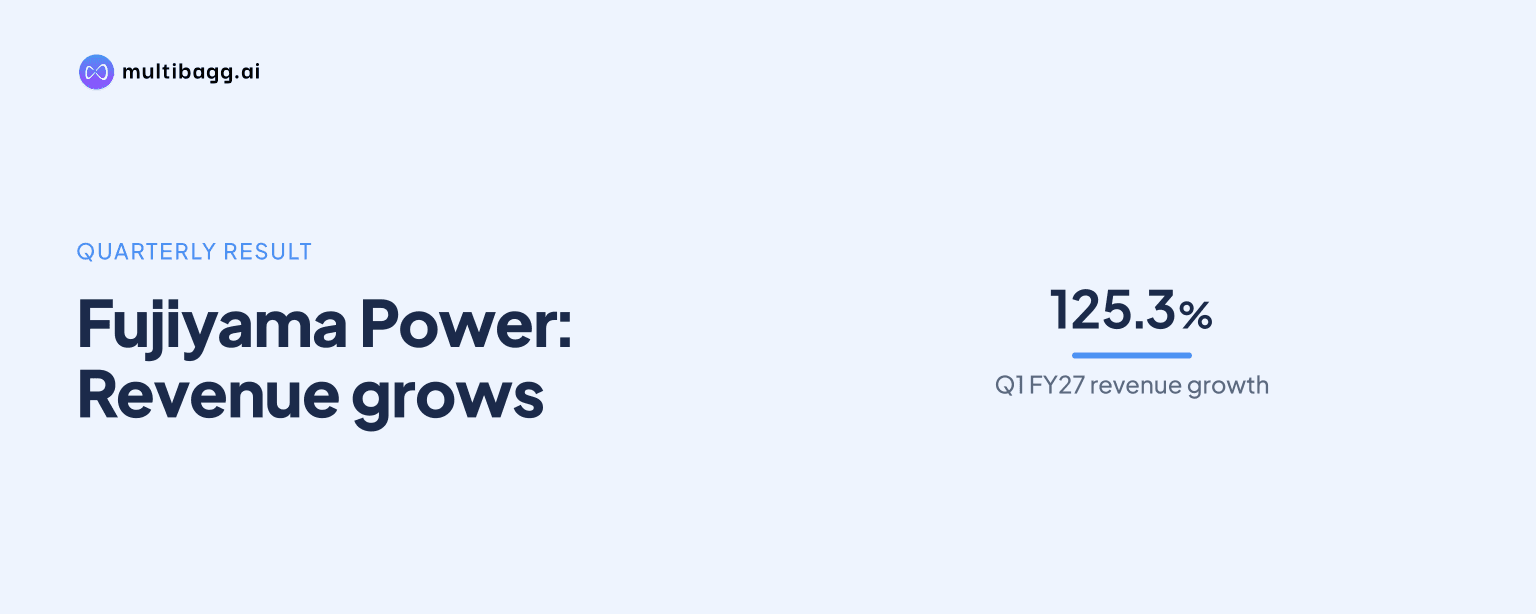
Fujiyama Power Systems Limited reported Q1 FY27 revenue from operations of ₹1,345.69 crore, up 125.3% year-on-year, while EBITDA increased 140.6% to ₹254.8 crore and the margin rose to 18.9%.
Know Fujiyama Power Systems inside out
Results, valuation, peers and who's buying, in one view.
What did Fujiyama Power Systems report for Q1 FY27?
Fujiyama Power Systems reported strong growth for the quarter ended June 30, 2026, with revenue from operations reaching ₹1,345.69 crore. Total income stood at ₹1,348.04 crore. The company said revenue increased 49.4% sequentially from the preceding quarter as well as 125.3% from a year earlier.
EBITDA rose to ₹254.8 crore from the year-earlier period, translating into an EBITDA margin of 18.9%. The margin improvement accompanied higher revenue and reflected the company's focus on scale, distribution expansion and greater backward integration across its rooftop solar and power-backup product portfolio.
The quarterly numbers were presented in Fujiyama's investor presentation dated August 13, 2026. The board was scheduled to consider the unaudited results on the same date, and the company scheduled an earnings call for August 14, 2026 to discuss the quarter's performance.
Why was reported profit lower than adjusted profit?
Reported profit was affected by a ₹143.58 crore loss related to a fire at the company's Bawal facility. Fujiyama reported standalone profit of ₹57.80 crore and consolidated profit of ₹57.79 crore after accounting for this loss.
The company also disclosed adjusted PAT of ₹165.2 crore, which shows the profit figure before the stated fire-related impact. The distinction is important for investors assessing quarterly operating growth, because EBITDA rose sharply even as the reported profit reflected an exceptional operational loss.
The available material does not provide further details on the timing, extent of damage, insurance recovery or any production effect from the Bawal incident. Therefore, those matters remain relevant disclosures to monitor in future company filings and management interactions.
How is Fujiyama expanding its manufacturing base?
Fujiyama is expanding manufacturing capacity and increasing backward integration in solar products and power electronics. The company separately announced the commissioning of a 2 GW power electronics manufacturing facility at Ratlam, Madhya Pradesh.
Its earlier FY26 presentation also referred to a 1 GW Mono-PERC solar-cell manufacturing facility at Dadri, Uttar Pradesh, built with an investment of about ₹300 crore. The output was intended for captive consumption and aligned with Fujiyama's existing 1.6 GW solar-panel capacity.
The company stated that it plans to commission a 2,000 MWh lithium-ion battery facility at Ratlam by Q2 FY27. This planned battery capacity is separate from the commissioned 2 GW power electronics facility. Together, these initiatives indicate Fujiyama's stated strategy of controlling more of its supply chain while supporting its solar and energy-storage offerings.
Got a follow-up? Ask IRIS
What is supporting demand for Fujiyama's products?
Fujiyama attributed demand momentum to residential rooftop solar and power-backup solutions, alongside wider distribution. The company manufactures and sells rooftop solar products under the UTL Solar and Fujiyama Solar brands, including panels, inverters, batteries, power conditioning units and related charging products.
The company has identified rooftop solar potential of 637 GW across 25 states and Union Territories. It has said that government initiatives, consumer awareness and increasing residential adoption support the addressable market, although the presentation does not provide a market-share estimate for Fujiyama.
Distribution has been another stated operating priority. During Q3 FY26, the company added more than 60 distributors, 400 dealers and 20 exclusive Shoppes, taking its channel partner base above 8,200. This network expansion was described as strengthening the company's reach in Tier-2 and Tier-3 cities.
How do the Q1 numbers compare with earlier FY26 performance?
The Q1 FY27 growth followed an expansion in revenue and profitability reported during FY26. In Q3 FY26, Fujiyama reported revenue from operations of ₹588.5 crore, EBITDA of ₹109.9 crore and PAT of ₹67.3 crore. EBITDA margin in that quarter was 18.7%.
For the first nine months of FY26, revenue from operations was ₹1,753.7 crore, EBITDA was ₹318.8 crore and PAT was ₹197.8 crore. The nine-month EBITDA margin was 18.2%, compared with 16.0% in the corresponding earlier period. The Q1 FY27 margin of 18.9% was therefore higher than both the Q3 FY26 and nine-month FY26 margins disclosed in the presentations.
For investors, the quarter combines rapid top-line growth with an improved operating margin, while the Bawal fire loss materially affected reported earnings. The planned battery facility, manufacturing ramp-up and channel development are the key operational items disclosed by the company alongside its financial performance.
Conclusion
Fujiyama delivered Q1 FY27 revenue of ₹1,345.69 crore and EBITDA of ₹254.8 crore, with year-on-year growth of 125.3% and 140.6%, respectively. Its 18.9% EBITDA margin and larger distribution network point to stronger operating scale, while the ₹143.58 crore Bawal fire loss reduced reported consolidated profit to ₹57.79 crore.
The next disclosed milestone is the planned commissioning of the 2,000 MWh lithium-ion battery facility at Ratlam by Q2 FY27. Investors may also track management commentary from the August 14, 2026 earnings call and disclosures on the Bawal facility, including any production or financial implications.