










Fujiyama plans 3 GWh batteries, 1.2 GW cells to cut sourcing
Key highlights
- Fujiyama expects its 3 GWh Ratlam lithium-ion plant to lift total battery capacity from 545 MWh to 3.5 GWh.
- Fujiyama targets a 1.2 GW TOPCon cell line in Q1 FY28, increasing total cell capacity from 1 GW to 2.2 GW.
- A 1 GW Hathras tubular-battery plant is expected in the coming quarter to replace capacity lost in the May Bawal fire.
- Fujiyama reported Rs 2,652 crore of H1 FY27 revenue, up 127%, with an 18.0% EBITDA margin.
powered by IRIS
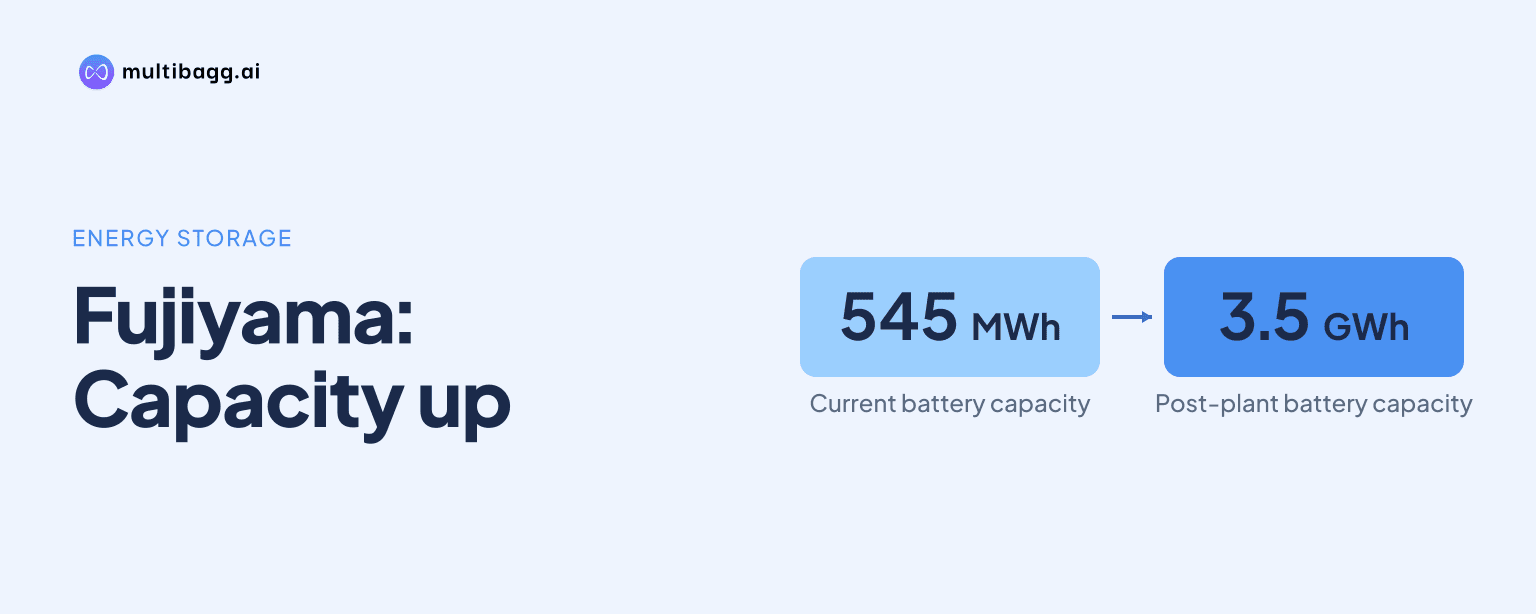
Fujiyama Power Systems Limited expects its 3 GWh Ratlam lithium-ion battery plant to start in the coming quarter, lifting total battery capacity to 3.5 GWh as it replaces externally purchased batteries used in existing sales. Fujiyama also targets a 1.2 GW TOPCon cell line in Q1 FY28, lifting cell capacity to 2.2 GW.
Know Fujiyama Power Systems inside out
Results, valuation, peers and who's buying, in one view.
What capacity is Fujiyama adding and when?
Fujiyama plans three manufacturing additions: a 3 GWh lithium-ion battery facility at Ratlam in the coming quarter, a 1 GW tubular-battery plant at Hathras in the coming quarter, and a 1.2 GW TOPCon solar-cell line at Ratlam in Q1 FY28. Management said it had increased the planned Ratlam lithium-ion facility from 2 GWh to 3 GWh, which would raise total lithium-ion capacity from 545 MWh to 3.5 GWh.
The planned TOPCon line would add to Fujiyama's existing 1 GW solar-cell capacity, bringing total capacity to 2.2 GW. Management said Ratlam's 2 GW power-electronics facility was commissioned in August 2026, while solar-panel production at the site began in May 2026. The new cell line is intended to operate alongside the existing PERC, or passivated emitter and rear cell, manufacturing operation.
Why is Fujiyama replacing outside sourcing?
Fujiyama is replacing outside sourcing because its planned additions are intended to supply products it already buys externally for existing sales. Management said lithium-ion battery demand already exceeds its current in-house capacity, and it buys every solar cell needed for panel production beyond its existing 1 GW cell capacity. The company therefore expects the planned facilities to supply products already required by its sales business.
The Hathras tubular-battery plant has a more immediate substitution role because Fujiyama has bought tubular batteries from external suppliers since a May fire at its Bawal facility. Management expects the 1 GW Hathras plant to replace the Bawal capacity that was lost. It described lower margin from externally sourced tubular batteries as temporary until Hathras is commissioned in the coming quarter.
This model makes the expansion a test of manufacturing execution and internal absorption rather than a test of incremental market demand. Fujiyama reported Rs 2,652 crore of revenue in the first half of FY27, nearly matching the Rs 2,655 crore reported for all of FY26, and management said demand for the new battery and cell output already exists within this sales base.
How could the TOPCon line change Fujiyama's cell supply?
Fujiyama says the 1.2 GW TOPCon line is designed to increase cell self-sufficiency and improve its offer for the domestic-cell market. Once operational in Q1 FY28, the line would increase total cell capacity to 2.2 GW from 1 GW. Management said combining TOPCon cells with existing PERC production should enhance efficiency and competitiveness for panels that use domestic cells.
The timing follows a regulatory change that management said takes effect on January 1, 2027: net-metered rooftop systems, whether subsidised or not, must use panels made with domestic cells listed under ALMM List-II. Management cited about 35 GW of domestic cell capacity in June 2026, compared with more than 200 GW of module capacity, and said shortages in domestic cells were continuing.
Fujiyama is also evaluating ingot and wafer manufacturing ahead of ALMM List-III, which management said starts in June 2028. That evaluation is not a committed project. Separately, the company is assessing sodium-ion and other advanced battery chemistries, while gaining storage experience through a 5 MW pilot at Dadri and a planned 10 MW installation at Ratlam.
Got a follow-up? Ask IRIS
What does the expansion mean for Fujiyama's margins?
Fujiyama's management expects backward integration to support margins by displacing external purchases, but the near-term margin outcome depends on commissioning and volume ramp-up. Second-quarter FY27 EBITDA, or earnings before interest, tax, depreciation and amortisation, margin was 17.1%, down from 18.9% in Q1 FY27. Management said gross margin was similar across the two quarters, while seasonal softness and fixed costs at Ratlam reduced operating-cost absorption.
The company also attributed the second-quarter margin movement to running and staffing Ratlam before its new panel and power-electronics capacity reached full volume. In the call's question session, management said EBITDA margin would be sustainable at its earlier guidance of 18% to 19%. That is management guidance, not a reported result, and no specific margin contribution from the 3 GWh battery project or 1.2 GW cell line was disclosed.
Fujiyama's first-half FY27 EBITDA margin was 18.0%, compared with 17.9% in the first half of FY26, while first-half revenue rose 127% to Rs 2,652 crore. The comparison shows that the reported half-year margin was broadly stable despite the Bawal disruption and Ratlam pre-ramp costs. The company said higher internal output could spread largely fixed overhead over a larger revenue base as production volume grows.
What financial and operating factors need monitoring?
Fujiyama's execution plan will need to be assessed against working-capital needs, commissioning schedules and domestic-cell availability. Inventory rose to Rs 1,230 crore in September 2026 from Rs 910 crore in March 2026, but inventory days fell to 99 from 123 as sales expanded. Management said some inventory was positioned for the second half and for the domestic-cell transition.
Net working-capital days declined to 59 in the first half of FY27 from 83 in FY26, while receivable days declined to 10 from 15. At September 30, 2026, Fujiyama had total debt of Rs 851 crore, cash and cash equivalents of Rs 52 crore, and net debt of Rs 800 crore. Management said the increase in net debt funded working capital and capital expenditure at Ratlam.
The company has not provided a revised full-year growth outlook. Management told an analyst it would review guidance after Q3 results because of continuing domestic-cell shortages, the pending clarity on PM Surya Ghar 2.0, and possible changes around ALMM List-II implementation. These matters affect the market conditions into which Fujiyama plans to ramp its new capacity.
Conclusion
Fujiyama's 3 GWh Ratlam lithium-ion project, 1 GW Hathras tubular-battery plant and 1.2 GW TOPCon cell line are designed to internalise supply that management says is already being bought externally for existing sales. The plan would lift lithium-ion capacity to 3.5 GWh and cell capacity to 2.2 GW, while reducing reliance on bought-out batteries and cells beyond current internal output.
The next milestones are the expected commissioning of Ratlam lithium-ion and Hathras tubular-battery capacity in the coming quarter, followed by the TOPCon line in Q1 FY28. Investors should also watch Fujiyama's Q3 results, when management plans to revisit guidance, and any government clarity on PM Surya Ghar 2.0 and ALMM List-II implementation.