










Carraro India sees 4WD penetration rising to 35%-40% in India
Key highlights
- Carraro India expects Indian 4WD tractor penetration to rise from an estimated 23%-25% towards 35%-40% over coming years.
- Carraro India’s domestic agricultural revenue increased 34% to Rs 480 crore in H1 FY27.
- Carraro India estimates it holds 56%-58% of the non-captive 4WD axle market.
- Carraro India’s H1 FY27 EBITDA increased 8% to Rs 123.2 crore, while EBITDA margin declined to 9.7% from 10.4%.
powered by IRIS
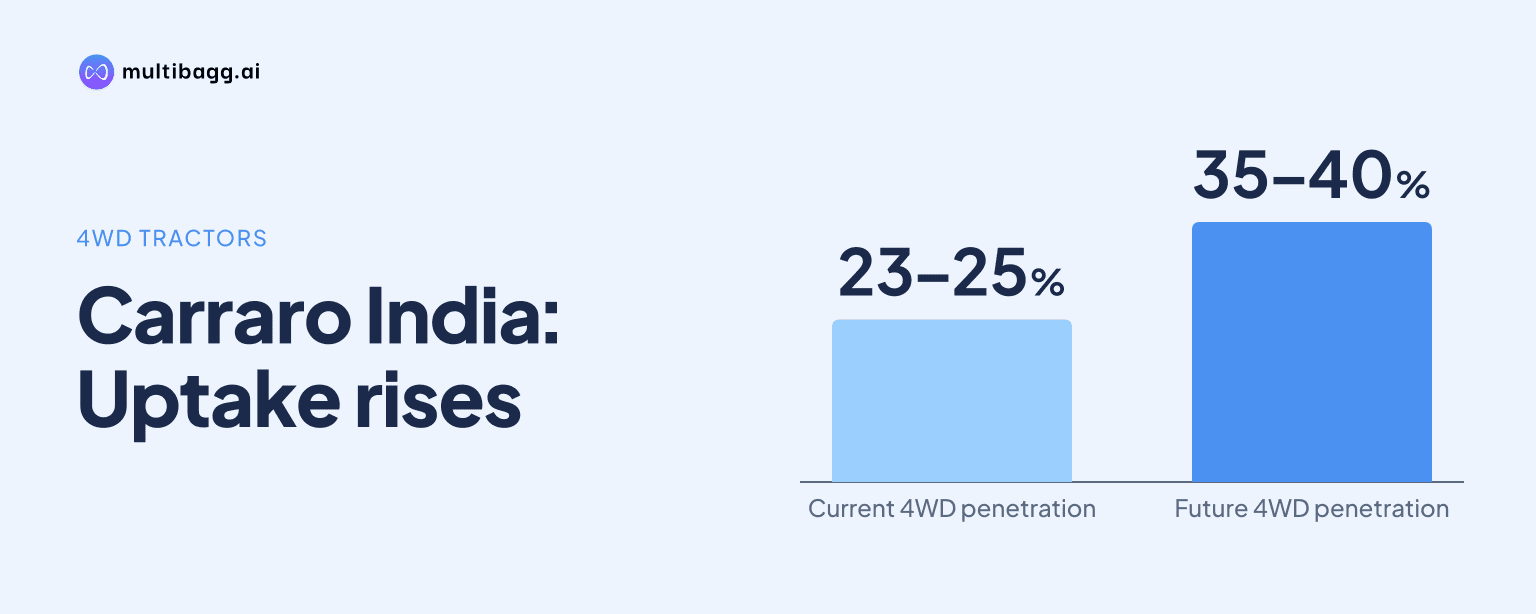
Carraro India Limited expects four-wheel-drive (4WD) tractor penetration in India to rise from its estimated 23%-25% currently towards 35%-40% over the coming years, as domestic agricultural revenue increased 34% year on year to Rs 480 crore in H1 FY27. Management said 4WD axle demand is growing faster than overall tractor wholesales.
Know Carraro India inside out
Results, valuation, peers and who's buying, in one view.
Why are Carraro India’s domestic axle sales outpacing tractor demand?
Carraro India’s domestic axle sales are outpacing tractor demand because its agricultural business is concentrated in 4WD tractors, where adoption is increasing, rather than in the wider tractor market. Agricultural revenue grew 23% in H1 FY27, while domestic tractor-industry wholesales increased by high single digits, according to management. Domestic revenue rose 30% to Rs 865.4 crore and represented about 70% of total H1 FY27 revenue from operations of Rs 1,241.1 crore.
Management said goods and services tax rationalisation had brought 4WD tractor prices closer to two-wheel-drive levels prevailing before the reform announcements, helping farmer demand. Tractor wholesale volumes softened in September and October after a high base, uneven monsoon and festive-season timing, but Carraro India described 4WD adoption as structural rather than cyclical. It said domestic 4WD axle volumes continued to grow faster than the overall tractor market.
The domestic and export comparison shows the role of Indian 4WD demand in H1 FY27. Domestic agricultural revenue rose to Rs 480 crore from the prior-year period, while export agricultural revenue declined to Rs 105 crore from Rs 120 crore. Management attributed the domestic rise mainly to 4WD axles, while it described overseas conditions as uneven in Europe, Turkey, Latin America and Africa.
What is Carraro India’s 4WD tractor opportunity?
Carraro India estimates 4WD tractors represent about 23%-25% of the Indian tractor market and could move to 27%-28% in the coming months before reaching 35%-40% over the longer term. Management cautioned that the current penetration estimate comes from customer discussions and industry intelligence, because published market data do not separately define the 4WD category in a consistent way.
Carraro India said it has only a small legacy two-wheel-drive business that would not materially register in its revenue, making 4WD the core of its addressable domestic tractor market. Management compared India’s estimated 23%-25% penetration with a global 4WD level of about 95%-98%. That gap is management’s basis for expecting continued adoption, rather than a forecast that total Indian tractor demand will rise without interruption.
Original equipment manufacturers, or OEMs, face no major technical barrier to shifting models to 4WD, according to management. It said the gearbox is generally compatible with a 4WD configuration, while the key additions are a driven front axle and connecting shaft. OEMs are providing future demand estimates and reserving capacity, management said, leading Carraro India to expand its supply capability.
How large is Carraro India’s non-captive 4WD axle position?
Carraro India estimates it has a 56%-58% share of the non-captive 4WD axle market. Management also made a calculated estimate that captive production accounts for roughly 30% of the wider 4WD market, while stressing that these are not scientifically researched market-share figures. The company’s estimates are based on its engagement with several OEMs.
Management said its supply model centres on co-designing axle and transmission solutions to an OEM’s required torque, gear ratios and duty cycle, rather than selling standard catalogue products. It said this approach can reduce customer development, testing and field-validation work. A 4WD axle contains at least 130 part numbers, management said, compared with roughly 15 to 25 part numbers in a fabricated, non-driven two-wheel-drive axle.
Carraro India said the commercial decision for an OEM is not solely a comparison of manufacturing cost. Management cited time to market, the reliability of field-tested products and the ability to tailor equipment for different applications as factors supporting external sourcing. It added that OEMs generally avoid using two different transmission sources within one vehicle model because servicing and spare-parts requirements would become more complex.
Got a follow-up? Ask IRIS
How is Carraro India adding capacity for 4WD demand?
Carraro India incurred capital expenditure of Rs 20.4 crore in H1 FY27 and began construction of a new paint-shop building. It also commissioned a side-drive sub-assembly line and a backlash machine, which management said would enhance portal-axle capacity and differential support capacity for the 4WD line.
Management indicated capital expenditure of more than Rs 100 crore for FY27, although it said only 70%-80% may be spent during the year and the balance could carry into FY28. It also indicated a similar broad level of capital expenditure for FY28, while noting that the FY28 plan and budget had not yet been approved. The spending plan is linked to capacity expansion where OEM demand has been established.
Raw-material localisation is another operating lever in the capacity plan. Localisation recovered to about 80% in Q2 FY27 from 74% in Q1 FY27 after supply from local partners normalised, and Carraro India retained its 86%-88% target. Management said it had used imports and air freight when supply-chain disruption affected local availability, in order to maintain customer deliveries.
What could affect Carraro India’s FY27 revenue and margins?
Carraro India maintained its FY27 revenue-growth target of 10%-15% after revenue from operations rose 15% to Rs 1,241.1 crore in H1 FY27. Management said it intended to close FY27 near Rs 2,500 crore of revenue and, based on customer indications, saw at least 10% growth in the following year. It also said export revenue could be broadly flat or show minor growth for FY27 after a Q2 recovery.
Profitability remains dependent on cost recovery, localisation and capacity utilisation. Earnings before interest, tax, depreciation and amortisation, or EBITDA, increased 8% to Rs 123.2 crore in H1 FY27, but the EBITDA margin declined to 9.7% from 10.4% in H1 FY26. Gross margin fell to 25.4% from about 27.5%, as steel, castings, energy, freight and supplier-labour costs increased.
Management said steel and casting costs are indexed in customer contracts but are recovered with a lag of three to six months. Energy, freight and supplier-labour inflation requires separate customer negotiations, of which management said 30%-40% remained unresolved at the time of the November 6, 2026 call. Management expected initial benefits from these negotiations to begin appearing from Q3 FY27 and committed to growth in absolute EBITDA for the full year.
Conclusion
Carraro India’s H1 FY27 results indicate that rising 4WD tractor adoption, rather than a broad-based tractor-demand cycle, was the main driver of domestic agricultural growth. Domestic agricultural revenue increased 34% to Rs 480 crore while export agricultural revenue declined 12% to Rs 105 crore, showing that Indian demand offset weakness in several overseas markets.
The next measures to watch are whether 4WD penetration advances from management’s estimated 23%-25% level, whether the company’s axle-capacity projects meet OEM demand, and whether localisation progresses from 80% in Q2 FY27 towards the 86%-88% target. Management also expects customer cost-recovery negotiations to have an initial effect from Q3 FY27, which will be relevant to its stated aim of progressively improving margins.