










Carraro India expands 4WD capacity as telehandler pipeline grows
Key highlights
- Carraro India spent Rs 20.4 crore on capital expenditure in H1FY27.
- Domestic revenue rose 30% year on year to Rs 865.4 crore in H1FY27.
- The domestic tele-boom handler market reached approximately 800 machines in H1FY27.
- Carraro India developed seven prototypes in H1FY27, and one progressed to production.
powered by IRIS
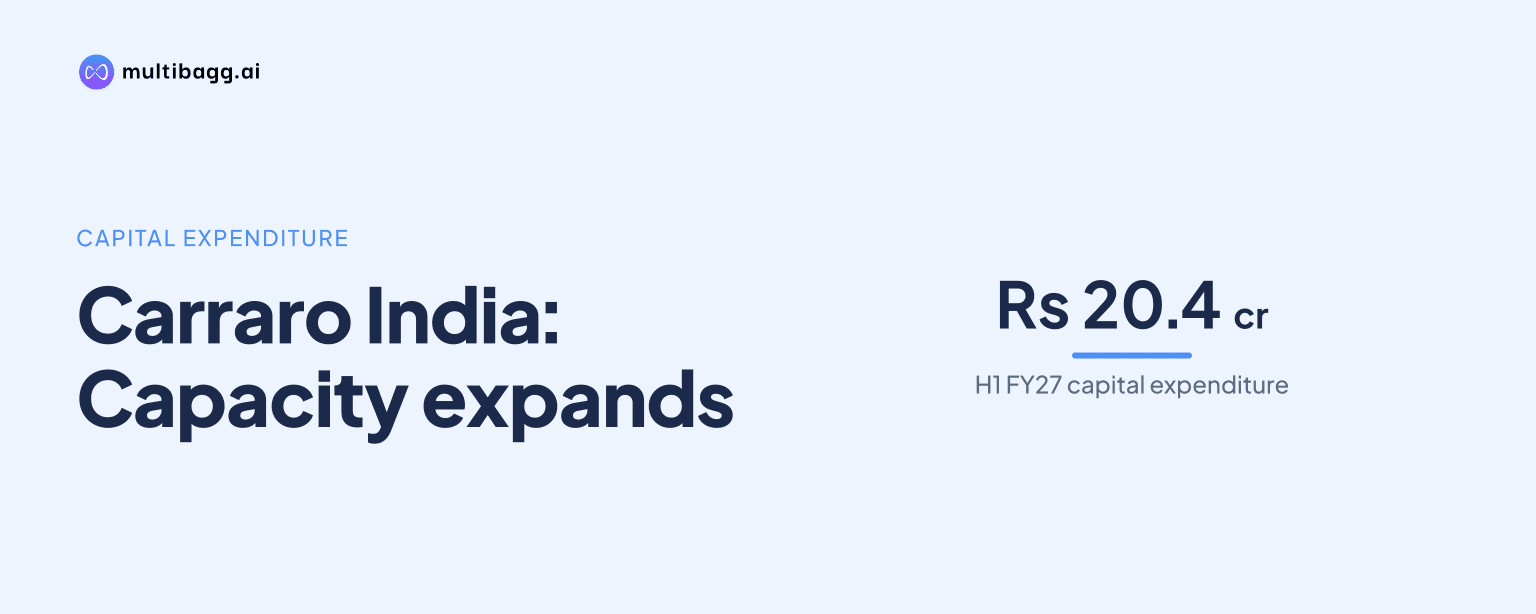
In H1FY27, Carraro India Limited spent Rs 20.4 crore on manufacturing additions, commissioning equipment for its 4WD line while tele-boom handler, domestic higher-horsepower driveline and e-transmission programmes advanced. The investment accompanied 30% year-on-year domestic revenue growth to Rs 865.4 crore, driven primarily by agricultural 4WD axle demand and construction-equipment activity.
Know Carraro India inside out
Results, valuation, peers and who's buying, in one view.
How is Carraro India expanding 4WD capacity?
Carraro India is adding manufacturing capability through Rs 20.4 crore of capital expenditure in H1FY27, including the start of construction of a new paint-shop building. It also commissioned a side-drive sub-assembly line and a backlash machine. The company said these additions are intended to enhance portal-axle capacity and raise differential-support capacity on its 4WD line.
The H1FY27 expenditure follows Rs 41.7 crore invested during FY26 in new telescopic-handler axle production, high-performance agricultural transmissions and capacity expansion. Carraro India said domestic 4WD axle demand continued to outpace the overall tractor industry and that it was ramping capacity for anticipated demand. Its gears business showed positive traction in H1FY27, although management expects its full-year performance to remain flat while business-development work continues.
What is happening in Carraro India’s telehandler programmes?
Carraro India continued the planned ramp-up of a new tele-boom handler, or TBH, axle range for a major international original equipment manufacturer, or OEM, in H1FY27. The company said the ramp-up was progressing alongside other export programmes, extending its construction-equipment activity beyond the domestic market.
The domestic TBH market reached approximately 800 machines in H1FY27, according to Carraro India, presenting further growth opportunities for driveline products. A couple of TBH programmes were in series production for two customers, while another four to five programmes were in field or prototype testing. Carraro India said new TBH driveline projects with Indian OEMs are expected to strengthen its domestic presence, but did not disclose revenue or launch dates for those projects.
Backhoe loader, or BHL, demand also supported the construction-equipment portfolio in H1FY27. Carraro India reported encouraging domestic BHL market growth, with additional traction during the festive season helping its sales. Management also said BHL driveline exports through Indian OEMs continued to perform well, distinguishing this product flow from the broader 9% decline in export revenue during the half year.
Which higher-horsepower and electric programmes are advancing?
Carraro India is progressing domestic higher-horsepower tractor driveline programmes through field validation, even as export markets have yet to regain momentum. The company said the weaker export environment temporarily affected offtake of higher-horsepower tractor transmissions. Its domestic OEM programmes remain in validation rather than stated series production, so their eventual volume contribution was not disclosed.
In engineering services, Carraro India received a prototype order from Montra Electric for an e-transmission project that is moving through field validation. It also received an additional engineering-services assignment from a customer in western India during H1FY27 and said discussions were under way with other customers. The announcement did not state the contract values, production timetable or expected revenue from these assignments.
Carraro India developed seven prototypes in H1FY27, with one progressing successfully to production, according to management. The company also cited a secured bull-gear nomination from a large global OEM and ongoing customer-development programmes as potential support for the gears business over coming periods. That forward view is management’s expectation, while the stated near-term outlook for the gears segment remains flat for FY27.
Got a follow-up? Ask IRIS
How did H1FY27 results support Carraro India’s plan?
H1FY27 operating growth provided the financial backdrop for Carraro India’s capacity and programme investments, with revenue from operations rising 15% to Rs 1,241.1 crore. Domestic revenue increased faster than total operating revenue, while export revenue fell 9%, shifting the mix towards the Indian market.
Agricultural equipment was the faster-growing major operating segment, increasing 23% to Rs 585.9 crore in H1FY27, compared with an 8% increase to Rs 524.3 crore for construction equipment. The company linked domestic growth mainly to agricultural 4WD axles and construction equipment. Spare-parts growth was also driven by increased Carraro India driveline penetration and expansion of its aftermarket dealer-distributor network, though no segment revenue was disclosed.
Profit increased in absolute terms, but margins were lower than a year earlier. Earnings before interest, tax, depreciation and amortisation, or EBITDA, margin was 9.7% in H1FY27 versus 10.4% in H1FY26, while profit-after-tax margin was 5.3% versus 5.6%. Management attributed the margin movement to higher raw-material, energy, transportation and conversion costs, and said customer cost recovery involves a time lag.
Conclusion
Carraro India’s H1FY27 activity concentrated on domestic agricultural 4WD axles, TBH drivelines and selected engineering programmes. Domestic revenue of Rs 865.4 crore, up 30%, contrasted with a 9% export decline, while the company used Rs 20.4 crore of half-year capital expenditure to support 4WD-line, portal-axle and paint-shop capability.
The next developments to watch are the progression of four to five TBH programmes in prototype or field testing, field validation of domestic higher-horsepower tractor drivelines and the Montra Electric prototype project. Management expects gradual margin improvement through higher volumes, cost recovery, productivity and operating efficiencies, while its FY27 outlook still assumes flat gears performance and no near-term recovery in higher-horsepower transmission export offtake.