










Carraro India operating cash flow drops 55% in first half
Key highlights
- Carraro India’s standalone operating cash flow fell 55% to Rs 35.135 crore in the half year ended 30 September 2026.
- Inventory consumed Rs 58.729 crore of cash, compared with Rs 3.727 crore in the prior-year half.
- Standalone profit after tax rose to Rs 72.125 crore from Rs 59.102 crore.
- Standalone cash and cash equivalents were Rs 90.194 crore at 30 September 2026, versus Rs 80.321 crore at 31 March 2026.
powered by IRIS
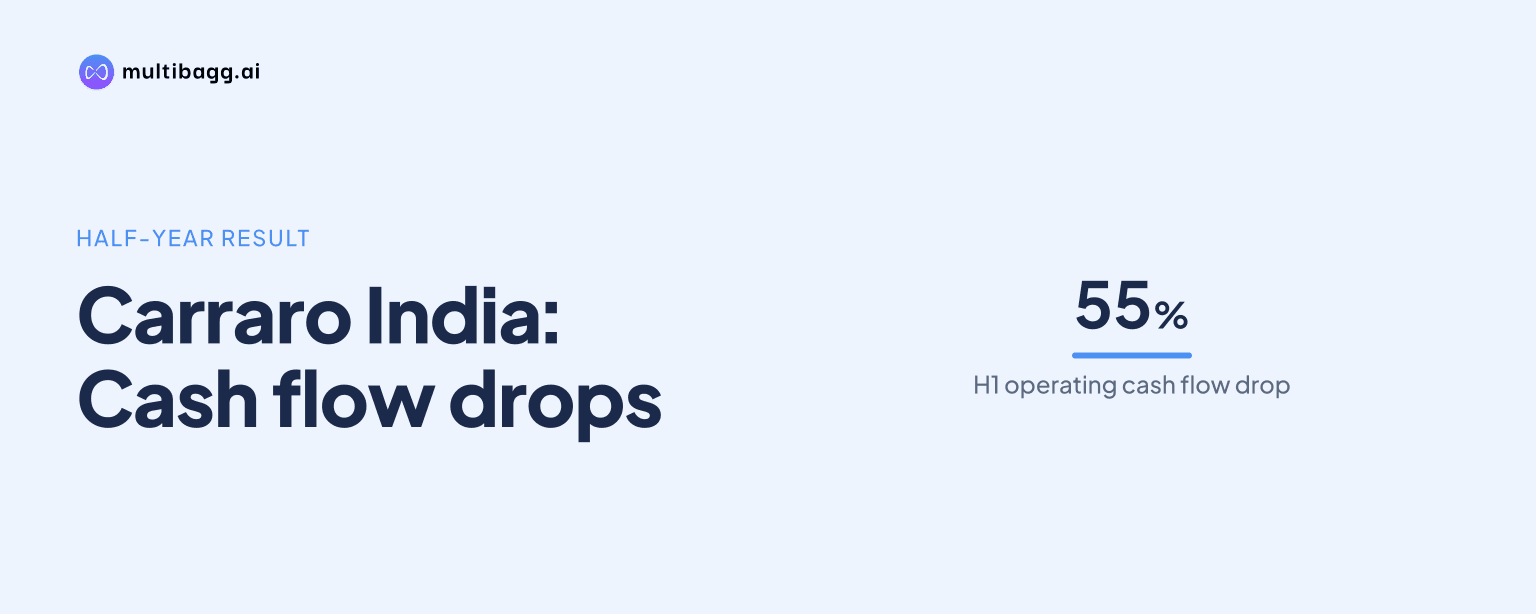
Carraro India Limited reported Rs 35.135 crore of net cash generated from operating activities for the half year ended 30 September 2026, down 55% from Rs 78.468 crore a year earlier, as inventory alone absorbed Rs 58.729 crore of cash. Standalone profit after tax nevertheless rose to Rs 72.125 crore from Rs 59.102 crore.
Know Carraro India inside out
Results, valuation, peers and who's buying, in one view.
Why did Carraro India’s operating cash flow fall?
Carraro India’s operating cash flow fell because working-capital movements consumed more cash in the half year ended 30 September 2026. Cash generated from operations, before income-tax payments, declined to Rs 64.225 crore from Rs 100.798 crore in the comparable half year ended 30 September 2025. Income taxes paid increased to Rs 29.090 crore from Rs 22.330 crore.
The largest working-capital movement was the Rs 58.729 crore cash outflow for inventories, compared with Rs 3.727 crore a year earlier. Trade receivables used Rs 13.524 crore and other current assets used Rs 19.195 crore. Together, those three items absorbed Rs 91.448 crore, against Rs 47.595 crore in the previous first half.
How did Carraro India’s working capital change?
Carraro India’s standalone inventory increased to Rs 376.143 crore at 30 September 2026 from Rs 317.414 crore at 31 March 2026, an increase of Rs 58.729 crore. The increase corresponds with the inventory cash outflow in the standalone cash-flow statement. The source does not provide a management explanation for the higher inventory balance.
Standalone trade receivables were Rs 381.783 crore at 30 September 2026, compared with Rs 370.096 crore at 31 March 2026. The cash-flow statement recorded a Rs 13.524 crore receivables outflow, lower than the Rs 33.424 crore outflow in the half year ended 30 September 2025. The filing does not provide a detailed reconciliation between the balance-sheet movement and the cash-flow line.
Other current assets rose to Rs 83.773 crore at 30 September 2026 from Rs 64.578 crore at 31 March 2026. The related cash-flow outflow was Rs 19.195 crore, compared with Rs 10.444 crore a year earlier. This was partly offset by a Rs 46.215 crore increase in trade payables, which was larger than the Rs 31.906 crore increase in the prior-year half.
Did Carraro India’s higher profit translate into more cash?
No. Carraro India’s standalone profit increased in the half year ended 30 September 2026 while net operating cash declined. Profit before tax rose to Rs 95.773 crore from Rs 78.655 crore, and profit after tax increased to Rs 72.125 crore from Rs 59.102 crore. Net operating cash flow, however, fell by Rs 43.333 crore year on year.
Cash flow before working-capital changes was broadly unchanged at Rs 113.617 crore, compared with Rs 112.955 crore in the prior-year period. Depreciation and amortisation expenses were Rs 22.141 crore versus Rs 21.974 crore, while interest on borrowings declined to Rs 7.861 crore from Rs 9.538 crore. The cash-flow reduction therefore followed the pre-working-capital stage of the statement.
Standalone revenue from operations increased to Rs 1,232.584 crore in the half year ended 30 September 2026 from Rs 1,071.026 crore a year earlier. The source also reported Rs 95.549 crore of materials consumed, up from Rs 79.472 crore, and Rs 8.221 crore of employee benefits expense, up from Rs 7.635 crore. These income-statement movements were reported alongside the increase in inventory and other current assets.
Got a follow-up? Ask IRIS
What changed in Carraro India’s cash, borrowing and investment flows?
Carraro India ended 30 September 2026 with standalone cash and cash equivalents of Rs 90.194 crore, compared with Rs 80.321 crore at 31 March 2026. The cash-flow statement recorded a Rs 9.450 crore net increase in cash before a Rs 0.423 crore positive exchange-rate effect. In the corresponding 2025 half year, cash increased by Rs 15.527 crore before a Rs 5.685 crore exchange-rate effect.
Purchases of property, plant and equipment, including capital work-in-progress, capital advances and capital creditors, were Rs 23.392 crore in the latest half year, compared with Rs 14.429 crore a year earlier. Capital work-in-progress stood at Rs 1.791 crore at 30 September 2026, up from Rs 0.246 crore at 31 March 2026. Purchases of intangible assets were Rs 0.065 crore, against Rs 0.119 crore in the previous first half.
The standalone balance sheet showed non-current borrowings of Rs 37.375 crore at 30 September 2026, down from Rs 107.625 crore at 31 March 2026, while current borrowings increased to Rs 142.178 crore from Rs 33.865 crore. The cash-flow statement recorded Rs 17.063 crore of long-term borrowing repayments, compared with Rs 23.861 crore a year earlier. It also showed dividend payments of Rs 38.355 crore, interest payments of Rs 7.861 crore and lease-liability payments of Rs 0.984 crore.
Carraro India purchased mutual-fund investments worth Rs 82.996 crore and sold mutual funds worth Rs 83.082 crore during the half year ended 30 September 2026. Dividend income received was Rs 6.829 crore, while the company reported Rs 6.829 crore of dividend income in operating cash-flow adjustments. The cash-flow statement also reported Rs 0.013 crore of interest received.
Conclusion
Carraro India’s first-half figures show that higher standalone revenue and profit did not produce higher operating cash in the half year ended 30 September 2026. Inventory, receivables and other current assets absorbed Rs 91.448 crore, while a Rs 46.215 crore rise in trade payables only partly offset those uses of cash. Net operating cash consequently fell to Rs 35.135 crore despite a Rs 13.023 crore increase in profit after tax.
The next results will indicate whether the Rs 58.729 crore inventory build and Rs 19.195 crore other-current-assets outflow reverse or continue. The 6 November 2026 filing does not disclose a working-capital target or a specific management plan, leaving subsequent inventory, receivables, payables and operating-cash movements as the reported measures to watch.