










Carraro India has two TBH programmes in series production
Key highlights
- Carraro India had two tele-boom handler programmes in series production and another four to five in field or prototype testing in H1FY27.
- The domestic tele-boom handler market reached approximately 800 machines in H1FY27.
- Construction-vehicle revenue increased 8% year on year to Rs 524.3 crore in H1FY27.
- Carraro India received a Montra Electric e-transmission prototype order for field validation.
powered by IRIS
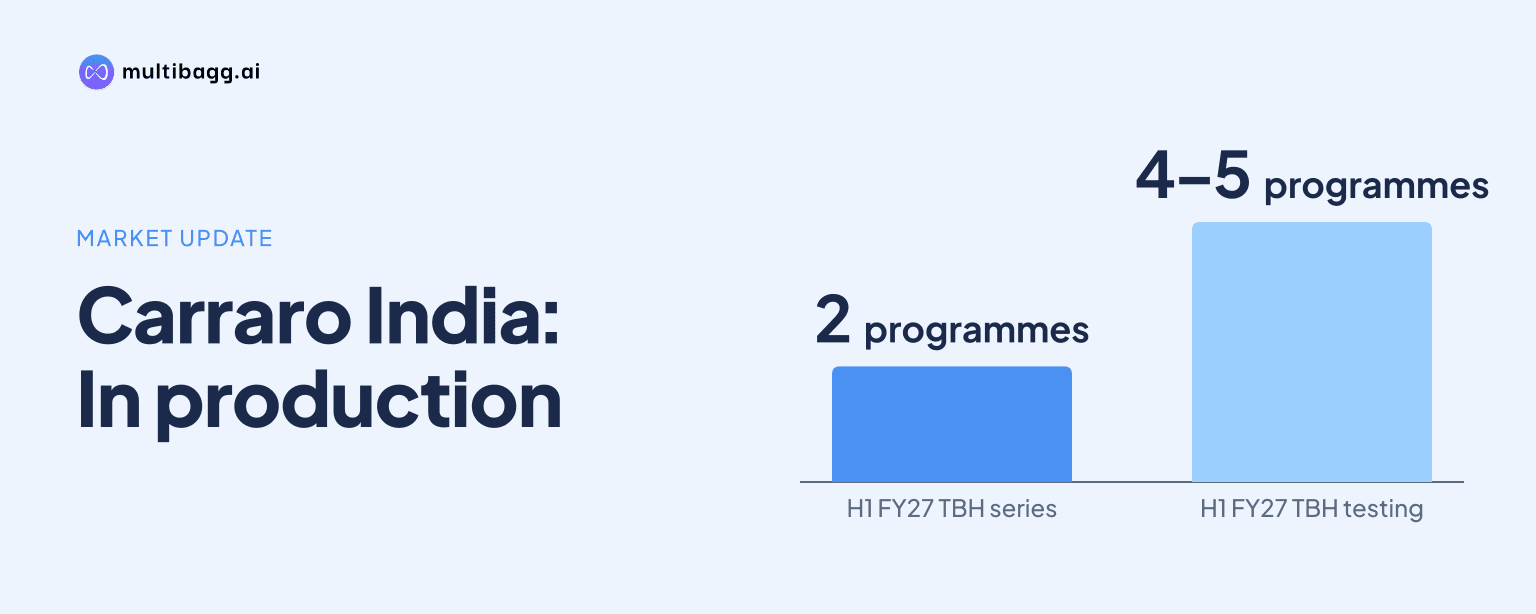
Carraro India Limited had two tele-boom handler axle programmes in series production for two customers and another four to five in field or prototype testing in H1FY27, when the domestic tele-boom handler market reached approximately 800 machines. Construction-vehicle revenue rose 8% year on year to Rs 524.3 crore in the half year.
Know Carraro India inside out
Results, valuation, peers and who's buying, in one view.
What is Carraro India’s tele-boom handler pipeline?
Carraro India’s tele-boom handler, or TBH, pipeline comprised two programmes in series production and another four to five undergoing field or prototype testing in H1FY27. The series-production programmes are for two customers, but the presentation does not name them or disclose programme values, volumes, margins or launch dates for the projects still in testing.
Carraro India said the ramp-up of a new TBH axle range for a major international original equipment manufacturer, or OEM, continued as planned alongside other export programmes. In the domestic market, it is pursuing new TBH driveline projects with Indian OEM customers, against a market that reached approximately 800 machines in H1FY27.
How did Carraro India’s construction revenue change in H1FY27?
Carraro India’s construction-vehicle revenue increased 8% to Rs 524.3 crore in H1FY27 from Rs 485 crore in H1FY26, trailing 23% growth in agricultural-vehicle revenue to Rs 585.9 crore. Total income, including other income, rose 16% to Rs 1,264.4 crore, while domestic revenue increased 30% to Rs 865.4 crore and export revenue declined 9% to Rs 375.8 crore.
In Q2 FY27, construction-vehicle revenue grew 12% to Rs 297.9 crore from Rs 267.2 crore a year earlier. Agricultural-vehicle revenue rose 29% to Rs 330 crore, while revenue classified as others increased 9% to Rs 68.6 crore, showing that construction expanded in both reported periods but more slowly than agriculture in the first half.
What supports Carraro India’s construction-equipment opportunity?
Carraro India said domestic backhoe loader, or BHL, demand showed encouraging growth, with festive-season traction supporting its sales in H1FY27. It also reported that BHL driveline exports through Indian OEMs continued to perform well, although the presentation does not disclose BHL or TBH revenue, unit shipments, or their individual contributions to the Rs 524.3 crore construction-vehicle segment.
The company’s disclosed TBH work spans axles and drivelines: the new axle range is being ramped for an international OEM, while domestic driveline projects are being developed with Indian OEMs. The four to five programmes in field or prototype testing have not yet reached series production, and their outcome depends on the stated validation process.
Carraro India invested Rs 41.7 crore during FY26 in new telescopic-handler axle production, high-performance agricultural transmissions and capacity expansion. In H1FY27, it incurred Rs 20.4 crore of capital expenditure, began construction of a paint-shop building, and commissioned a side-drive sub-assembly line and a backlash machine to enhance portal-axle capacity and differential-support capacity on its four-wheel-drive, or 4WD, line.
Got a follow-up? Ask IRIS
What other engineering programmes is Carraro India developing?
Carraro India received a prototype order from Montra Electric for an e-transmission engineering project, with field validation forming the next disclosed stage. The presentation gives no order value, unit count, production timetable or confirmation that the prototype will become a series-production supply programme.
During H1FY27, Carraro India also received an engineering-services assignment from a customer in western India and said discussions with other customers were progressing. Its research and development work produced seven prototypes in the half year, one of which progressed to production, but the company did not link that programme specifically to Montra Electric, TBH or the western India assignment.
Higher-horsepower agricultural driveline programmes for domestic OEMs were in field validation in H1FY27, while export markets had yet to gain momentum and temporarily affected tractor-transmission offtake. The gears business showed positive traction in the half year, but management expects full-year performance to remain flat despite a secured bull-gear nomination from a large global OEM.
How did Carraro India’s profit and margins move?
Carraro India reported earnings before interest, tax, depreciation and amortisation, or EBITDA, of Rs 123.2 crore in H1FY27, up 8% from Rs 114.1 crore in H1FY26. Profit after tax, or PAT, increased 9% to Rs 66.5 crore from Rs 60.8 crore, so both measures grew more slowly than the 16% increase in total income.
EBITDA margin declined to 9.7% in H1FY27 from 10.4% in H1FY26, while gross margin fell to 25.4% from 27.5% and PAT margin decreased to 5.3% from 5.6%. Management attributed the movement to higher raw-material, energy, transportation and conversion costs, and said customer cost recovery has a time lag.
In Q2 FY27, total income increased 19% to Rs 705.8 crore, EBITDA rose 10% to Rs 65.2 crore and PAT grew 11% to Rs 35.1 crore. Management said revenue performance was broadly aligned with its FY27 growth outlook and that margin recovery is expected to be gradual through higher volumes, cost recovery, productivity and operating efficiencies; it gave no quantitative FY27 target.
Conclusion
Carraro India has disclosed a defined TBH development pipeline, with two customer programmes already in series production and four to five at validation stages, alongside a domestic market of approximately 800 machines in H1FY27. Construction revenue increased to Rs 524.3 crore, although agricultural vehicles and domestic revenue grew faster while exports declined.
The next disclosed milestones are progress on the four to five TBH programmes in field or prototype testing, Montra Electric’s e-transmission field validation, and the capacity work supported by Rs 20.4 crore of H1FY27 capital expenditure. Management also expects gears performance to remain flat in FY27 and continues to seek recovery of higher operating costs from customers.