










Carraro India Limited domestic revenue rises 30% as exports fall 9%
Key highlights
- Carraro India’s H1 FY27 domestic revenue rose 30% to Rs 865.4 crore.
- Carraro India’s H1 FY27 export revenue fell 9% to Rs 375.8 crore.
- Carraro India’s H1 FY27 revenue from operations increased 15% to Rs 1,241.1 crore.
- Carraro India’s H1 FY27 EBITDA margin declined to 9.7% from 10.4%.
powered by IRIS
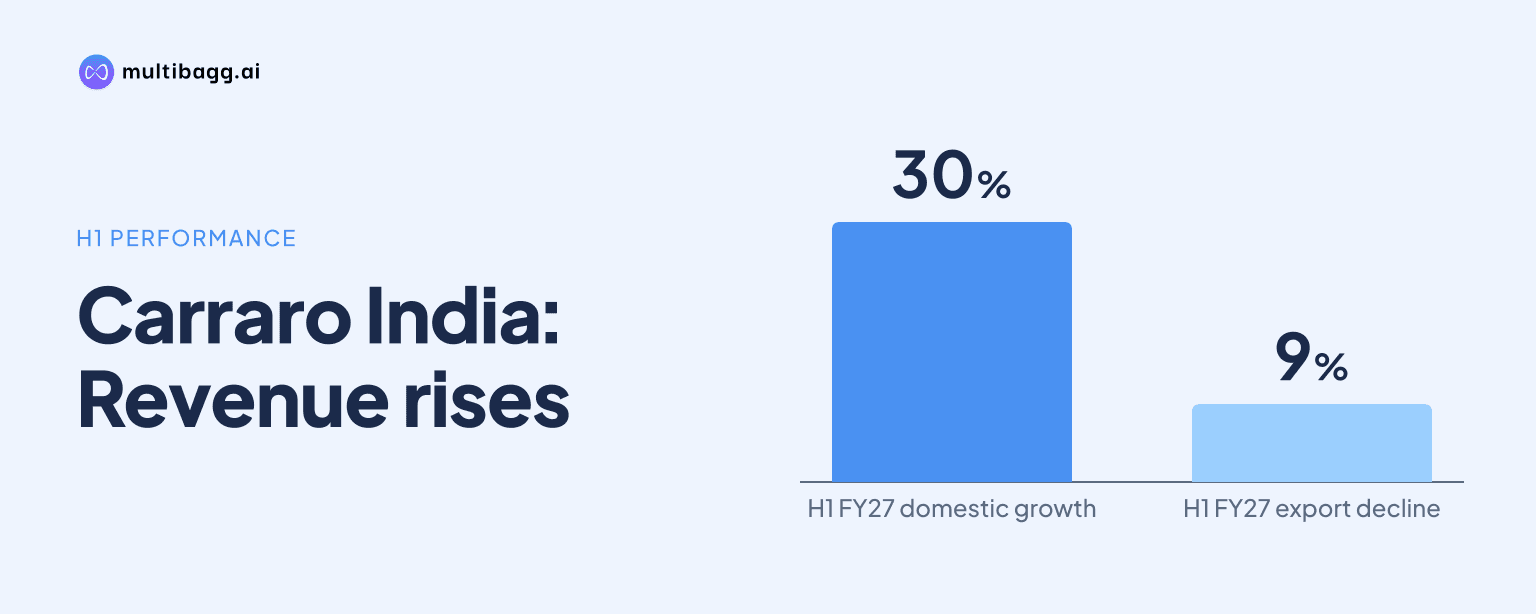
Carraro India Limited reported 30% year-on-year domestic revenue growth to Rs 865.4 crore in H1 FY27, while export revenue fell 9% to Rs 375.8 crore amid West Asia-linked supply-chain disruption. Carraro India said domestic demand for agricultural four-wheel-drive axles and construction equipment supported a 15% rise in revenue from operations.
Know Carraro India inside out
Results, valuation, peers and who's buying, in one view.
How did Carraro India’s domestic and export revenue change in H1 FY27?
Carraro India’s domestic revenue increased by Rs 197.6 crore, or 30%, from Rs 667.8 crore in H1 FY26 to Rs 865.4 crore in H1 FY27. Export revenue moved in the opposite direction, declining by Rs 35.5 crore, or 9%, to Rs 375.8 crore from Rs 411.3 crore. Management attributed the export decline to supply-chain disruptions arising from geopolitical tensions in West Asia.
The geographic change made domestic business the principal source of the Rs 161.9 crore increase in revenue from operations, which reached Rs 1,241.1 crore in H1 FY27 from Rs 1,079.2 crore a year earlier. The revenue bridge identifies domestic growth of Rs 197.5 crore and an export decrease of Rs 35.6 crore, showing that domestic gains more than offset the overseas shortfall.
The divergence was also present in the second quarter. Domestic revenue rose 33% to Rs 485.9 crore in Q2 FY27 from Rs 366.2 crore in Q2 FY26, whereas exports declined 4% to Rs 210.6 crore. This means the H1 pattern was not solely a first-quarter movement, although the quarterly export decline was smaller than the half-year decline.
What products drove Carraro India’s domestic growth?
Carraro India said domestic agricultural four-wheel-drive, or 4WD, axle demand was the main driver of the 30% domestic revenue increase in H1 FY27. Management said the transition towards 4WD tractors is progressing as expected and that 4WD axle demand continues to outpace the overall tractor industry, prompting the company to ramp up capacity for anticipated demand.
Agricultural-vehicle revenue rose 23% to Rs 585.9 crore in H1 FY27 from Rs 478.1 crore in H1 FY26, the largest segment increase in rupee terms at Rs 107.8 crore. Construction-vehicle revenue increased 8% to Rs 524.3 crore, adding Rs 39.3 crore, while the others category rose 13% to Rs 130.9 crore. Agriculture therefore supplied most of the operating-revenue increase by segment.
Construction demand also contributed domestically. Carraro India said the domestic backhoe-loader, or BHL, market showed encouraging growth, with further traction during the festive season. In tele-boom handlers, or TBH, the domestic market reached about 800 machines in H1 FY27, while two customer programmes were in series production and another four to five were in field or prototype testing.
The company’s domestic development activity extends beyond current axle sales. Higher-horsepower driveline programmes for domestic original equipment manufacturers, or OEMs, were in field validation, and the Montra Electric e-transmission engineering project had received a prototype order for field validation. Carraro India also received one additional engineering-services assignment from a customer in western India during the year.
Got a follow-up? Ask IRIS
Why did Carraro India’s profit margins decline despite higher revenue?
Carraro India’s earnings before interest, tax, depreciation and amortisation, or EBITDA, rose 8% to Rs 123.2 crore in H1 FY27, but its EBITDA margin fell to 9.7% from 10.4% in H1 FY26. Profit after tax, or PAT, increased 9% to Rs 66.5 crore, while the PAT margin decreased to 5.3% from 5.6%.
The margin movement followed a slower increase in gross profit than in income. H1 gross profit rose 7% to Rs 321.1 crore, but total income increased 16% to Rs 1,264.4 crore. Gross margin consequently declined to 25.4% from 27.5%. Management cited higher raw-material, energy, transportation and conversion costs, and said customer cost recovery involves a time lag.
The second quarter showed a similar relationship. Q2 FY27 EBITDA was Rs 65.2 crore, up 10% from Rs 59.3 crore, yet the EBITDA margin fell to 9.2% from 10.0%. Q2 gross margin dropped to 23.3% from 26.4%, even as total income grew 19% to Rs 705.8 crore.
H1 other income was Rs 23.3 crore compared with Rs 13.8 crore a year earlier. It included an Rs 8.807 crore one-time provision write-back related to customs proceedings following a reassessment in Q1 FY27, plus Rs 2.5 crore of interest on an income-tax refund in Q2 FY27. The company said the remaining other income primarily comprised export incentives; its margin calculations are based on total income.
What is Carraro India doing to support future domestic demand?
Carraro India incurred capital expenditure of Rs 20.4 crore in H1 FY27 to expand capability and capacity. Construction began on a new paint-shop building, while a side-drive sub-assembly line and a backlash machine were commissioned to raise portal-axle capacity and differential-support capacity on the 4WD line.
That investment follows Rs 41.7 crore of capital expenditure in FY26 on new telescopic-handler axle production, high-performance agricultural transmissions and broader capacity expansion. Management linked the H1 FY27 4WD-line work to the expected continuation of domestic 4WD tractor demand, rather than setting a quantified output or revenue target.
The export-side product pipeline remains active despite the H1 decline. The new TBH axle range for a major international OEM was ramping up as planned alongside other export programmes, while BHL driveline exports through Indian OEMs continued to perform well. However, management said export markets had yet to gain momentum, temporarily affecting higher-horsepower tractor-transmission offtake.
Carraro India also developed seven prototypes in H1 FY27, with one progressing to production. In gears, it has a secured bull-gear nomination from a large global OEM and customer-development programmes underway, although management expects the gears business to remain flat for the full year despite positive H1 traction.
Conclusion
Carraro India’s H1 FY27 results show that domestic agricultural 4WD axles and construction applications offset a decline in exports: operating revenue increased 15% to Rs 1,241.1 crore even as exports fell to Rs 375.8 crore. The trade-off was lower margins, with EBITDA margin down 0.7 percentage points to 9.7% as operating-cost increases exceeded the pace of recovery.
Next, readers should watch whether export markets regain momentum and whether management’s stated progressive cost recovery improves margins. The company’s Rs 20.4 crore H1 FY27 capital programme, including the paint shop and 4WD-line equipment, and the four to five TBH programmes under validation are disclosed mechanisms that could affect future volumes and product mix.