










Carraro India expects FY27 EBITDA margin above 10%
Key highlights
- Carraro India reported Q2 FY27 EBITDA margin of 9.2%, compared with 10.0% in Q2 FY26.
- Carraro India said 30% to 40% of cost-recovery negotiations remained open on November 6, 2026.
- Carraro India’s H1 FY27 revenue rose 15% to Rs 1,241.1 crore and EBITDA increased 8% to Rs 123.2 crore.
- Carraro India’s raw-material localization recovered to about 80% in Q2 FY27 from 74% in Q1 FY27.
powered by IRIS
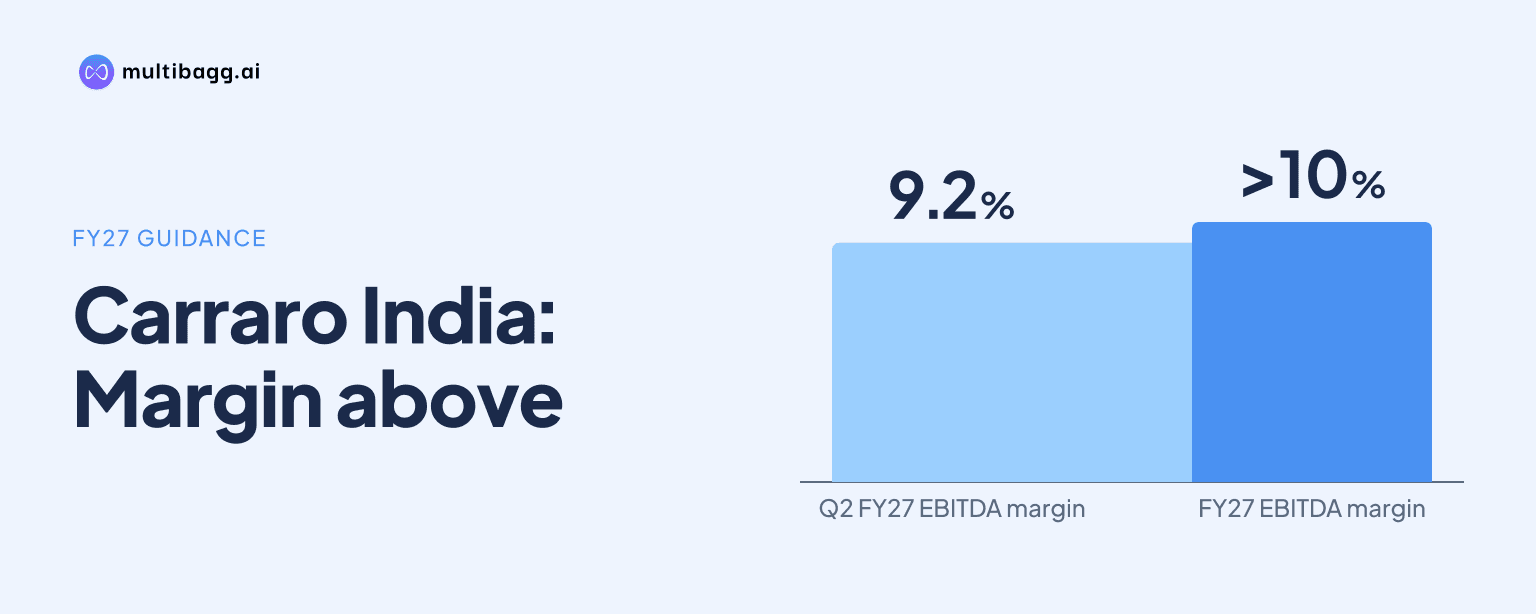
Carraro India Limited expects to close FY27 with an EBITDA margin of 10% or higher after its Q2 FY27 margin fell to 9.2% from 10.0% a year earlier. Management said customer recoveries should begin contributing from Q3, while delayed raw-material pass-throughs, localization and capacity utilization are expected to support progressive improvement.
Know Carraro India inside out
Results, valuation, peers and who's buying, in one view.
Why did Carraro India’s EBITDA margin fall in Q2 FY27?
Carraro India’s Q2 FY27 EBITDA margin fell because input costs increased faster than the company could recover them from customers. Revenue from operations rose 19% year-on-year to Rs 696.5 crore, while EBITDA increased 10% to Rs 65.2 crore. The difference in growth rates reduced EBITDA margin to 9.2% from 10.0% in Q2 FY26, despite higher operating earnings in rupee terms.
The larger pressure appeared at the gross-profit level. Q2 gross margin declined to 23.3% from 26.4% in Q2 FY26, a 310-basis-point decline. Management attributed the movement to higher steel and casting prices, as well as energy, logistics and supplier-labour costs, which it linked to the conflict in West Asia and related supply-chain conditions.
Steel and castings are covered by indexation clauses in Carraro India’s customer contracts, but recoveries usually trail cost movements by three to six months. Steel and casting prices continued rising through H1 FY27, so each quarter reflected costs that were higher than the customer recoveries booked in that period. Chief Financial Officer Davide Grossi described this as a temporary timing effect expected to be reabsorbed in subsequent months.
Energy, freight and supplier-labour costs follow a separate mechanism. These costs are not indexed in customer contracts and require commercial negotiations with individual customers. Management said the initial effects of these discussions had started to appear in the profit and loss account only very recently, with a more visible contribution expected in H2 FY27.
How much cost recovery remains under negotiation?
Carraro India said about 30% to 40% of its cost-recovery negotiations remained open on November 6, 2026. Management said customers had agreed in principle that the cost increases should be passed through, but discussions continued on the appropriate amount because there is no established index for energy, freight and supplier-labour inflation.
Management’s objective is to recover the full difference between purchase variation and sales variation, although it acknowledged that the final result will depend on settlements with customers. Managing Director Balaji Gopalan said Carraro India was sharing its cost details transparently and expected to recover most of the gap. Director, Sales and Business Development Ashok Kumar characterized the discussions as constructive.
Grossi said roughly 2% of Carraro India’s H1 FY27 growth represented price increases secured so far. Domestic revenue rose 30% to Rs 865.4 crore in H1 FY27, and management said clean year-on-year growth was about 12% to 13% after allowing for the pricing contribution. That disclosure separates demand and volume-related expansion from cost-linked price recovery.
The timing of settlements will influence reported profitability. Grossi said Carraro India would begin seeing initial results from the negotiations in Q3 FY27. However, the full margin outcome remains affected by the three-to-six-month lag on steel and casting recovery and by whether energy, freight and supplier-labour costs continue to rise in the second half.
Got a follow-up? Ask IRIS
What is Carraro India’s FY27 EBITDA margin outlook?
Carraro India expects FY27 EBITDA margin to finish in double digits, which management defined as 10% or 10% plus. Gopalan said the company had previously discussed an EBITDA range of 11% to 11.3%, but its current realistic guidance reflects uncertainty over when the conflict-driven cost disruption will ease.
H1 FY27 EBITDA margin was 9.7%, compared with 10.4% in H1 FY26, while EBITDA rose 8% to Rs 123.2 crore. Profit before tax increased 12% to Rs 90.5 crore and profit after tax rose 9% to Rs 66.5 crore. These increases show that earnings grew in absolute terms even as higher costs narrowed operating and gross margins.
Management identified three factors behind a gradual margin recovery: customer recoveries, improved raw-material localization and greater fixed-cost absorption from higher capacity utilization. Raw-material localization recovered to about 80% in Q2 FY27 from 74% in Q1 FY27 after local-partner supply normalized. The company’s stated localization target remains 86% to 88%.
Higher volume already provided some offset to gross-margin pressure in H1 FY27 through fixed-cost absorption. Revenue from operations increased 15% to Rs 1,241.1 crore, within management’s stated full-year revenue growth range of 10% to 15%. Carraro India also reported cash and cash equivalents of about Rs 95.5 crore, debt-to-equity of 0.34 times and net working capital of about 40 days.
Which businesses are supporting Carraro India’s revenue growth?
Carraro India’s domestic business is supporting revenue growth while export demand remains uneven. Domestic revenue rose 30% to Rs 865.4 crore in H1 FY27 and accounted for about 70% of total revenue. Agricultural revenue increased 23% to Rs 585.9 crore, with management attributing much of the domestic progress to demand for four-wheel-drive tractor axles.
Carraro India said it has only an immaterial legacy presence in two-wheel-drive products and is focused on four-wheel-drive applications. Management estimated, using industry intelligence rather than formal market research, that four-wheel-drive tractors account for roughly 23% to 25% of the Indian market. It expects penetration to move toward 35% to 40% over coming years and is adding axle capacity to meet projected original equipment manufacturer demand.
Construction-equipment revenue increased 8% to Rs 524.3 crore in H1 FY27. Domestic construction revenue rose to Rs 327 crore from Rs 256 crore, while construction export revenue declined to Rs 198 crore from Rs 228 crore. The comparison shows that domestic construction demand more than offset part of the export decline within this segment.
Tele-boom Handler axle programs remain part of Carraro India’s medium-term pipeline. Management said a program for a global original equipment manufacturer remains on track to reach about Rs 300 crore over three years. It also said it had reached about 55% to 60% of that level in FY27, without giving an exact program revenue figure.
Exports were less consistent than domestic demand. H1 export revenue declined to Rs 375.8 crore from Rs 411.3 crore, although Q2 export revenue of Rs 210.6 crore was 27% higher sequentially and 4% below the prior year. Management expects exports to be broadly flat or modestly higher for FY27, citing changing conditions in Turkey, Europe, Africa and Latin America as well as continuing logistics disruption.
Conclusion
Carraro India’s margin outlook depends primarily on converting cost-recovery negotiations into revenue and allowing delayed steel and casting pass-throughs to catch up with costs. Q2 FY27 revenue rose 19% and EBITDA grew 10%, but the 310-basis-point gross-margin decline showed that energy, freight, supplier labour, steel and castings had increased faster than recoveries.
The next measure will be Q3 FY27, when management expects the initial effect of negotiated recoveries to appear. Investors can also watch progress on the remaining 30% to 40% of unsettled discussions, localization toward the 86% to 88% target, and H2 FY27 capital spending after Rs 20.4 crore of expenditure in H1 FY27 on capacity-related projects.