










Ceigall H1 FY27 operating cash outflow reaches Rs 4.302 billion
Key highlights
- Ceigall reported negative consolidated operating cash flow of Rs 4.302 billion in H1 FY27.
- Working-capital changes used Rs 7.015 billion of cash in H1 FY27.
- Ceigall’s consolidated net debt increased to Rs 13.518 billion at 30 September 2026 from Rs 11.381 billion at March 2026.
- Ceigall’s H1 FY27 revenue rose 21.1% to Rs 19.921 billion and profit after tax rose 45.1% to Rs 1.560 billion.
powered by IRIS
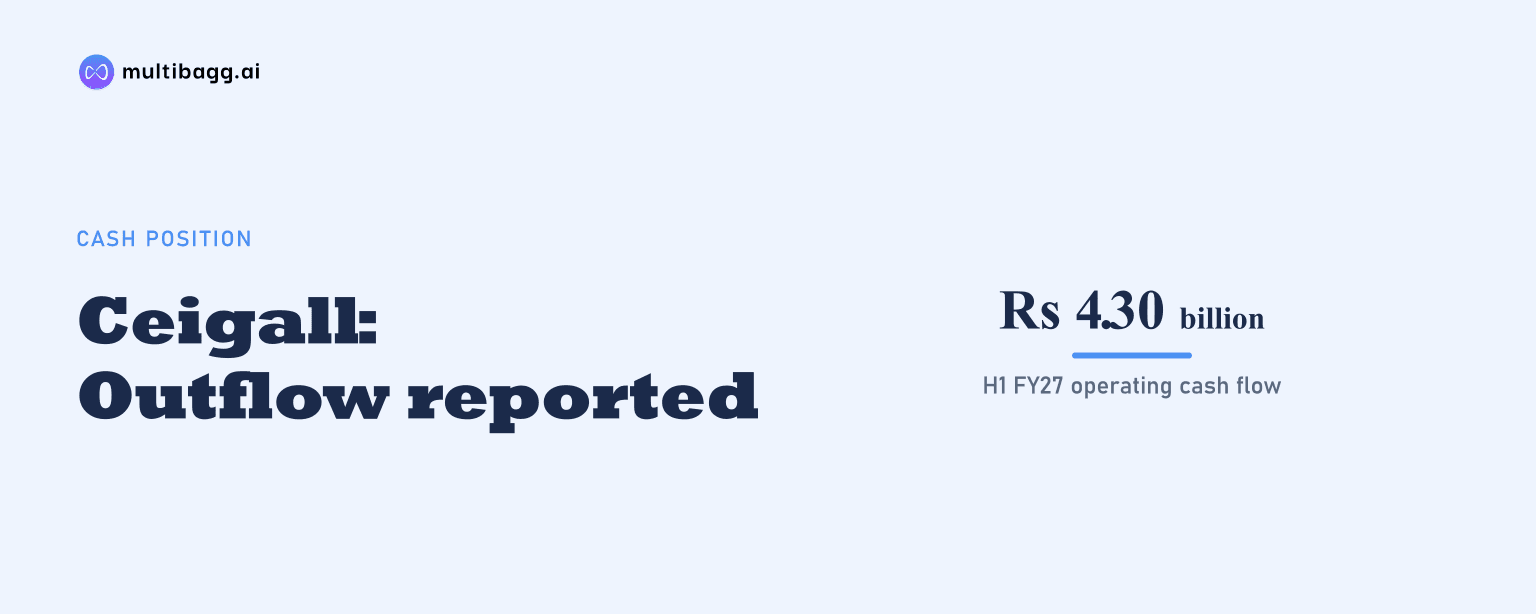
Ceigall India Limited recorded negative consolidated operating cash flow of Rs 4.302 billion in H1 FY27, as a Rs 7.015 billion working-capital outflow exceeded Rs 3.188 billion of operating profit before working-capital changes. Ceigall nevertheless reported 21.1% year-on-year revenue growth and a 45.1% increase in profit after tax during the half year.
Know Ceigall India inside out
Results, valuation, peers and who's buying, in one view.
Why did Ceigall report negative operating cash flow in H1 FY27?
Ceigall reported negative operating cash flow because its Rs 7.015 billion use of working capital was larger than its Rs 3.188 billion operating profit before working-capital changes in H1 FY27. The movement reduced cash generated from operations to negative Rs 3.827 billion, compared with positive Rs 326 crore in FY26.
After direct taxes paid of Rs 475 crore, net cash from operating activities was negative Rs 4.302 billion in H1 FY27. The half-year outflow followed negative operating cash flow of Rs 913 crore in FY26 and negative Rs 5.196 billion in FY25, although both comparison periods are full financial years.
Financing activities generated Rs 3.547 billion of cash in H1 FY27, while investing activities used Rs 43 crore. As a result, consolidated cash and cash equivalents declined by Rs 798 crore from the Rs 2.802 billion opening balance on 1 April to Rs 2.004 billion at the reported period end.
Which balance-sheet items increased during H1 FY27?
Ceigall’s consolidated contract assets and service-concession receivables increased during H1 FY27. Contract assets rose by Rs 1.883 billion from Rs 14.132 billion at FY26 to Rs 16.015 billion, while non-current receivables under service concession arrangements rose by Rs 4.717 billion to Rs 19.017 billion.
Those two asset categories increased by a combined Rs 6.60 billion over the six months, alongside the Rs 7.015 billion working-capital cash outflow. Trade receivables increased by Rs 156 crore to Rs 6.513 billion, inventories rose by Rs 243 crore to Rs 1.235 billion, and other current assets increased by Rs 624 crore to Rs 4.848 billion.
Ceigall’s historical consolidated working-capital data show that work-in-progress, or WIP, days increased from 37 in FY24 to 60 in FY25 and 98 in FY26. Debtor days rose from 45 in FY24 to 64 in FY25 and remained at 64 in FY26, while inventory days declined from 17 to 11 over the same period.
Net working-capital days fell to 49 in FY26 from 67 in FY25 but remained above 45 in FY24. Creditor days increased from 55 in FY24 to 72 in FY25 and 124 in FY26; the presentation does not provide an H1 FY27 working-capital-days calculation.
Got a follow-up? Ask IRIS
How much debt did Ceigall have at September 2026?
Ceigall reported consolidated total debt of Rs 17.303 billion at 30 September 2026, up from Rs 15.723 billion at March 2026. The cash balance used in the debt-positioning disclosure, labelled cash and cash equipment, declined from Rs 4.342 billion to Rs 3.518 billion, taking net debt to Rs 13.518 billion from Rs 11.381 billion.
The increase in net debt was Rs 2.137 billion over six months, and consolidated net debt to equity rose to 0.6 times in H1 FY27 from 0.4 times in FY26. Ceigall’s total equity increased from Rs 21.464 billion at FY26 to Rs 22.938 billion in H1 FY27, while total assets rose to Rs 58.569 billion from Rs 55.234 billion.
Working-capital loans increased by Rs 1.026 billion to Rs 3.456 billion at September 2026. Among hybrid annuity model, or HAM, project loans, Ayodhya Bypass borrowings rose by Rs 649 crore to Rs 2.145 billion and Northern Ayodhya Bypass borrowings rose by Rs 609 crore to Rs 1.856 billion.
The debt schedule also records Rs 1.197 billion of borrowing for Indore Ujjain, Rs 800 crore for Velgaon and Rs 473 crore for Southern Ludhiana Bypass at September 2026. Reported physical progress was 48.5% for Ayodhya Bypass, 43.5% for Northern Ayodhya Bypass, 46.5% for Ludhiana Bathinda Greenfield, 19.8% for Velgaon and 13% for Indore Ujjain.
Did Ceigall’s earnings grow despite the cash outflow?
Ceigall’s reported earnings grew despite the operating cash outflow, with consolidated revenue from operations rising 21.1% year on year to Rs 19.921 billion in H1 FY27. Profit after tax increased 45.1% to Rs 1.560 billion, while earnings before interest, tax, depreciation and amortisation, or EBITDA, increased 42.5% to Rs 3.174 billion.
EBITDA margin rose to 15.9% in H1 FY27 from 13.5% in H1 FY26, an increase of 239 basis points. Gross profit increased 36.3% to Rs 4.083 billion and gross-profit margin rose to 20.5% from 18.2%, while finance cost increased from Rs 793 crore to Rs 867 crore.
The half-year margin improvement differs from the annual trend through FY26. Consolidated EBITDA margin declined from 17.1% in FY24 to 15.1% in FY25 and 14.6% in FY26, while profit-after-tax margin declined from 10.0% to 8.3% and then 7.7% across those three years.
Ceigall’s order book stood at Rs 226.811 billion on 30 September 2026, with roads accounting for 55%, transmission and distribution for 21%, and renewables for 16%. By revenue model, HAM and tariff-based projects each represented 37% of the order book, while engineering, procurement and construction, or EPC, projects accounted for 25%.
Conclusion
Ceigall’s H1 FY27 disclosures show that earnings growth and cash generation diverged during the half year. Revenue rose by Rs 3.474 billion year on year and profit after tax rose by Rs 485 crore, but a Rs 7.015 billion working-capital outflow resulted in negative Rs 4.302 billion of operating cash flow and lifted net debt by Rs 2.137 billion from March 2026.
The presentation does not disclose an operating-cash-flow target or a scheduled financing event. The next disclosures to watch are changes in contract assets, service-concession receivables and project borrowing as execution progresses on the three HAM projects with appointed dates, which together aggregate about Rs 40.50 billion, and on the 147-megawatt MSKVY 2.0 solar project, of which 10 megawatts had been commissioned.