










Ceigall transmission award carries ₹608.7 crore annual charges
Key highlights
- Ceigall disclosed ₹608.7 crore of annual transmission charges for the Jam Khambhaliya–Jamnagar project.
- The project combines a 36-month execution period with a 35-year operating period.
- Ceigall’s tariff-based order-book schedule lists ₹4,500 crore of project cost and 0.00% completion as of September 30, 2026.
- Ceigall’s order book rose to ₹22,681.1 crore in H1 FY27 from ₹18,554.3 crore in FY26.
powered by IRIS
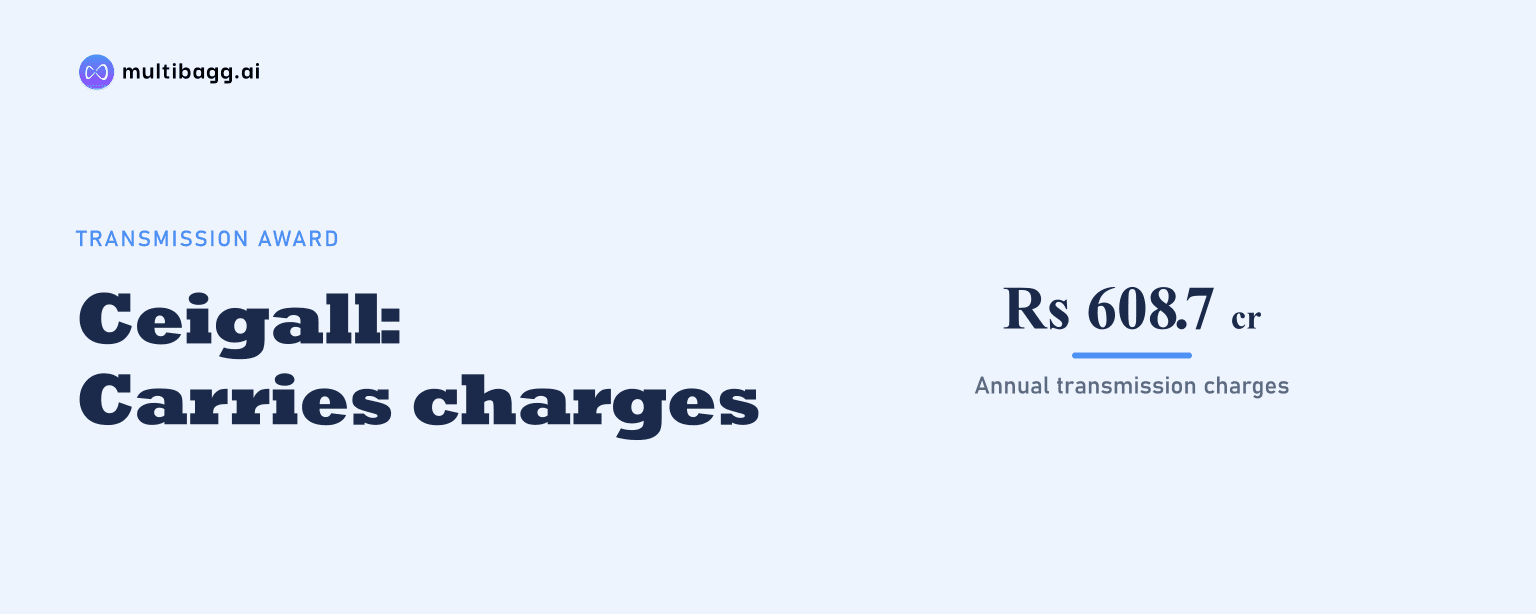
Ceigall India Limited has received a letter of intent for the ₹4,500 crore Jam Khambhaliya–Jamnagar transmission project, with disclosed annual transmission charges of ₹608.7 crore, a 36-month execution period and a 35-year operating period. The award is Ceigall’s stated entry into large-scale transmission infrastructure.
Know Ceigall India inside out
Results, valuation, peers and who's buying, in one view.
What has Ceigall won in the Jam Khambhaliya–Jamnagar project?
Ceigall has received a letter of intent, or LOI, from RECPDCL to develop a common transmission system for power evacuation from Lakadia Phase II, Jam Khambhaliya Phase II and Jamnagar Phase I. The presentation identifies Gujarat and Maharashtra as the project geography and says the system supports power evacuation from key renewable-energy zones in Gujarat.
The order-book schedule lists the Jam Khambhaliya–Jamnagar Transmission Project at a total project cost of ₹4,500 crore and zero completion as of September 30, 2026. The landmark-project page separately states a total project cost of ₹5,700 crore including Goods and Services Tax, or GST. The presentation does not explain the difference beyond explicitly identifying GST in the higher figure.
The stated physical scope comprises about 300 kilometres of lines and a 765/400 kilovolt, or kV, air-insulated substation, or AIS. The project is listed under the tariff-based model, while Ceigall’s order-book authority column identifies CTU and the landmark-project page identifies RECPDCL.
How long will Ceigall operate the transmission asset?
Ceigall states that the project has 36 months of execution followed by a 35-year operational period. The disclosed structure therefore combines construction of the transmission system with a long-duration operating phase, rather than describing an engineering, procurement and construction, or EPC, assignment alone.
Ceigall identifies annual transmission charges of ₹608.7 crore as the mechanism for long-term revenue visibility. The presentation does not disclose when charges begin, their escalation terms, project-level profit, financing arrangements or conditions for commissioning, so those details cannot be derived from the annual-charge figure.
The company describes the award as its strategic entry into large-scale transmission infrastructure. In its project-model overview, Ceigall lists regulatory approvals, revenue predictability and cost recovery as tariff-based capabilities, but it does not offer a project-specific cash-flow forecast for the Jam Khambhaliya–Jamnagar asset.
How does the award affect Ceigall’s order-book mix?
Ceigall’s ₹4,500 crore project represented about 19.8% of its ₹22,681.1 crore total order book in H1 FY27, based on the presentation’s figures. It was the largest individual tariff-based project in the September 30, 2026 schedule, ahead of the ₹1,487.5 crore Morena solar project with battery energy storage systems.
The total order book rose from ₹18,554.3 crore in FY26 to ₹22,681.1 crore in H1 FY27, while order inflow was ₹5,204.7 crore in H1 FY27 after ₹11,332 crore in FY26. The Jam Khambhaliya–Jamnagar project is included in the ₹8,666.4 crore balance order book for design-build-finance-operate-transfer, or DBFOT, and tariff-based projects.
Ceigall’s order-book mix has also shifted beyond roads. Roads represented 85% of order book in FY24 and other sectors 15%, whereas roads represented 69% and other sectors 31% in FY26. The transmission project is classified as tariff based, adding to the non-road portion of the portfolio.
Got a follow-up? Ask IRIS
How large is Ceigall’s transmission and renewables portfolio?
Ceigall reports a cumulative value of ₹4,906.8 crore for transmission and distribution projects, including the ₹4,500 crore Jam Khambhaliya–Jamnagar project and the 400/220 kV Velgaon gas-insulated substation, or GIS. The presentation describes this business as operating under tariff-based competitive bidding, or TBCB.
Renewables are separately reported at a cumulative value of ₹3,684 crore. The disclosed portfolio includes a power-purchase agreement, or PPA, for 337 megawatts, or MW, of solar supply to Maharashtra State Electricity Distribution Company Limited, a 130 MW solar photovoltaic project under the Surya Mitra Krishi Feeders Scheme, and 150 MW of standalone battery energy storage systems, or BESS, in Punjab valued at ₹375 crore.
Ceigall lists two ongoing transmission and distribution projects, six renewable-energy projects and two wind-turbine projects. These counts remain below the 22 ongoing roads, highways and flyovers projects, 18 EPC projects and 10 Hybrid Annuity Mode, or HAM, projects, although the Jam Khambhaliya–Jamnagar award is the largest individual tariff-based project disclosed.
What must Ceigall deliver before operations begin?
Ceigall must execute the approximately 300-kilometre transmission-line system and the 765/400 kV AIS substation during the stated 36-month execution period before the disclosed 35-year operational phase. The order-book schedule records 0.00% completion for the project as of September 30, 2026.
The presentation does not state project milestones, package-level deadlines, capital-expenditure timing, debt sanctions or equity commitments for this asset. It also does not reconcile the RECPDCL and CTU labels used in separate project disclosures, leaving those documentation details unresolved in the supplied material.
Ceigall says it is pursuing broader activity in transmission and distribution, renewables, build-operate-transfer projects and standalone operations and maintenance opportunities. Separately, it has initiated a programme to monetise completed and near-complete HAM assets, but it does not state that proceeds from those divestments will finance this transmission project.
Conclusion
Ceigall’s transmission award adds a ₹4,500 crore tariff-based project with a stated 36-month delivery phase, ₹608.7 crore of annual transmission charges and a 35-year operating period. It is the largest individual tariff-based entry in the September 30, 2026 order-book schedule and extends the company’s shift from an 85% road order-book share in FY24 to 69% in FY26.
The next disclosed matters to watch are progress from the 0.00% completion recorded on September 30, 2026, delivery against the 36-month plan, and any subsequent disclosure of commissioning and financing terms. Ceigall’s stated plan to monetise mature HAM assets as they reach commercial operation date, or COD, is also relevant to how it recycles capital for ongoing and upcoming projects.