










Ceigall Q2 EBITDA margin rises 293 basis points as profit grows
Key highlights
- Ceigall’s Q2 FY27 consolidated EBITDA margin rose 293 basis points to 17.02%.
- Q2 FY27 consolidated revenue grew 26.8% to Rs 1,022.5 crore, while EBITDA grew 53.2% to Rs 174 crore.
- Q2 FY27 consolidated PAT increased 64.1% to Rs 92.2 crore and PAT margin reached 9.02%.
- Ceigall’s order book stood at Rs 22,681.1 crore as of September 30, 2026.
powered by IRIS
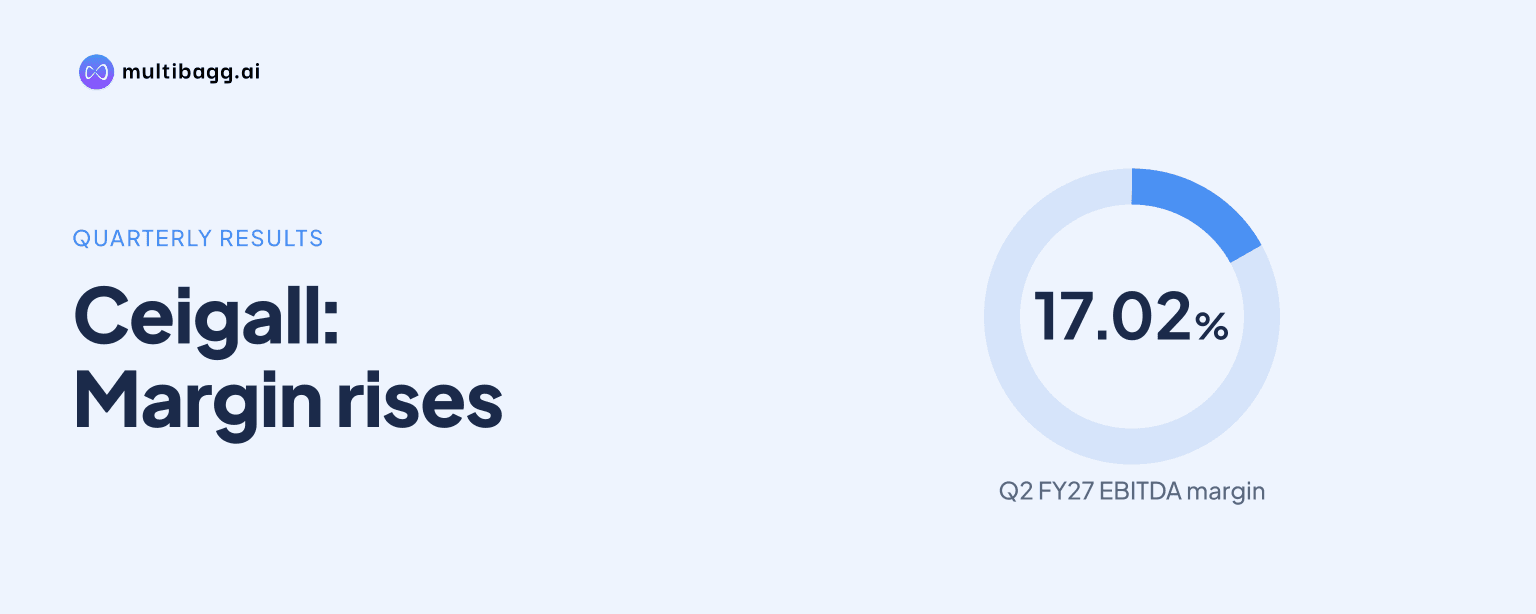
Ceigall India Limited reported a 293-basis-point rise in consolidated EBITDA margin to 17.02% in Q2 FY27, as EBITDA increased 53.2% to Rs 174 crore while revenue grew 26.8% to Rs 1,022.5 crore. Profit after tax rose 64.1% to Rs 92.2 crore, exceeding both revenue and EBITDA growth.
Know Ceigall India inside out
Results, valuation, peers and who's buying, in one view.
How did Ceigall’s Q2 FY27 margin change?
Ceigall’s consolidated EBITDA margin increased to 17.02% in Q2 FY27 from 14.09% in Q2 FY26, a gain of 293 basis points. EBITDA means earnings before interest, tax, depreciation and amortisation, and the reported margin change accompanied a Rs 60.4 crore year-on-year increase in EBITDA, from Rs 113.6 crore to Rs 174 crore.
Revenue from operations rose by Rs 215.9 crore to Rs 1,022.5 crore in Q2 FY27 from Rs 806.6 crore a year earlier. EBITDA therefore grew 53.2%, compared with revenue growth of 26.8%, meaning reported operating profit grew faster than revenue during the quarter.
Ceigall’s profit after tax, or PAT, margin also widened to 9.02% from 6.96%, an increase of 206 basis points. PAT rose by Rs 36 crore from Rs 56.2 crore in Q2 FY26 to Rs 92.2 crore in Q2 FY27, while its 64.1% growth rate was above the 53.2% increase in EBITDA.
What does the gap between revenue and profit growth show?
The gap shows that Ceigall recorded faster growth in reported operating profit and net profit than in revenue in Q2 FY27. Revenue added Rs 215.9 crore year on year, while EBITDA added Rs 60.4 crore and PAT added Rs 36 crore; EBITDA margin expanded by 293 basis points and PAT margin by 206 basis points.
Management attributed the quarter’s performance to sustained execution across its core infrastructure business, operational efficiency, strategic diversification and disciplined capital allocation. These are management’s stated explanations, while the release does not provide a cost-line breakdown showing how much each factor contributed to the margin movement.
The consolidated result differed from the standalone presentation. Standalone revenue increased 23.8% to Rs 974.5 crore in Q2 FY27, EBITDA rose 42.2% to Rs 130.5 crore, and EBITDA margin improved 173 basis points to 13.39%; consolidated EBITDA margin was 3.63 percentage points above the standalone figure.
Standalone PAT rose 46.7% to Rs 82 crore and standalone PAT margin increased 131 basis points to 8.41%. The results were unaudited for the quarter ended September 30, 2026, and the release does not explain the individual consolidation adjustments behind the difference between consolidated PAT of Rs 92.2 crore and standalone PAT of Rs 82 crore.
Got a follow-up? Ask IRIS
Did Ceigall maintain the margin improvement in H1 FY27?
Ceigall maintained a higher consolidated EBITDA margin in H1 FY27, reporting 15.93% against 13.54% in H1 FY26, a 239-basis-point increase. First-half EBITDA rose 42.5% to Rs 317.4 crore from Rs 222.7 crore, while revenue increased 21.1% to Rs 1,992.1 crore from Rs 1,644.7 crore.
The first-half comparison followed the Q2 direction, although Q2 EBITDA margin of 17.02% was 1.09 percentage points above the H1 FY27 margin of 15.93%. Q2 revenue of Rs 1,022.5 crore was slightly more than half of the Rs 1,992.1 crore reported for H1 FY27, and the release does not provide quarterly Q1 figures for a direct margin calculation.
H1 FY27 PAT rose by Rs 48.4 crore to Rs 155.9 crore, producing a PAT margin of 7.83%, compared with 6.54% in H1 FY26. That 129-basis-point expansion was smaller than the 206-basis-point increase in Q2; standalone H1 EBITDA margin was 13.41%, up 187 basis points.
What project activity and order book support Ceigall’s execution plan?
Ceigall reported an order book of Rs 22,681.1 crore as of September 30, 2026, after order inflow of Rs 5,204.7 crore during the period. Roads represented Rs 12,473 crore, or 55% of the order book, while industrial infrastructure represented Rs 4,826.2 crore, or 21%, and renewables represented Rs 3,697.3 crore, or 16%.
Management said Ceigall received appointed dates for three Hybrid Annuity Model, or HAM, projects aggregating about Rs 4,050 crore. It also reported a letter of intent from RECPDCL for the Lakadia-Jam Khambhaliya-Jamnagar transmission project in Gujarat, valued at Rs 5,700 crore including tax, with a 36-month execution period and a 35-year operational period.
In renewables, Ceigall commissioned 10 megawatts of capacity under its 147-megawatt MSKVY 2.0 solar project in Maharashtra ahead of schedule. Other reported developments included the August 2026 provisional commercial operation date for the Jabalhe-Shahabad HAM project and a Rs 225 crore, including goods and services tax, letter of acceptance for the Bulk Drug Park at Una, Himachal Pradesh.
Management said it is pursuing HAM asset monetisation to unlock capital from mature assets and support future growth opportunities. Subsequent to Q2, Ceigall received a completion certificate for the 16.85-kilometre Delhi-Saharanpur Highway project, while the release does not state a monetisation timetable, transaction value or the specific HAM assets involved.
Conclusion
Ceigall’s Q2 FY27 figures show reported profitability improving alongside revenue growth: revenue rose 26.8%, EBITDA rose 53.2%, PAT rose 64.1%, and EBITDA margin reached 17.02%. The H1 FY27 comparison showed the same pattern, with EBITDA growth of 42.5% against revenue growth of 21.1% and a 239-basis-point year-on-year margin increase.
What to watch next is execution of the Rs 22,681.1 crore order book, including three HAM projects worth about Rs 4,050 crore and the Rs 5,700 crore transmission project with a 36-month execution period. Management identified renewable energy, power transmission and disciplined capital allocation as priorities, while the timing and proceeds of its HAM asset monetisation strategy remain undisclosed.