










Ceinsys targets Rs 10,000-11,000 crore transport market
Key highlights
- Ceinsys estimates visible ITMS and ATMS transport opportunities at Rs 10,000-11,000 crore.
- About Rs 4,500 crore of the opportunity relates to NHAI-linked corridor work that management said remains in the pipeline.
- More than 16 EPC corridor opportunities are being pursued, with each valued at Rs 800-1,000 crore.
- Ceinsys said three to four consortiums currently compete for transport projects.
powered by IRIS
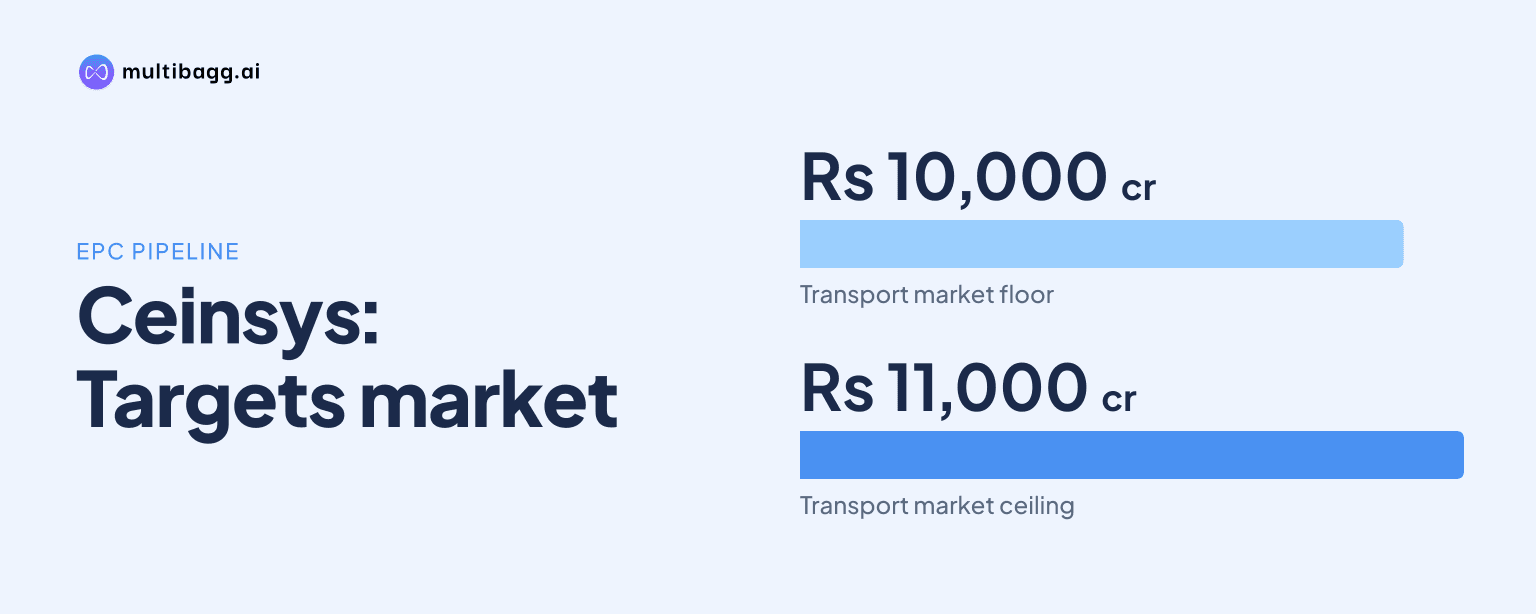
Ceinsys Tech Limited said visible transport-domain opportunities in integrated traffic management systems and advanced traffic management systems total Rs 10,000-11,000 crore, including about Rs 4,500 crore of National Highways Authority of India-linked corridor work. Management said Ceinsys is bidding through consortiums in a market with three to four active groups.
Know Ceinsys Tech inside out
Results, valuation, peers and who's buying, in one view.
What is Ceinsys's transport-technology opportunity size?
Ceinsys puts the currently visible opportunity in the transport domain at Rs 10,000-11,000 crore. Management said the estimate covers integrated traffic management systems, or ITMS, and advanced traffic management systems, or ATMS, alongside corridor-related opportunities in which the company has developed capabilities.
The figure is a market-opportunity estimate rather than Ceinsys's order book, awarded contracts or revenue guidance. Management said it was tracking a substantial funnel but could not quantify it, while expecting several opportunities to close at the end of the fourth quarter or in the first or second quarter thereafter.
The two routes differ in their procurement structure. The first consists of NHAI or subsidiary tenders for specific corridors, while the second involves EPC corridor projects where Ceinsys can participate through a PPP model. Management did not disclose how much of either route the company expects to win or when work could begin.
How much of the opportunity comes from NHAI-linked tenders?
Ceinsys said about Rs 4,500 crore of the identified opportunity relates to ITMS and ATMS corridors being considered by NHAI or its subsidiaries. Management said requests for proposals, or RFPs, for these specific corridors had started being invited from February, while also describing the opportunities as still in the pipeline and saying the relevant RFPs had not been published.
That qualification means the Rs 4,500 crore component remains prospective. The call did not provide a corridor count, contract values for individual tenders, execution dates or a target share for Ceinsys. It also did not establish that the full Rs 4,500 crore will reach the bidding or award stage on a defined schedule.
Management separately discussed three opportunities where Ceinsys was already L1, meaning its bid had ranked first in the relevant process, but final awards were still pending. It said two of the three were being pursued for conclusion in December after a change in secretary-level leadership at the relevant authority.
The possible December awards should not be treated as confirmed transport wins or as an allocation from the Rs 4,500 crore pool. Management said it hoped one or two of the three L1 opportunities would be awarded, but did not provide their values, their sector classification or their potential revenue contribution.
How does Ceinsys compete for ITMS and ATMS projects?
Ceinsys said it participates as a system integrator alongside software and hardware vendors. Management said no bidder has every required capability internally, so transport tender participants operate as teams combining system integration, software and hardware functions.
The company said there are currently three to four players or consortiums competing in the market. Ceinsys has tied up with software and hardware vendors and has already bid for opportunities under this model, according to management, placing its role at the integration layer rather than as a standalone provider of all components.
Management described some prospective orders as areas where Ceinsys has a technology edge, but did not quantify that advantage against the other three to four groups. It did not name competing consortiums, identify its partners, disclose tender pricing or state a market-share target for the Rs 10,000-11,000 crore opportunity.
This transport model is different from the land-survey activity discussed on the call. Management said Ceinsys does not undertake actual land surveys as its primary work and may outsource lower-end survey or data-gathering tasks when they form part of a project; in transport, its stated position is system integration with specialist vendors.
Got a follow-up? Ask IRIS
What will determine whether Ceinsys converts the opportunity into revenue?
Tender publication, final awards and project closure will determine conversion, not the stated Rs 10,000-11,000 crore market estimate. Management said it expected some orders to close in December and saw a larger group of opportunities closing around the fourth-quarter end or in the following first or second quarter, without giving associated revenue or margin guidance.
Ceinsys is also seeking to reduce dependence on the conventional order book through recurring business. Management said run-rate business accounted for almost 27% of total turnover in the reported quarter, up as a share of activity because regular orders are not included in the order book; it did not identify how much of this run-rate business came from transport.
Working-capital collections are another disclosed consideration for cash availability, though they are not transport awards. Management targeted a working-capital cycle of 125-145 days by FY27-end and said debtor days, including unbilled revenue, could be 125-130 days once expected funds are received.
Management agreed with an analyst's estimate that total trade receivables could move to around Rs 250 crore. It also said more than Rs 250 crore of Maharashtra-related unbilled revenue was expected to be realised by 31 March, while it had received about Rs 11 crore from Uttar Pradesh in October and November and expected a further Rs 14 crore within that month.
Why is the opportunity not an order-book forecast?
The opportunity estimate aggregates projects at different stages, from pipeline tenders to more than 16 EPC corridor opportunities, rather than contracts signed by Ceinsys. Management said each EPC opportunity was valued at Rs 800-1,000 crore, but did not state the company's bid participation, consortium role or expected contract value in each case.
The company also said two previously evaluated acquisition opportunities were dropped after due diligence found matters that were unsatisfactory. It continues to evaluate two opportunities with a targeted ticket size of about $20 million plus or minus, including transport-related and ITMS-related acquisition possibilities, but management said it did not expect a closing within the financial year.
Management said available funds were held in fixed deposits earning more than 7.5% while it evaluated suitable deployment opportunities. This capital-allocation discussion does not change the tender pipeline, but it shows that Ceinsys has identified transport-related capability acquisition as one potential use of funds alongside organic bidding.
Conclusion
Ceinsys has identified Rs 10,000-11,000 crore of visible transport opportunity across ITMS, ATMS and EPC-linked corridor projects, but none of that aggregate is presented as secured revenue. The Rs 4,500 crore NHAI-linked component remains in the pipeline, while Ceinsys's route to contracts relies on system-integration consortiums in a field management described as having three to four active groups.
The next marker is management's expectation that one or two of three pending L1 opportunities could receive awards in December after the leadership change at the relevant authority. Readers should also watch for publication of the NHAI-linked RFPs and for whether management's FY27-end target of a 125-145-day working-capital cycle is supported by the expected 31 March unbilled-revenue collections.