










Ceinsys sees most Rs 446 crore unbilled revenue clear by March
Key highlights
- Ceinsys expects the majority of its Rs 446 crore unbilled revenue to clear by 31 March.
- More than Rs 250 crore of Ceinsys's unbilled revenue is linked to Maharashtra state-government projects.
- Ceinsys received Rs 11 crore from Uttar Pradesh in October and November and expected Rs 14 crore more within November.
- Ceinsys targets debtor days of 125 days to 130 days after expected collections, including unbilled revenue and billed debtors.
powered by IRIS
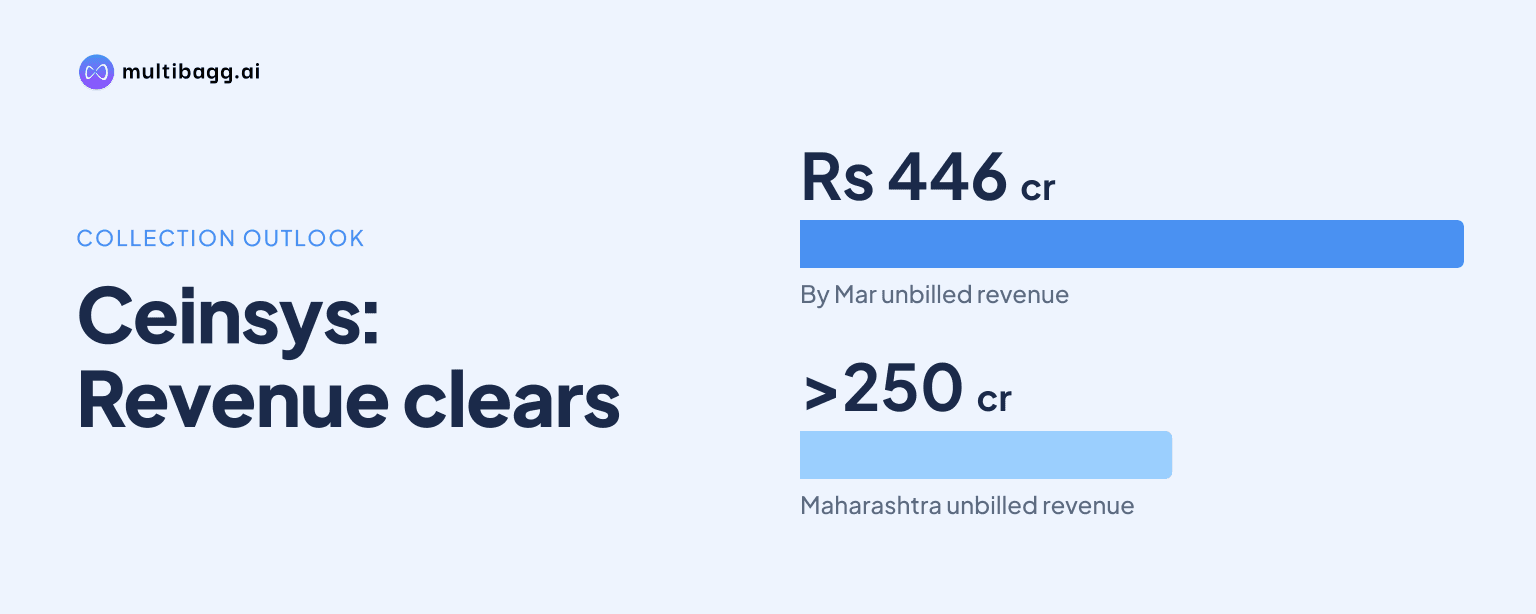
Ceinsys expects the majority of its Rs 446 crore unbilled-revenue balance to be billed and realised by 31 March in the current financial year, including more than Rs 250 crore from Maharashtra projects. Management said the underlying work is certified and undisputed, while payments have begun on its Uttar Pradesh exposure.
Know Ceinsys Tech inside out
Results, valuation, peers and who's buying, in one view.
Why has Ceinsys unbilled revenue increased?
Ceinsys's unbilled revenue increased as project work continued before billing milestones and government funding releases were delayed. An analyst cited a balance of Rs 67 crore in FY24, Rs 134 crore in FY25, Rs 319 crore in FY26 and Rs 422 crore in H1 FY27, while also noting limited operating cash flow over the preceding three years.
The figures cited on the call show a Rs 252 crore increase between FY24 and FY26, followed by a further Rs 103 crore increase to the H1 FY27 figure cited by the analyst. Management later referred to Rs 446 crore of unbilled revenue, a Rs 24 crore difference from the H1 FY27 figure. The transcript does not reconcile the two balances or identify their respective reporting dates.
Ceinsys said unbilled revenue is a moving balance rather than an amount that can only fall. Work completed on an ongoing project is added until a billing milestone is met, after which it is invoiced; new work can therefore add to the balance while earlier certified work is billed or collected. This mechanism links the balance to both execution progress and funding timing.
How much of Ceinsys's unbilled revenue is tied to Maharashtra?
More than Rs 250 crore of Ceinsys's Rs 446 crore unbilled-revenue balance is expected to be realised from Maharashtra state-government projects. Management said the exposure was mainly related to projects it identified on the call as JJM work, including Internet of Things, or IoT, and AEC projects.
Management said Maharashtra had issued a government order covering the projects and expected a December cabinet session in Nagpur to clear it and issue funding-release instructions. The order referred to more than Rs 500 crore of funding held up for IoT, AEC and JJM projects. That Rs 500 crore amount covered the broader projects and was not presented as Ceinsys's receivable alone.
For one IoT project, management said about Rs 150 crore of funding was expected to be released in the financial year. It said the associated billing and the unbilled revenue were already approved, rather than awaiting approval of fresh scope. The company therefore described the dependency as release of approved government funds, not agreement on completed work.
Got a follow-up? Ask IRIS
Is Ceinsys's Rs 446 crore unbilled revenue disputed?
No, Ceinsys said none of the unbilled revenue discussed in the call was subject to dispute or arbitration. Management said the statement of work, or SOW, had been approved for the pending IoT project and other projects, and that completed work was certified rather than recorded solely from the company's own calculation.
Certification does not determine the date of collection, but management described funding release as the obstacle rather than a customer challenge to the work. It reiterated that the majority of the Rs 446 crore balance should be cleared, billed and realised by 31 March. The recovery expectation is consequently dependent on the Maharashtra funding process proceeding as management described.
Outside Maharashtra, Ceinsys identified Uttar Pradesh as the main location of its unbilled-revenue exposure. Management said the Uttar Pradesh government had begun payments in October and November, with Rs 11 crore received and another Rs 14 crore expected within November under an approved SOW. It said this funding flow should prevent further unbilled-revenue build-up on the Uttar Pradesh project.
What working-capital outcome is Ceinsys targeting by year-end?
Ceinsys is targeting a 125-day to 145-day working-capital cycle by the end of FY27, with debtor days expected in a 125-day to 130-day range once anticipated funds are realised. Management said its measure combines unbilled revenue and billed debtors, instead of calculating the two categories separately.
Management said the previous year's turnover base was Rs 660 crore and the working-capital cycle on that base was 125 days. At 30 September, it said the cycle was higher because funds had not been realised. An analyst suggested total trade receivables could decline to about Rs 250 crore, and management agreed that this was the approximate range.
The plan requires two separate steps: certified work must reach billable milestones, and released government funds must translate into payment. Management did not provide a quarterly cash-flow forecast or quantify how much of the expected reduction by 31 March would arise from invoicing rather than collections. It also said run-rate business accounted for almost 27% of turnover in the quarter discussed, which can support delivery while creating new unbilled amounts before milestones are invoiced.
Conclusion
Ceinsys has framed the Rs 446 crore unbilled-revenue balance as a working-capital and funding-timing matter, supported by approved SOWs and work certificates rather than disputed claims. The recovery case centres on more than Rs 250 crore tied to Maharashtra, alongside Rs 11 crore already received in Uttar Pradesh during October and November and a further Rs 14 crore expected within November.
The next item to watch is the Maharashtra funding-release process associated with the December cabinet session in Nagpur, followed by evidence of billing and cash receipts before 31 March. Ceinsys also targets a 125-day to 130-day debtor-days range after collections, including both billed debtors and unbilled revenue, with total trade receivables discussed at about Rs 250 crore.