










Cello made 77% of FY26 revenue through in-house production
Key highlights
- Cello derived 77% of FY26 revenue from in-house manufacturing.
- Cello operates 14 manufacturing facilities with approximately 20,000 tonnes of installed annual capacity.
- Cello reported about 60% utilisation of its installed annual capacity.
- Cello's network includes more than 5,000 distributors and more than 180,000 retailers.
powered by IRIS
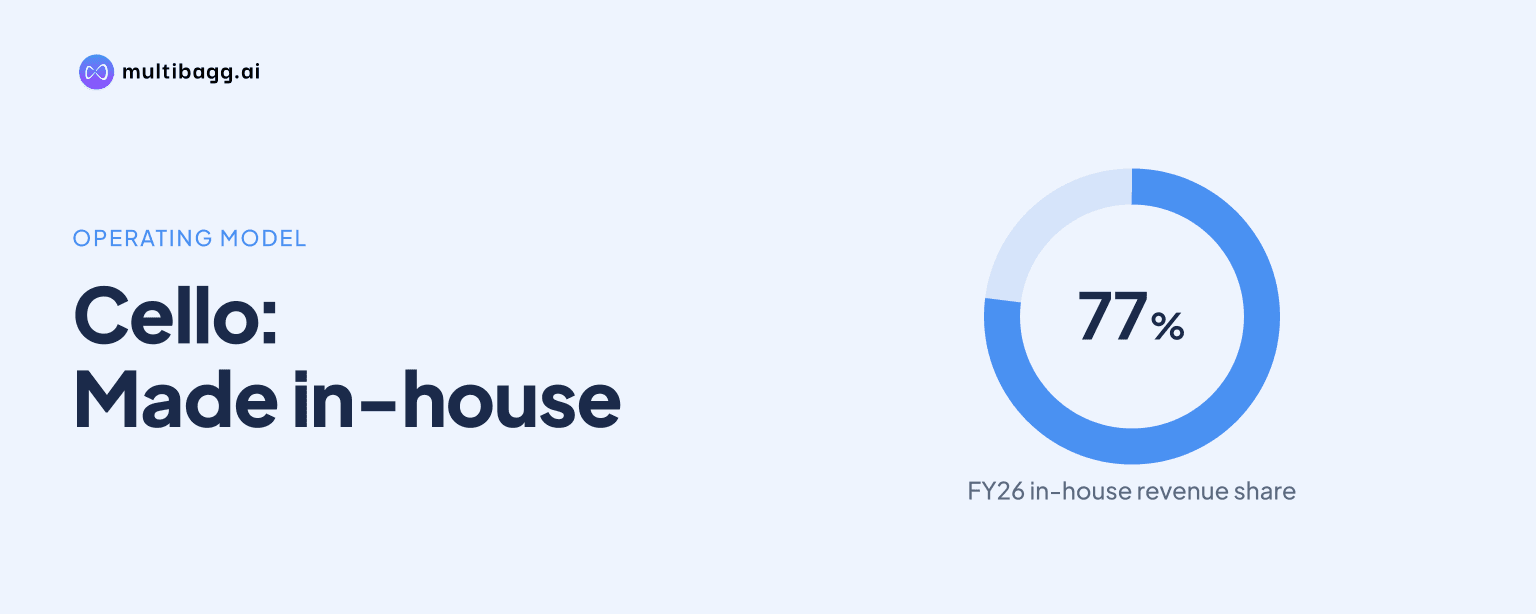
Cello World Limited, referred to here as Cello, derived 77% of FY26 revenue from in-house manufacturing through 14 facilities, with approximately 20,000 tonnes of installed annual capacity operating at about 60% utilisation. Its nationwide sales network included more than 5,000 distributors and more than 180,000 retailers.
Know Cello World inside out
Results, valuation, peers and who's buying, in one view.
How much of Cello's FY26 revenue came from in-house manufacturing?
Cello derived 77% of FY26 revenue from in-house manufacturing. The company reported this as a consolidated measure for its manufacturing footprint and did not disclose separate in-house production shares for Consumer Ware, Writing Instruments, or Moulded Furniture.
Cello reported approximately 20,000 tonnes of installed annual manufacturing capacity and current utilisation of about 60%. The presentation says this capacity is approximate and can vary with changes in product mix, so the disclosed utilisation rate does not identify output by factory or category.
Consumer Ware was Cello's largest reported revenue segment at 69%, compared with 16% for Writing Instruments and 15% for Moulded Furniture. Consumer Ware therefore exceeded Writing Instruments by 53 percentage points and Moulded Furniture by 54 percentage points.
Where are Cello's 14 manufacturing facilities located?
Cello's 14 manufacturing facilities are located in Daman, Haridwar, Baddi, Falna, Kolkata and Chennai. Daman has eight facilities, Haridwar has two, and Baddi, Falna, Kolkata and Chennai have one each.
Daman Units I and II manufacture plastic moulded furniture and other articles, while Daman Unit III manufactures plastic extrusion sheet. Daman Units IV and V make household and insulated ware, Unit VI makes opalware and glassware, and Units VII and VIII make stationery and allied products.
Outside Daman, Haridwar Unit I makes plastic moulded furniture and other articles, while Haridwar Unit II makes houseware, insulatedware, melamine and allied products. Baddi Unit I makes plastic extrusion sheet; Chennai Unit I makes plastic moulded furniture, other articles and tooling; Kolkata Unit I makes plastic moulded furniture and other articles; and the Rajasthan unit is a glassware and steel facility.
Cello states that it is the only domestic consumer-products company with presence across all material types to have an in-house glassware manufacturing unit in India. The facility table identifies Daman Unit VI as producing opalware and glassware, while the Rajasthan unit is listed as a glassware and steel facility.
How extensive is Cello's distribution network?
Cello reported more than 5,000 distributors and more than 180,000 retailers in its nationwide sales and distribution network. The presentation says a dedicated sales team supports distributors and trade consumers while responding to changing consumer preferences and fluctuating demand.
Consumer Houseware had more than 900 distributors, more than 55 super-stockists and 86,144 retailers. Writing Instruments had more than 2,500 distributors and 90,000 retailers, while Moulded Furniture and Allied Products had more than 1,300 distributors and 14,891 retailers.
Writing Instruments had the largest disclosed distributor count at more than 2,500, ahead of more than 1,300 for Moulded Furniture and Allied Products and more than 900 for Consumer Houseware. It also had the highest stated retailer count at 90,000, compared with 86,144 for Consumer Houseware and 14,891 for Moulded Furniture and Allied Products.
The category figures explain the scale of Cello's reported network, but the presentation does not state whether distributors or retailers serve multiple categories. It also does not provide distribution-count comparisons with an earlier period, so expansion or contraction in the network cannot be quantified from the disclosed information.
Got a follow-up? Ask IRIS
What products does Cello make across its three segments?
Cello sells Consumer Ware, Writing Instruments and Moulded Furniture, which contributed 69%, 16% and 15% of revenue respectively. The company uses the Cello brand for Consumer Ware and Moulded Furniture, while Unomax is listed as the Writing Instruments brand.
Consumer Ware includes cookware, insulated ware, hot-drinks products, dinner sets, lunch packs, kids' tiffin and bottles, copper ware, bowl sets, kitchen appliances, cleaning aids, bakeware, pet bottles, storage, drinkware and gift sets. Household and insulated ware are manufactured at Daman Units IV and V and at Haridwar Unit II.
Writing Instruments includes liquid ball-point pens, gel pens, metal pens, mechanical pencils, markers, highlighters, art supplies, roller pens and fountain pens. The presentation says the Cello brand was added in Q3FY26 to this category, whose manufacturing base includes Daman Units VII and VIII for stationery and allied products.
Moulded Furniture includes lifestyle, premium, horeca, stools, storage and crates collections, along with dustbins and air coolers. The presentation defines this segment as including the plastic moulded furniture and air-cooler market, while facilities in Daman, Haridwar, Chennai and Kolkata manufacture plastic moulded furniture and other articles.
What does Cello's footprint show about its operating model?
Cello's disclosed model combines internal production for 77% of FY26 revenue with a trade network of more than 5,000 distributors and more than 180,000 retailers. The 14-factory base covers consumer houseware, writing instruments, moulded furniture and allied products.
Manufacturing is concentrated in Daman, which accounts for eight of the 14 facilities and covers furniture, extrusion sheet, household and insulated ware, glassware, opalware and stationery. The remaining six facilities are distributed across Haridwar, Baddi, Falna, Kolkata and Chennai, with product assignments that include furniture, extrusion sheet, houseware, glassware, steel and tooling.
The 69%, 16% and 15% segment mix identifies Consumer Ware as Cello's largest commercial category, while the facility list shows manufacturing activity across all three reported segments. The presentation does not disclose factory-level revenue, output, profitability, capital expenditure or capacity utilisation, so the contribution of individual plants cannot be measured.
Conclusion
Cello's presentation describes an operating model in which 14 manufacturing facilities produced 77% of FY26 revenue in-house and a network of more than 5,000 distributors and more than 180,000 retailers carried products to market. Consumer Ware accounted for 69% of revenue, while Writing Instruments and Moulded Furniture accounted for 16% and 15%, respectively.
The next disclosed operating measure to watch is utilisation of the approximately 20,000-tonne annual capacity, which stood at about 60% and may vary with product mix. Investors can also watch for further disclosure on category-level network changes and the effect of adding the Cello brand to Writing Instruments in Q3FY26.