










Cello World Q2 revenue grows 8% as EBITDA and PAT decline
Key highlights
- Cello World’s Q2 FY27 revenue rose 8% year on year to Rs 633.2 crore.
- Cello World’s Q2 FY27 EBITDA fell 4% to Rs 135.0 crore, and EBITDA margin declined to 21.3% from 24.0%.
- Cello World’s Q2 FY27 profit after tax declined 10% to Rs 81.9 crore, with margin at 12.9%.
- Cello World generated Rs 173.4 crore of operating cash flow in H1 FY27, compared with Rs 130.8 crore a year earlier.
powered by IRIS
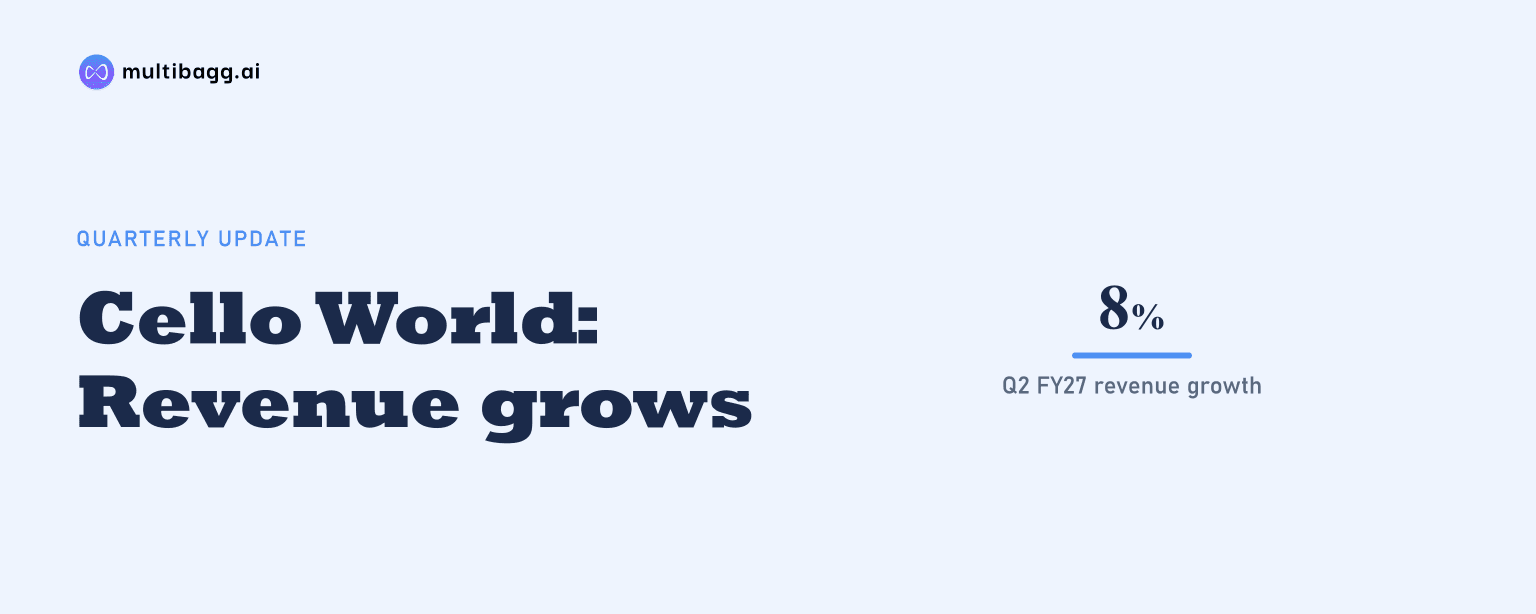
Cello World Limited reported Q2 FY27 revenue of Rs 633.2 crore, up 8% year on year, but earnings before interest, tax, depreciation and amortisation fell 4% to Rs 135.0 crore and profit after tax fell 10% to Rs 81.9 crore. Higher employee, other operating and depreciation costs outweighed a 70-basis-point improvement in gross profit margin.
Know Cello World inside out
Results, valuation, peers and who's buying, in one view.
What happened to Cello World’s Q2 FY27 revenue and profit?
Cello World increased revenue from operations to Rs 633.2 crore in Q2 FY27 from Rs 587.4 crore in Q2 FY26, while gross profit rose 9% to Rs 318.1 crore from Rs 291.1 crore. Gross profit margin increased to 50.2% from 49.5%, reflecting the favourable product mix cited by management. Revenue was also 20.2% above the Rs 527 crore reported in Q1 FY27.
The higher gross profit did not translate into higher operating or net profit. EBITDA fell to Rs 135.0 crore from Rs 141.3 crore, reducing its margin to 21.3% from 24.0%. Profit after tax declined to Rs 81.9 crore from Rs 91.3 crore, while its margin narrowed to 12.9% from 15.5% and earnings per share decreased to Rs 3.63 from Rs 4.05.
Why did Cello World’s Q2 FY27 margins fall?
Cello World’s employee cost rose to Rs 70.9 crore in Q2 FY27 from Rs 61.7 crore a year earlier, while other expenses increased to Rs 125.4 crore from Rs 101.7 crore. These two lines rose by a combined Rs 32.9 crore, exceeding the Rs 27.0 crore increase in gross profit. The gap explains why EBITDA declined despite the 8% increase in revenue.
Management said polymers, fuel, gas and packaging-material costs remained elevated amid the West Asia conflict, while low-priced imports continued to pressure certain categories. Depreciation increased to Rs 24.1 crore from Rs 19.5 crore, and earnings before interest and tax fell 9% to Rs 110.9 crore. Other income was Rs 13.2 crore versus Rs 13.6 crore, while finance cost was unchanged at Rs 0.5 crore.
How did Cello World perform in H1 FY27?
Cello World reported H1 FY27 revenue of Rs 1,159.9 crore, up 4% from Rs 1,116.5 crore in H1 FY26. EBITDA declined 6% to Rs 252.2 crore and profit after tax declined 10% to Rs 155.3 crore. The first-half outcome included Q1 FY27 revenue of Rs 527 crore, compared with Rs 529 crore in Q1 FY26, before Q2 returned to year-on-year revenue growth.
Gross profit for H1 FY27 increased 3% to Rs 594.2 crore, but gross profit margin declined to 51.2% from 51.6%. Employee cost rose to Rs 138.9 crore from Rs 122.2 crore and other expenses reached Rs 233.4 crore from Rs 217.7 crore. EBITDA margin therefore declined to 21.7% from 24.0%, while profit after tax margin fell to 13.4% from 15.4%.
Got a follow-up? Ask IRIS
Which Cello World businesses and channels contributed most in H1 FY27?
Cello World’s Consumerware vertical accounted for 64.8% of H1 FY27 revenue and had a 53.4% gross profit margin. Writing Instruments contributed 21.5% of revenue with a 52.6% gross profit margin. Moulded Furniture and Allied Products represented 13.7% of revenue and reported a 39.0% gross profit margin.
Consumerware’s disclosed margin was 80 basis points above Writing Instruments and 1,440 basis points above Moulded Furniture and Allied Products. General Trade accounted for 70.3% of the H1 FY27 distribution-channel mix, followed by Online at 15.7%, Exports at 8.1% and Modern Trade at 5.9%. Management said Writing Instruments delivered strong growth, led by the Cello brand, but did not provide vertical-level revenue growth figures.
What changed in Cello World’s balance sheet and cash flow?
Cello World’s total assets were Rs 3,164.4 crore at September 2026, compared with Rs 3,003.2 crore at March 2026, while total equity rose to Rs 2,823.0 crore from Rs 2,700.9 crore. Property, plant and equipment increased to Rs 743.8 crore from Rs 698.7 crore, and inventories rose to Rs 614.1 crore from Rs 534.7 crore.
Current borrowings declined to Rs 21.7 crore at September 2026 from Rs 34.6 crore at March 2026, with no non-current borrowings reported at either date. H1 FY27 net cash from operating activities rose to Rs 173.4 crore from Rs 130.8 crore, but investing outflow increased to Rs 227.3 crore from Rs 116.5 crore. Cash and cash equivalents ended H1 FY27 at Rs 24.3 crore, down from Rs 126.4 crore at the start of the period.
Why does festive demand matter for Cello World’s H2 FY27?
Cello World said part of seasonal and institutional gifting demand moved from Q2 to Q3 FY27 because the festive season falls later this year. Management described H2 FY27 as the seasonally stronger half and expects business performance to improve over coming quarters. This is management’s expectation, rather than a reported financial result.
Management also said its in-house Rajasthan steel-bottle facility is progressing toward ramp-up, with production expected to scale steadily through H2 FY27 as the stock-keeping-unit portfolio expands. Its priorities include operating efficiencies, product-portfolio rationalisation, capacity utilisation and working-capital discipline. The presentation states current capacity utilisation is about 60% across 14 owned manufacturing facilities.
Conclusion
Cello World’s Q2 FY27 figures show that revenue growth and improved gross margin were insufficient to offset higher employee, other operating and depreciation costs. The result was a 4% fall in EBITDA and a 10% fall in profit after tax, while H1 FY27 showed the same pattern of revenue growth alongside lower operating and net profitability.
The next result will indicate whether demand shifting into Q3 FY27 supports the H2 improvement management expects. Other disclosed items to watch are the Rajasthan steel-bottle facility’s planned H2 FY27 ramp-up, expansion of its stock-keeping-unit portfolio, and the effect of operational-efficiency and working-capital measures on margins and cash generation.