










Cello revenue rose but FY26 margins and returns declined
Key highlights
- Cello reported FY26 revenue from operations of Rs 2,323.7 crore, up from Rs 1,359.18 crore in FY22.
- FY26 EBITDA was Rs 526.4 crore and EBITDA margin was 22.7%, versus Rs 554.7 crore and 26.0% in FY25.
- Consumer Ware generated Rs 1,606 crore and contributed 69.1% of Cello’s FY26 revenue.
- FY26 return on equity was 12.3%, while return on capital employed was 16.3%.
powered by IRIS
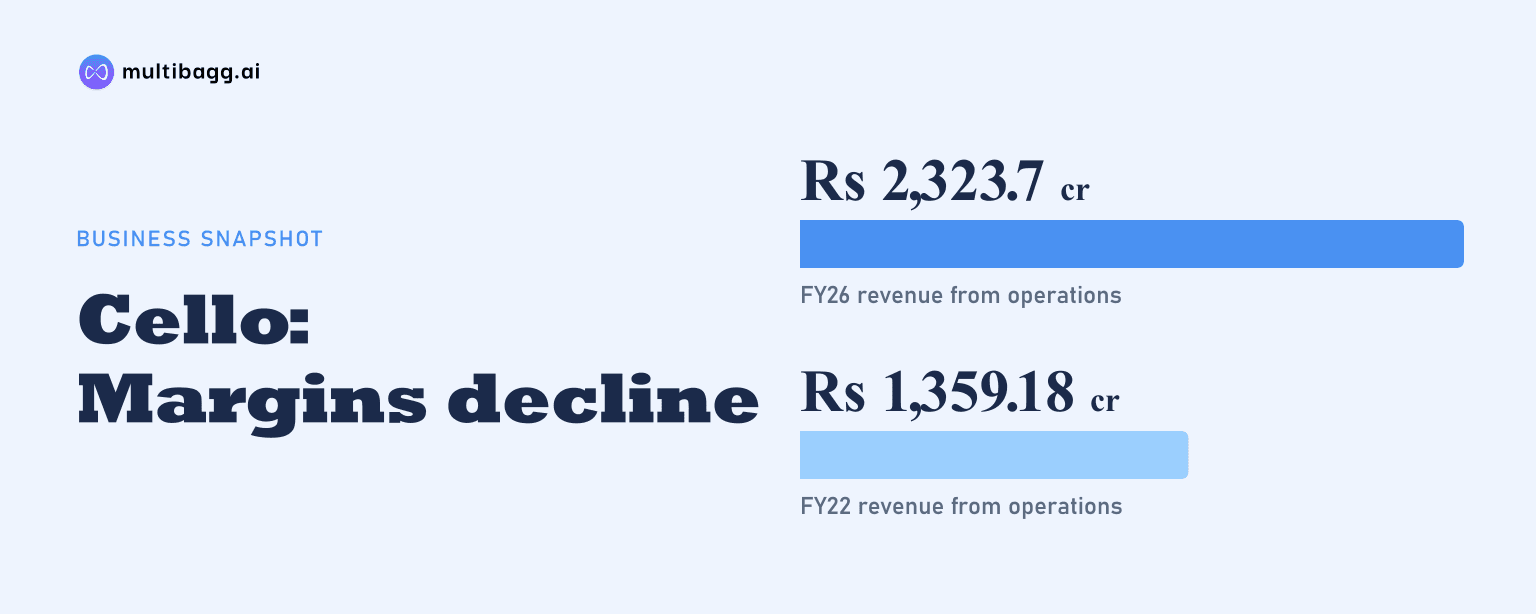
Cello World Limited reported FY26 revenue from operations of Rs 2,323.7 crore, up from Rs 1,359.18 crore in FY22, while EBITDA margin fell to 22.7% from 26.0% in FY25 and return on equity declined to 12.3%. The FY26 result combined higher sales with lower EBITDA, profit after tax and return ratios than the preceding year.
Know Cello World inside out
Results, valuation, peers and who's buying, in one view.
How much did Cello’s revenue grow between FY22 and FY26?
Cello’s revenue from operations increased by Rs 964.52 crore between FY22 and FY26, reaching Rs 2,323.7 crore from Rs 1,359.18 crore. Revenue rose in every reported year, moving to Rs 1,796.7 crore in FY23, Rs 2,000.3 crore in FY24 and Rs 2,136.4 crore in FY25 before the FY26 result. The presentation labels the historical revenue series as showing 14% growth.
The larger revenue base did not translate into a higher FY26 EBITDA or profit after tax. EBITDA was Rs 526.4 crore in FY26, below Rs 554.7 crore in FY25, while profit after tax was Rs 331.5 crore, down from Rs 364.6 crore. Gross profit nevertheless increased to Rs 1,156.2 crore from Rs 1,104.9 crore, showing that the profit decline occurred below the gross-profit line.
Which Cello segments drove FY26 revenue growth?
Consumer Ware was Cello’s largest reported segment in FY26, generating Rs 1,606 crore and accounting for 69.1% of revenue. Its sales increased from Rs 1,460 crore in FY25 and Rs 871 crore in FY22, while its revenue share rose from 64.1% in FY22. The presentation reports 17% growth for the segment across the displayed historical period.
Writing Instruments generated Rs 369 crore in FY26, up from Rs 309 crore in FY25 and Rs 169 crore in FY22. Its revenue contribution was 15.9%, compared with 14.4% in FY25 and 12.5% in FY22, and the presentation shows 21% historical growth. Moulded Furniture and Allied Products moved in the other direction in FY26, declining to Rs 349 crore from Rs 367 crore in FY25; its share fell to 15.0% from 23.5% in FY22.
Segment gross-profit data shows the same uneven movement. Consumer Ware gross profit rose to Rs 818 crore from Rs 768 crore, and Writing Instruments gross profit rose to Rs 198 crore from Rs 175 crore. Moulded Furniture and Allied Products gross profit fell to Rs 140 crore from Rs 162 crore, alongside its lower FY26 sales.
Why did Cello’s FY26 margins decline?
Cello’s gross profit margin declined to 49.8% in FY26 from 51.7% in FY25 and 52.6% in FY24. Cost of goods sold increased to Rs 1,167.6 crore from Rs 1,031.5 crore, while revenue increased to Rs 2,323.7 crore from Rs 2,136.4 crore. Gross profit therefore grew by Rs 51.3 crore, less than the Rs 187.3 crore increase in sales.
Employee cost rose to Rs 242.0 crore in FY26 from Rs 211.2 crore in FY25, while other expenses increased to Rs 442.8 crore from Rs 383.3 crore. EBITDA consequently fell by Rs 28.3 crore to Rs 526.4 crore, and EBITDA margin dropped by 3.3 percentage points to 22.7%. Other income rose to Rs 55.1 crore from Rs 44.7 crore, but that increase did not offset the gross-margin and operating-expense movement.
All three disclosed segments recorded lower gross-profit margins in FY26. Consumer Ware’s margin declined to 50.9% from 52.6%, Writing Instruments’ margin fell to 53.6% from 56.6%, and Moulded Furniture and Allied Products’ margin declined to 40.2% from 44.1%. This segment pattern coincided with the consolidated gross margin reaching its lowest level in the FY22-to-FY26 series.
Got a follow-up? Ask IRIS
What happened to Cello’s profit and return ratios in FY26?
Cello’s profit after tax margin fell to 14.3% in FY26 from 17.1% in FY25 and 17.8% in FY24. Earnings before interest and tax were Rs 448.7 crore, compared with Rs 492.7 crore in FY25, while depreciation increased to Rs 77.7 crore from Rs 62.0 crore. Finance cost was Rs 1.5 crore in both years.
FY26 included a Rs 7.4 crore exceptional item related to increased gratuity liability arising from past service cost and higher leave liability following changes in labour laws. Profit before tax was Rs 439.7 crore, down from Rs 491.3 crore, and tax declined to Rs 108.2 crore from Rs 126.7 crore. Earnings per share were Rs 14.70 in FY26, compared with Rs 16.16 in FY25.
Return on equity was 12.3% in FY26, down from 15.14% in FY25 and 45.9% in FY22. Cello defines return on equity as profit after tax divided by total equity, excluding capital reserve on business combinations under common control. Return on capital employed, defined as earnings before interest and tax divided by capital employed, declined to 16.3% from 20.3% in FY25 and 31.1% in FY23.
How did Cello’s working capital and borrowings change in FY26?
Cello reported working capital of 178 days in FY26, compared with 176 days in FY25 and 154 days in FY23. March 2026 inventories were Rs 534.7 crore, compared with Rs 524.6 crore a year earlier, while trade receivables rose to Rs 749.6 crore from Rs 657.8 crore. Total current assets increased to Rs 2,170.2 crore from Rs 1,942.0 crore.
The debt-to-equity ratio was displayed as 0.0 in both FY25 and FY26, compared with 0.3 in FY24 and 1.7 in FY22. The March 2026 balance sheet nevertheless listed Rs 34.6 crore of current borrowings and no non-current borrowings, versus Rs 0.5 crore of current borrowings in March 2025. Cash and cash equivalents rose to Rs 126.4 crore from Rs 51.7 crore.
The presentation states that the Composite Scheme of Arrangement involving Wim Plast Limited, Cello Consumer Products Private Limited and Cello became effective on May 27, 2026, with an appointed date of April 1, 2025. The FY22-to-FY25 comparatives were restated, including the impact on earnings per share for shares pending issuance, to give effect to the scheme from the beginning of the previous year.
Conclusion
Cello expanded revenue by Rs 964.52 crore from FY22 to FY26, led by Consumer Ware and supported by Writing Instruments, while Moulded Furniture and Allied Products lost revenue share. FY26 showed a different earnings outcome: gross margin, EBITDA margin, profit after tax margin, return on equity and return on capital employed all declined from FY25 levels.
The next disclosed items to watch are management’s plans to scale the Rajasthan glassware facility, indigenous steel tableware production, and capacity across plastics, insulated ware, furniture and stationery. Management also identifies distributor additions, wider domestic and international penetration, and increased marketing and digital visibility as initiatives whose effects on segment revenue, margins and working-capital days remain unresolved in the reported figures.