










Century Enka Limited Q2 profit fell 17% as costs rose
Key highlights
- Century Enka’s Q2 FY27 revenue rose 37% year-on-year to Rs 558 crore, supported by a 13% increase in volume to 20,162 metric tons.
- Q2 FY27 profit after tax fell 17% year-on-year to Rs 19 crore as raw-material and energy costs increased and lower-cost inventory benefits normalized.
- Tyre cord fabric sales rose 37% to Rs 251 crore and filament yarn sales increased 39% to Rs 293 crore in Q2 FY27.
- H1 FY27 EBITDA increased 130% to Rs 119 crore and profit after tax rose 113% to Rs 80 crore, but Q2 EBITDA margin declined to 5.88% from the first-half margin of 10.66%.
powered by IRIS
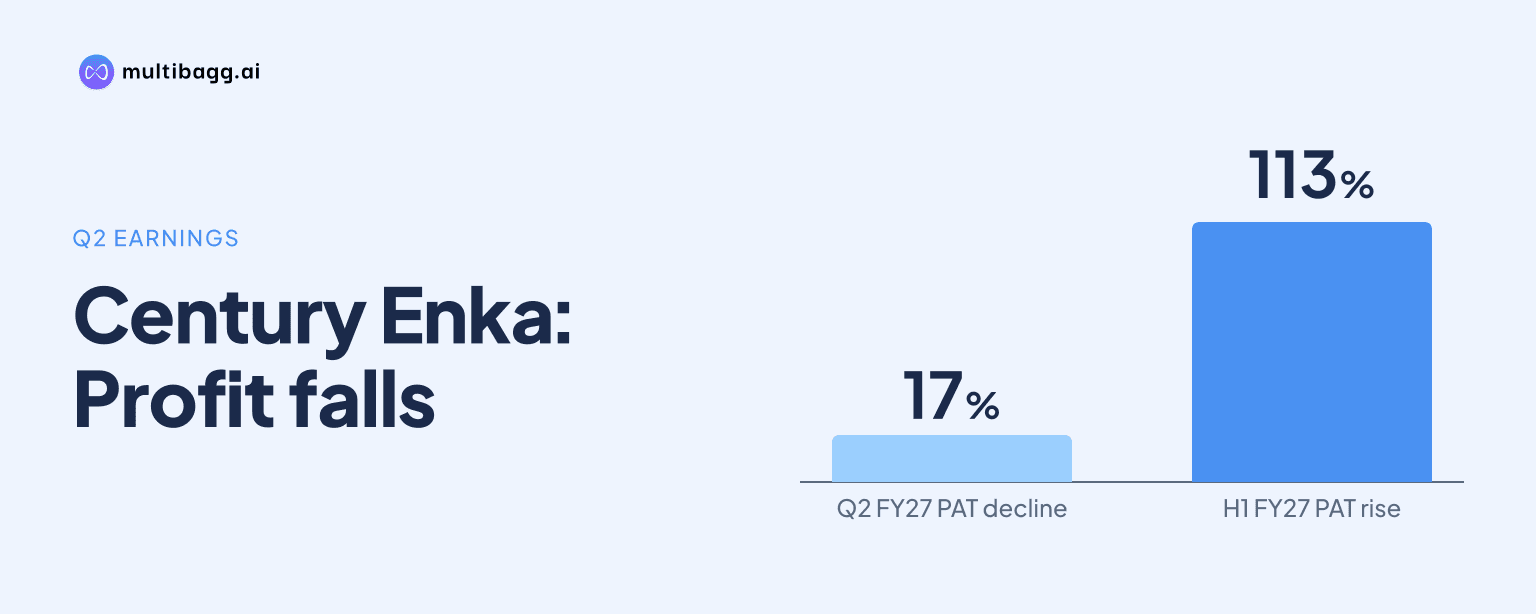
Century Enka Limited reported Q2 FY27 revenue growth of 37% year-on-year to Rs 558 crore, but profit after tax fell 17% to Rs 19 crore. Management attributed the mismatch to higher crude-linked raw-material costs, normalization of lower-cost inventory benefits, increased Bharuch power tariffs, elevated liquefied natural gas prices and import-led pricing pressure.
Know Century Enka inside out
Results, valuation, peers and who's buying, in one view.
What drove Century Enka’s Q2 FY27 revenue growth?
Century Enka said both higher volume and higher realizations drove its 37% year-on-year revenue increase to Rs 558 crore in Q2 FY27. Total volume rose 13% to 20,162 metric tons, while management said realizations increased primarily because prices of crude-based caprolactam and polymerized chips, its key inputs, moved higher.
The gap between 37% revenue growth and 13% volume growth shows that pricing was a significant contributor during Q2 FY27. Management said raw-material prices increased significantly quarter-on-quarter and compared with Q1 FY27, while future realizations would primarily depend on the movement in underlying raw-material prices.
Century Enka said festive demand supported passenger and commercial vehicles during Q2 FY27, providing a constructive backdrop for tyre demand. However, management identified geopolitical developments, crude prices, inflation, interest rates, the rupee and deficit-monsoon effects as factors that could affect market demand and volumes in coming quarters.
Why did Century Enka’s Q2 FY27 profit decline despite sales growth?
Century Enka’s Q2 FY27 profit after tax declined 17% year-on-year to Rs 19 crore because operating-cost growth outpaced earnings gains from higher sales. Earnings before interest, tax, depreciation and amortization, or EBITDA, rose only 4% to Rs 33 crore, producing an EBITDA margin of 5.88% and a profit-after-tax margin of 3.31%.
Management said lower-cost opening inventory had supported margins in Q1 FY27, but that benefit moderated in Q2 FY27. It also said significant volatility in caprolactam and polymerized-chip prices weighed on operating margins, without quantifying the change in material costs.
Energy costs added to the Q2 FY27 pressure, according to Century Enka. Higher grid-power tariffs at Bharuch and elevated liquefied natural gas, or LNG, prices increased operating costs, helping explain why EBITDA growth of 4% trailed revenue growth of 37%.
How did Century Enka’s tyre cord and yarn segments perform?
Century Enka reported Q2 FY27 tyre cord fabric sales of Rs 251 crore, up 37% year-on-year, and filament yarn sales of Rs 293 crore, up 39%. Total quarterly volume rose 13% to 20,162 metric tons, although the company did not disclose segment-level volumes or margins.
Underlying nylon tyre cord fabric, or NTCF, demand remained healthy, management said, in line with the automotive backdrop in Q2 FY27. Imports nevertheless affected sales volume in tyre cord fabric, while Century Enka said it was managing competitive pricing pressure in that business.
In filament yarn, festive-season demand improved sales volume in Q2 FY27, but management said margins remained constrained. It cited competitively priced Chinese imports, particularly in base and low-grade yarn, and fluctuations in raw-material costs; the company said it expanded value-added product capacity during the quarter to improve its product mix.
Got a follow-up? Ask IRIS
What does Century Enka’s first-half performance show?
Century Enka’s H1 FY27 revenue rose 37% year-on-year to Rs 1,113 crore, the same growth rate reported for Q2 FY27, but earnings growth was materially faster in the first half. H1 EBITDA increased 130% to Rs 119 crore and profit after tax rose 113% to Rs 80 crore.
The first-half margin profile was higher than the Q2 FY27 profile. H1 EBITDA margin was 10.66%, versus 5.88% in Q2 FY27, while the H1 profit-after-tax margin was 7.21%, versus 3.31% in Q2 FY27; management linked the quarterly decline to inventory-cost normalization and higher material and energy costs.
H1 FY27 volume increased 13% year-on-year to 39,361 metric tons. Tyre cord fabric sales rose 53% to Rs 557 crore, compared with 30% growth in filament yarn sales to Rs 523 crore, differing from Q2 FY27 when filament yarn sales growth of 39% was slightly higher than tyre cord fabric’s 37% increase.
What projects does Century Enka expect to affect costs and sales?
Century Enka expects expanded hybrid-power capacity to start delivering cost benefits from Q4 FY27. Management presented the project as a response to higher Bharuch grid tariffs and LNG prices, but did not disclose an expected saving amount, margin effect or FY28 cost forecast.
The company also expects commercial sales of polyester tyre cord fabric, or PTCF, to begin in Q4 FY27. Management said the approval process was progressing in the desired direction and described PTCF as a diversification initiative for its tyre-reinforcement presence, without providing a sales, capacity or profitability target.
Management identified mother-yarn expansion at Pune, increased value-added product capacity at Bharuch, energy-saving capital expenditure at both sites, safety improvements and old-asset replacement as ongoing projects. An analyst said capital work-in-progress had increased from about Rs 13 crore in FY26 to about Rs 38 crore in H1 FY27, while management did not confirm project-specific spending or commissioning dates.
Conclusion
Century Enka’s Q2 FY27 results show that higher realizations and a 13% increase in volume lifted revenue to Rs 558 crore, but did not translate into comparable earnings growth. Raw-material volatility, the fading inventory-cost benefit, higher energy costs and import competition limited profitability, leaving profit after tax at Rs 19 crore and EBITDA margin at 5.88%.
The next disclosed milestones are the expected Q4 FY27 start of hybrid-power cost benefits and commercial PTCF sales. Management’s Pune mother-yarn expansion, Bharuch value-added-product capacity increase and energy-saving projects are also relevant to whether product mix and operating costs change as crude-linked inputs and imports continue to influence performance.