










Menon Bearings reduces tractor dependence with new uses
Key highlights
- Menon Bearings said tractor business fell to 34% of engine-bearing mix from 54% 10 years ago.
- HCV, LCV and tractor applications now account for 58% of engine-bearing business, versus about 70% to 75% earlier.
- Menon Bearings said automotive represents about 60% to 65% of current business, with the balance in engineering and other applications.
- Menon Bearings said Menon Alkop has automotive exposure of only about 18% to 20%.
powered by IRIS
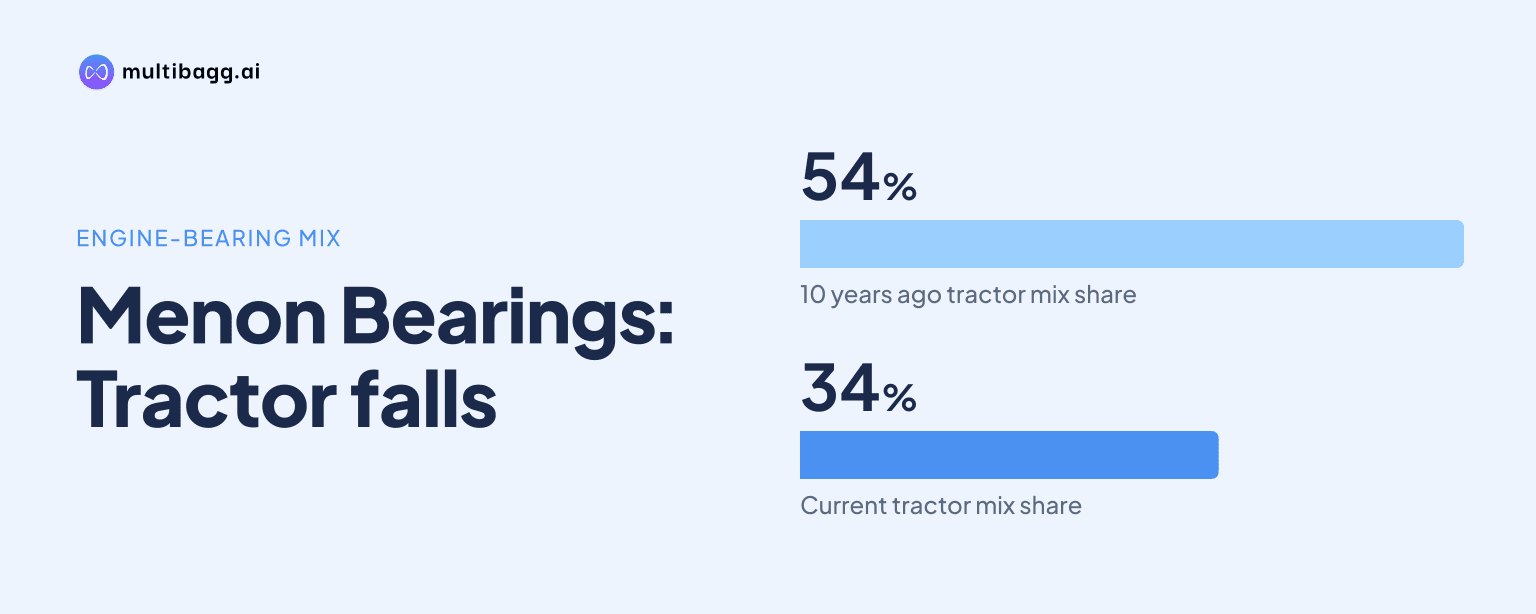
Menon Bearings Limited said on its Q2 & H1 FY27 earnings call that tractor business accounted for 34% of its engine-bearing mix, down from 54% 10 years earlier. Management attributed the change to expansion into generator, heavy earth-moving, braking, steering, transmission and compressor applications while retaining tractors as a core market.
Know Menon Bearings inside out
Results, valuation, peers and who's buying, in one view.
How has Menon Bearings reduced tractor dependence?
Menon Bearings said it has reduced reliance on tractors within engine bearings by widening the applications and customer base it serves. Management said tractors represented 54% of this market mix 10 years ago and now represent 34%, although tractor volumes have continued to rise. The company described the shift as a deliberate effort to address dependence on one cyclical application.
The broader exposure to heavy commercial vehicles, light commercial vehicles and tractors has also declined within the engine-bearing business. Management said these automotive uses accounted for about 70% to 75% of engine-bearing business earlier and now represent 58%, while sales have increased. The lower share therefore reflects growth in other applications rather than a withdrawal from engine bearings or tractors.
Which applications are replacing part of tractor exposure?
Menon Bearings said the incremental applications include generators, heavy earth-moving equipment, braking systems, steering systems and transmission systems. Management also cited refrigerant compressors and said it seeks opportunities wherever rotating components require its products. These uses broaden the end-market base beyond vehicle and tractor engines.
The company drew a distinction between its two principal product areas. Engine bearings remain more automotive-focused, while Menon Alkop has automotive exposure of only about 18% to 20%, management said. Menon Alkop serves industrial applications, house and automation, oil and gas, and electric vehicles, or EVs, giving that business a different application profile from engine bearings.
Menon Bearings also said its agricultural exposure is not limited to tractor engines. It supplies applications related to harvesters and seeding equipment, according to management. The call did not provide revenue figures for harvesters, seeding products or any individual non-tractor application.
Is Menon Bearings moving away from automotive markets?
Menon Bearings is not moving away from automotive markets. Management said automotive remains the company’s “basic DNA” and accounts for about 60% to 65% of the current revenue mix, with engineering and other applications making up the balance. Management expects the percentage split between automotive and non-automotive activities to remain more or less constant even as both areas grow.
That position makes the strategy one of diversification within and alongside the automotive base, rather than a planned replacement of it. Management said it will continue seeking greater automotive market share and noted that new tractor companies are approaching the business. If those opportunities convert, tractor-related sales could rise in absolute terms while the company maintains a wider application mix.
The call also described a broader move into EV-related business through Menon Alkop. Management said growth in heavy commercial vehicles, light commercial vehicles and passenger vehicles had been about 14% to 15% for the previous six months, while EV growth had reached 20%. These were management observations rather than a separately reported segment-revenue breakdown.
Got a follow-up? Ask IRIS
Can diversification limit the effect of an auto or tractor slowdown?
Menon Bearings said diversification should reduce the effect on total revenue if an automotive downturn occurs, but management did not say it would eliminate cyclical risk. It acknowledged that the automobile industry has gone through cycles for decades and said drought-like conditions in Maharashtra could affect the tractor industry. Its stated response is to add business from customers unrelated to tractors.
Management said schedules from non-tractor customers had increased substantially and that it did not expect an adverse effect from a potential auto slowdown at the time of the Q2 & H1 FY27 call. It also said tractor-company schedules were at an all-time high for the quarter despite drought concerns. Management suggested Indian tractor makers may be exporting more, but did not provide export data to support that possibility.
The company identified seasonality as another consideration. Management said the second quarter is normally the period most exposed to a cyclical hit in its historical pattern, while the third and fourth quarters are generally better. Menon Bearings said it nevertheless recorded its highest sales, profit, earnings before interest, tax, depreciation and amortisation, or EBITDA, margin, and profit after tax, or PAT, margin in company history during the quarter, without supplying the underlying amounts on the pages provided.
How do margins differ across Menon Bearings’ businesses?
Menon Bearings said braking products generate margins of 30% to 35%, depending on product mix, compared with 23% in bearings and 18% to 19% in Alkop. The figures show that its businesses have different reported margin profiles. Management also said braking could take a substantial role in the replacement market.
At the company level, management said raw-material volatility can affect a quarter before costs are substantially passed on to customers. It described a usual EBITDA margin range of 20% to 22% and set a target of about 23% for the following year. Automation, rooftop solar, lower manpower requirements, productivity gains and process improvements were identified as measures intended to sustain or improve margins.
Conclusion
Menon Bearings’ disclosed business mix indicates that growth in industrial and other applications has reduced concentration in conventional automotive uses, while automotive still represents about 60% to 65% of revenue. The decline in the combined HCV, LCV and tractor share of engine-bearing business to 58% supports management’s position that it is broadening the end-market base without leaving its core market.
The next indicators to watch are management’s plans to expand braking replacement business, add new tractor customers and develop Menon Alkop’s industrial and EV applications. Management expects the third and fourth quarters to be seasonally better and is targeting EBITDA margin of about 23% next year, while acknowledging possible tractor-market pressure from drought conditions.