










Menon Bearings targets 23% EBITDA margin next year after Q2
Key highlights
- Menon Bearings targets about 23% EBITDA margin next year, above management’s stated 20% to 22% usual range.
- Management said raw-material increases may be absorbed for one quarter before being substantially passed to customers.
- Brakes margins were stated at 30% to 35%, compared with 23% for bearings and 18% to 19% for Alkop.
- Q2 FY27 OEM business grew almost 50% year on year and exports rose more than 75%.
powered by IRIS
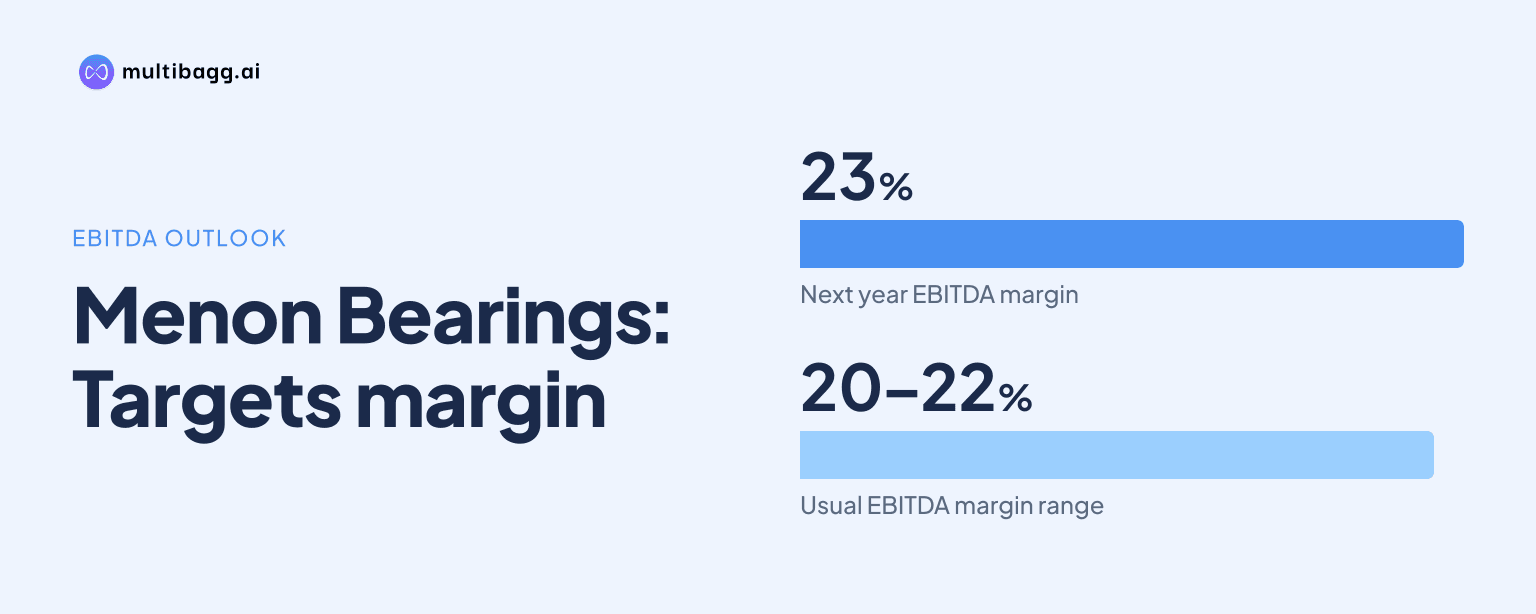
Menon Bearings Limited is targeting an EBITDA, or earnings before interest, tax, depreciation and amortisation, margin of about 23% next year after its Q2 and H1 FY27 call, compared with management’s stated usual range of 20% to 22%. Management linked the goal to raw-material price resets, automation, rooftop solar and a brakes business with stated margins of 30% to 35%.
Know Menon Bearings inside out
Results, valuation, peers and who's buying, in one view.
What EBITDA margin is Menon Bearings targeting next year?
Menon Bearings is targeting an EBITDA margin of about 23% next year. Management said margins normally range from 20% to 22%, and added that its business pipeline and expected growth could allow the operating margin to exceed 22%.
The target emerged when an analyst asked about a return to a 22% EBITDA margin excluding other income in the Q2 FY27 discussion. Management said a margin above 20% was preferable, then described 23% as its target for next year. It did not specify the financial-year label for the target or provide a revenue forecast used to calculate the margin.
Menon Bearings also said Q2 FY27 delivered the company’s highest sales, profit, EBITDA margin and profit-after-tax margin in its history. The call did not disclose the reported Q2 margin percentage, so the 23% figure remains a management target rather than a reported quarterly result.
How will Menon Bearings manage raw-material cost volatility?
Menon Bearings said it has a pre-decided formula under which raw-material cost increases can be passed on to customers and prices can be reduced when input costs fall. Management said it may absorb higher raw-material prices for one quarter before substantially passing them through, allowing margins to be restored after that period.
That one-quarter timing difference is the mechanism management cited for changes in quarterly profitability. During Q2 FY27, it described raw-material prices and shipment times as being at all-time highs, while saying results were better than both the preceding quarter and the same quarter a year earlier.
Menon Bearings identified automation, rooftop solar, lower manpower requirements, productivity improvement and process changes as additional margin measures. Management said automation should raise productivity and rooftop solar should reduce electricity costs, but it did not disclose the capital cost, savings amount or implementation date for those initiatives.
Which Menon Bearings segments have the highest stated margins?
Menon Bearings said brakes has the highest stated segment margin, at 30% to 35%, followed by bearings at 23% and Alkop at 18% to 19%. Management said the brakes range varies with the product mix, so it is not a fixed margin for every order.
The stated comparison places brakes 7 to 17 percentage points above Alkop and 7 to 12 percentage points above bearings, depending on the brakes mix. Management said the brakes business could take a substantial role in the replacement market, in addition to opportunities with major original equipment manufacturers, or OEMs, and railways.
Menon Bearings did not disclose segment revenue, segment profit or the share of consolidated EBITDA generated by brakes in Q2 FY27. It did say automotive applications account for about 60% to 65% of business, with the balance in engineering and other applications, including oil and gas automation, electric vehicles, generators, compressors, refrigeration and air conditioning.
Got a follow-up? Ask IRIS
What growth plans could support Menon Bearings' target?
Menon Bearings said Q2 FY27 OEM business rose by almost 50% from the same quarter a year earlier, while exports increased by more than 75%. Management said it expects at least 30% growth from domestic, export and European opportunities if geographic and geopolitical conditions remain stable.
Management cited its order book, parts developed for A-class customers and European requests for quotation, or RFQs, as growth drivers. It said RFQs from Europe exceeded Rs 35 crore to Rs 40 crore, but did not say how much had converted into orders. Management described Europe as a long-term export opportunity and said it was not relying solely on a prospective India-European trade agreement.
On revenue scale, management said Menon Bearings had expected Rs 270 crore in the previous year and delivered Rs 300 crore. For the current year, executives discussed Rs 350 crore to Rs 370 crore, noting that the first two quarters are usually slower than the third and fourth quarters. They said Rs 500 crore could be possible next year or the year after.
Menon Bearings said it is undertaking capital expenditure, or CapEx, needed for those growth plans, while existing infrastructure requires additional machines as demand rises. Management also said tractor exposure in the engine-bearing business declined from 54% of its market mix 10 years ago to 34%, even as volumes increased, with generators, heavy earth-moving equipment, braking, steering and transmission applications adding diversification.
Conclusion
Menon Bearings’ 23% EBITDA-margin target depends on customer price adjustments after a stated one-quarter lag, cost measures such as automation and rooftop solar, and the contribution of product lines including brakes, where management stated a 30% to 35% margin range. The target is above the 20% to 22% range management described as normal in the Q2 and H1 FY27 call.
The next disclosures to watch are whether raw-material increases continue to be substantially passed through after one quarter, whether CapEx supports the Rs 350 crore to Rs 370 crore current-year discussion and the Rs 500 crore ambition, and whether European RFQs worth more than Rs 35 crore to Rs 40 crore become production business. Management also conditioned its growth expectations on geographic and geopolitical stability.