










Menon Bearings sees cash conversion hold after US stock build
Key highlights
- An analyst cited about Rs 20 crore of operating cash flow in H1 FY27, versus Rs 23 crore for the full previous year.
- Menon Bearings said most US customers prefer three months of warehouse inventory.
- Menon Bearings said packing credit costs 4.65% to 4.75% and cited a 2.75% government subvention.
- Management said almost 20%-plus of expected 30%-plus growth should come from volumes.
powered by IRIS
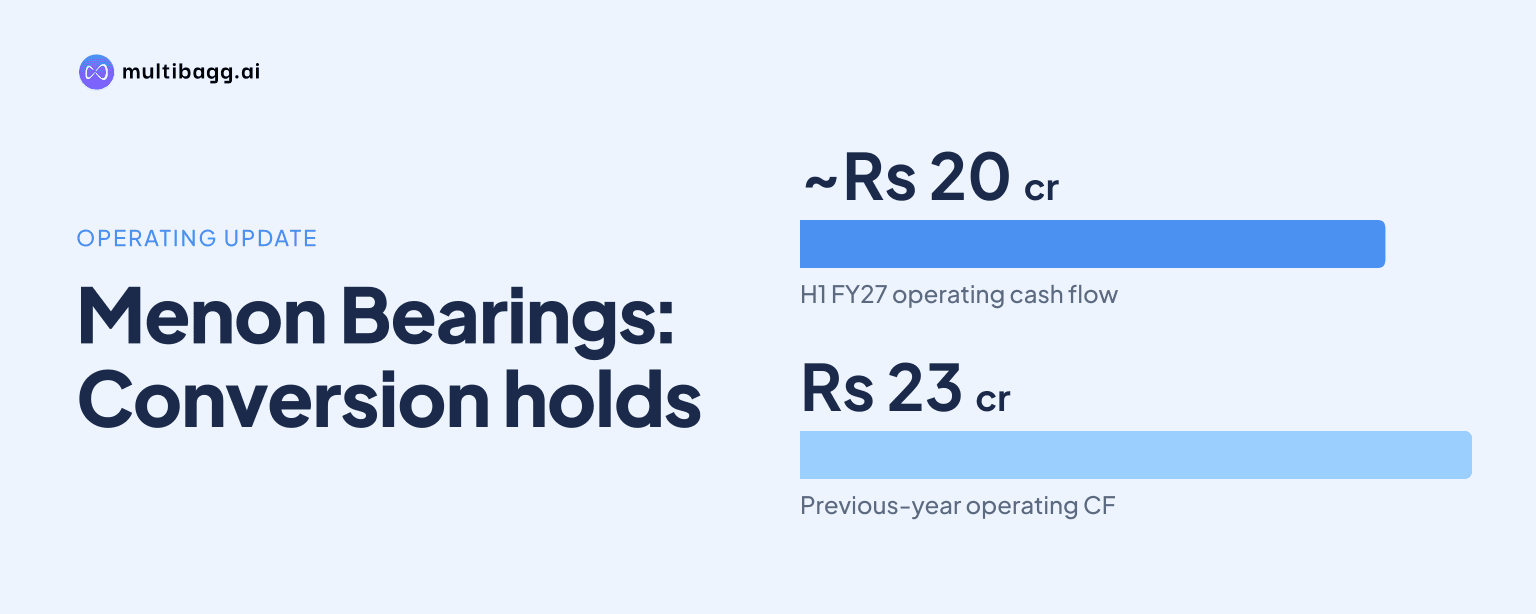
Menon Bearings Limited expects its working-capital improvement to continue after completing planned US customer inventory buffers, with an analyst citing about Rs 20 crore of operating cash flow in H1 FY27 against Rs 23 crore for the full previous year. Management said the initial three-month US stock build has been completed and collections have entered a steadier cycle.
Know Menon Bearings inside out
Results, valuation, peers and who's buying, in one view.
Why does Menon Bearings expect working-capital gains to continue?
Menon Bearings expects the improvement to continue because the initial inventory build for new US business and customer warehouses has been completed. Analyst Bhargav Buddhadev said on the call that operating cash flow in H1 FY27 was about Rs 20 crore, compared with Rs 23 crore for the full previous year, and attributed the improvement primarily to lower inventory days. Management said payments released after the initial stock build had settled into a normal rotation of working capital.
Menon Bearings said new business often requires inventory at both its own facility and a US warehouse before supplies begin. Over the prior six months to one year, it had built stock while developments and new plants were being established. Management said spare inventory was held during the transition to avoid disrupting customer production, but added that sales are now being realised and the inventory cycle is becoming more established.
Management did not disclose inventory days, a cash-flow target or a precise inventory amount for H1 FY27. It said inventory could increase somewhat as volumes rise, including in the next quarter, but should not rise significantly beyond the stock already established. The company is therefore describing a shift from an initial setup requirement to replenishment more closely related to volumes, rather than the end of inventory needs.
How does Menon Bearings finance export inventory?
Menon Bearings said it uses bank packing credit at interest rates of 4.65% to 4.75% to fund working-capital needs when receivables increase. Management also cited a government subvention of 2.75% associated with this financing. The facility is relevant to exports because goods held in customer warehouses or shipped overseas can result in receivables remaining outstanding before payment is released.
Management said borrowing cost had remained more or less constant despite turnover rising by 100% and quarterly turnover rising by 55%, although it did not specify the periods or absolute borrowing-cost figure for that comparison. It also said that, in the prior year, inventory carrying cost or total inventory working capital had remained the same despite 30% quarterly growth. Those comments were management’s explanation of how it has funded additional business without a stated increase in financing cost.
Menon Bearings uses customer-specific delivery arrangements rather than one export policy. These include delivered duty paid, or DDP, ex-works, free on board, or FOB, shipments directly to factories, and warehouses near customer facilities in the US or Europe. It also described using third-party warehouses for repackaging where a customer requires parts to arrive in a particular factory-ready format.
How do freight disruption and customer terms affect Menon Bearings?
Menon Bearings said shipping delays linked to the Strait of Hormuz and war can extend transit times and sometimes require air freight, affecting working capital to some extent. Management said most US customers prefer three months of stock in their warehouses as a precaution. It said the inventory carrying cost of that planned buffer has already been considered in pricing, limiting the effect of a pre-planned stock position on each shipment.
Freight-cost treatment depends on the customer and the commercial situation, according to management. Menon Bearings said it passes on raw-material cost increases to customers, while temporary reductions can benefit the company, and said logistics operates similarly. The call did not specify contractual formulas, timing or the proportion of freight cost that is passed through under DDP, ex-works or FOB arrangements.
For selected critical parts, Menon Bearings may hold extra inventory because a missed delivery can stop a customer production line. Management said it particularly wanted to avoid delivery problems during the first six months of supply to a new business or new US plant. It said air freight can sometimes cost more than the product itself, and the company may bear that expense if the delay results from its own delivery failure.
Got a follow-up? Ask IRIS
What could make Menon Bearings' inventory rise again?
Menon Bearings said future inventory will have a direct relationship with sales volumes, so stock can rise if business expands. Management said a modest increase could occur in the next quarter depending on sales, but did not expect a significant increase because the baseline inventory for the US supply arrangement has already been built. The view depends on the existing buffer remaining adequate for product mix, transit times and customer requirements.
The company also said some customers require buffers because its supplied products are critical to their production lines. That means stock requirements can differ by part and customer, particularly where a new plant, new development or technical risk is involved. Management’s stated objective is to prevent delivery failure and the associated risk of air-freight expense or damage to its record with a customer.
Menon Bearings linked the inventory position to expected revenue growth of 30%-plus, saying almost 20%-plus of that growth should come from volume rather than price revisions. Management described this as additional business and said the completed US inventory build should allow subsequent sales to move through a more regular collection and replenishment cycle. It did not give a reporting-date target for volume, receivable days or inventory days.
How does the cash cycle fit Menon Bearings' wider growth plan?
Menon Bearings said automotive applications account for about 60% to 65% of business, while engineering and other applications make up the balance. In the engine-bearing business, management said the combined share of heavy commercial vehicles, light commercial vehicles and tractors had fallen from about 70% to 75% to 58%, while sales increased. It cited braking systems, steering systems, transmissions, refrigerant compressors, generators and heavy earth-moving equipment as additional applications.
Management also said it had not used a term loan for capital expenditure for more than six months, funding capital expenditure from internal accruals. It said this use of internal cash affects cash accruals even when profit rises. That distinction separates the operating-cash-flow improvement cited for H1 FY27 from cash used for capital expenditure, which can still affect total cash availability.
Management said the next two quarters looked positive and described the last quarter as generally higher than other quarters. It qualified its ability to meet estimated projections by referring to the possibility of adverse geopolitical developments. The call did not provide a quantified full-year operating-cash-flow forecast or a specific capital-expenditure amount.
Conclusion
Menon Bearings’ position is that about Rs 20 crore of H1 FY27 operating cash flow, compared with Rs 23 crore for the full previous year, reflects completion of an exceptional US inventory setup rather than a permanent reduction in inventory needs. The three-month US buffer, customer-specific delivery terms and packing credit priced at 4.65% to 4.75% are the mechanisms management cited for supporting the cycle.
The next points to watch are whether inventory increases only in line with the planned 30%-plus growth, whether almost 20%-plus volume growth materialises, and whether shipping disruption leads to air freight. Management said the next two quarters were positive, while identifying geopolitical developments as a factor that could affect deliveries and achievement of its projections.