










Chaman Metallics Limited Reports 91.6% H1 FY27 Revenue Growth
Key highlights
- Chaman Metallics reported H1 FY27 revenue of ₹376.58 crore, up 91.63% year on year.
- H1 FY27 EBITDA was ₹47.57 crore, with an operating margin of about 12.6%.
- Chaman Metallics reported H1 FY27 profit after tax of ₹11.91 crore versus a ₹2.55 crore loss a year earlier.
- The board approved a rights issue of up to ₹100 crore to repay borrowings and target ₹6 crore to ₹9 crore of finance-cost savings.
powered by IRIS
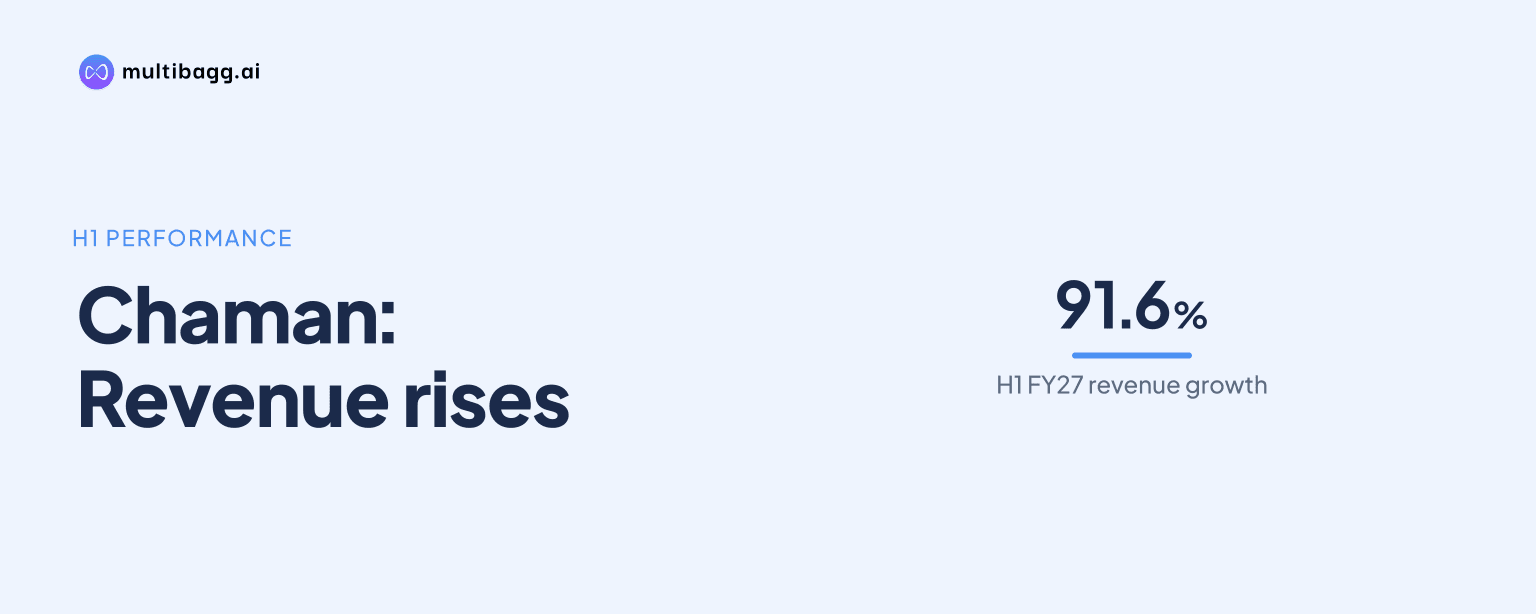
Chaman Metallics Limited reported H1 FY27 revenue of ₹376.58 crore, a 91.63% year-on-year increase, alongside all-time-high EBITDA of ₹47.57 crore and profit after tax of ₹11.91 crore. The company also approved a rights issue of up to ₹100 crore to repay borrowings and reduce finance costs.
Know Chaman Metallics inside out
Results, valuation, peers and who's buying, in one view.
What did Chaman Metallics report for H1 FY27?
Chaman Metallics reported revenue from operations of ₹376.58 crore for the first half of FY27, compared with ₹196.52 crore in H1 FY26. The 91.63% year-on-year growth was accompanied by sequential half-year growth of 9.23%, according to the investor presentation released with its H1 results.
EBITDA reached ₹47.57 crore, which the company described as its highest level to date. This represented year-on-year growth of 298.39%. Based on reported revenue and EBITDA, the operating margin was about 12.6%. Profit after tax was ₹11.91 crore, compared with a loss of ₹2.55 crore in the comparable prior-year half-year period.
The H1 figures were presented as part of the company's Q2 FY27 investor presentation. Chaman Metallics has not published an earnings-call transcript for the quarter, so the reported figures and operational statements are based on the presentation rather than management guidance from a call.
What supported the increase in revenue and EBITDA?
Chaman Metallics linked its H1 performance to the stabilisation of operations after its expansion programme, with improving capacity utilisation and throughput. The company said it is moving from an expansion phase to an execution phase focused on unlocking profitability from the expanded operating base.
Its installed facilities at Chandrapur, Maharashtra include 550 tonnes per day of sponge iron capacity, 400 tonnes per day of billets capacity and 65 tonnes per day of silico manganese capacity. The company had previously operated with 200 tonnes per day of sponge iron capacity, making the expanded asset base central to its current production and sales ramp-up.
Captive power is also part of the operating model. Chaman Metallics said its 30 MW captive power plant, based on atmospheric fluidised bed combustion and waste heat, was fully commissioned in FY26. The presentation reported power cost of ₹3.54 per unit from the captive plant, compared with ₹8.44 per unit from the grid.
Why is Chaman Metallics planning a ₹100 crore rights issue?
Chaman Metallics' board approved a rights issue of up to ₹100 crore on 5 November 2026. The stated purpose is repayment of borrowings and strengthening of the capital structure following a period of significant capital expenditure.
The company estimates that using the proceeds to lower debt could save ₹6 crore to ₹9 crore in finance costs. The presentation also showed debt raised or repaid of ₹40.95 crore as of 30 September 2026, indicating an increase in borrowings relative to earlier periods. The rights issue proposal is therefore directly connected to the funding structure built during expansion.
Capital expenditure has been substantial. Chaman Metallics reported capex spending of ₹99.18 crore as of 31 March 2026 and a further ₹22.77 crore in H1 FY27. It has also outlined plans for backward and forward integration, though the presentation does not provide a fresh investment amount or timetable for those proposed projects.
Got a follow-up? Ask IRIS
How does the H1 result compare with Chaman Metallics' FY26 performance?
The H1 FY27 profit marks a change from the full-year FY26 result, when Chaman Metallics reported revenue of ₹541.26 crore and a net loss of ₹4.17 crore. FY26 EBITDA was ₹39.96 crore, up from ₹15.18 crore in FY25, but higher depreciation and borrowing costs associated with recent capex weighed on the final profit figure.
Revenue in FY26 had risen 215% from ₹172.18 crore in FY25, showing that the company had already experienced a sharp rise in business volume after capacity additions. The H1 FY27 result extends that revenue momentum while reporting positive profit after tax for the six-month period.
The comparison also highlights why debt reduction is relevant to investors. The company has shown higher EBITDA after expansion, while its earlier FY26 loss was attributed to depreciation and borrowing costs. The planned use of rights issue proceeds for borrowings targets the latter cost line, although the eventual benefit will depend on the completion and utilisation of the issue.
What does the update mean for investors and operations?
For investors, the H1 update provides evidence of stronger revenue, EBITDA and profit after tax following the expansion cycle. The reported 12.6% EBITDA margin and ₹11.91 crore profit were achieved while the company said expanded operations were stabilising. However, the presentation does not include an earnings-call transcript or fresh management financial guidance.
The rights issue is a material capital-structure event because it is intended to repay borrowings rather than fund a separately quantified new project. Existing shareholders will need to assess the issue terms when they are disclosed, including the entitlement ratio, issue price, record date and final use-of-proceeds details.
For operations in Chandrapur, the larger sponge iron, billets, silico manganese and captive power facilities form the base for the company's stated focus on utilisation and throughput. Lower captive power cost relative to grid power is an operational factor reported by the company, while planned integration capex remains a future initiative without detailed financial terms in the presentation.
Conclusion
Chaman Metallics delivered H1 FY27 revenue of ₹376.58 crore, EBITDA of ₹47.57 crore and profit after tax of ₹11.91 crore, reversing the ₹2.55 crore loss reported in the comparable prior-year half. The numbers indicate that the company is reporting improved financial performance as its expanded capacities stabilise, while the proposed rights issue addresses the borrowings accumulated during the investment cycle.
The next key disclosures are the terms and completion of the up to ₹100 crore rights issue, including its effect on borrowings and finance costs. Investors will also watch subsequent updates on capacity utilisation, captive power operations and the company's proposed backward and forward integration plans.