










Chemkart amino acids account for 50% of H1 FY27 revenue
Key highlights
- Amino Acids generated Rs 102.86 crore and accounted for 50.0% of Chemkart's H1 FY27 segment-wise revenue.
- Protein revenue reached Rs 17.27 crore in H1 FY27, compared with Rs 4.90 crore in FY26.
- Amino Acids and Protein together contributed Rs 120.13 crore, or 58.4%, of H1 FY27 segment-wise revenue.
- Chemkart reported H1 FY27 EBITDA of Rs 29.37 crore at a 14.3% margin, compared with Rs 28.18 crore and a 13.1% margin in FY26.
powered by IRIS
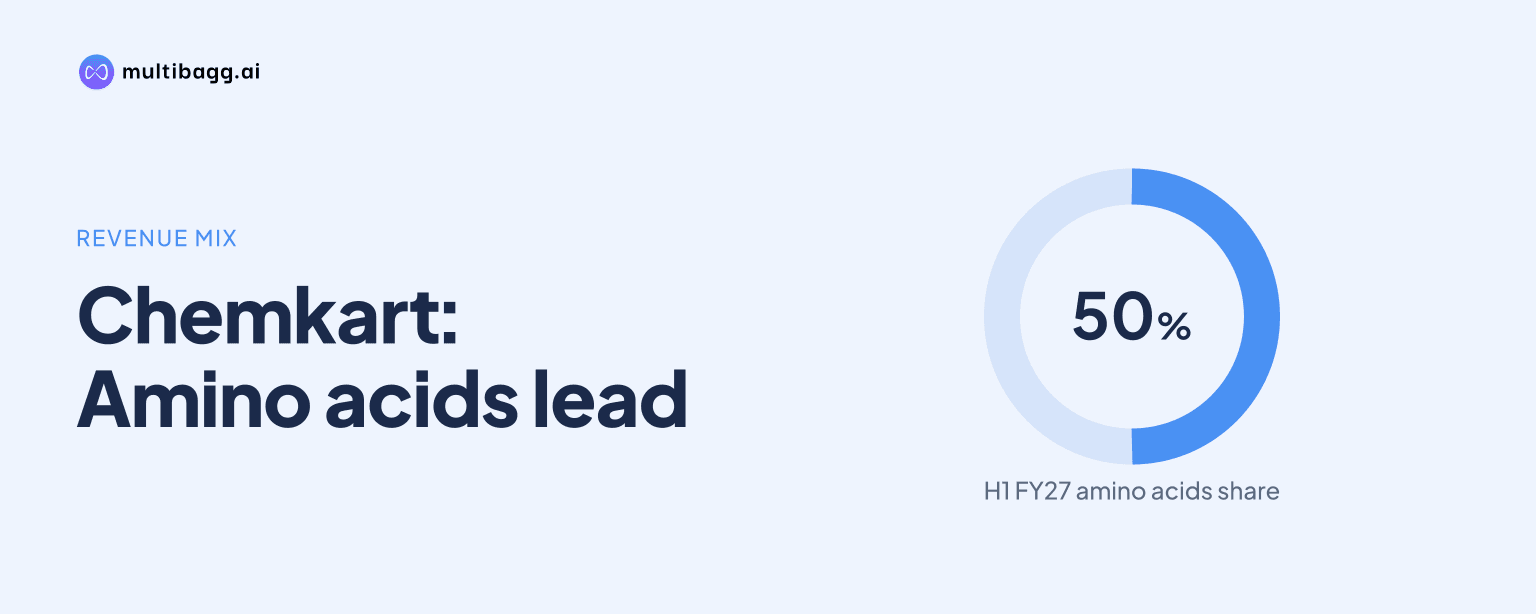
Chemkart reported that Amino Acids contributed 50.0% of H1 FY27 segment-wise revenue, up from 48.5% in FY26 and 44.4% in FY25. Protein was the largest mix mover, with H1 FY27 revenue of Rs 17.27 crore, more than three times the Rs 4.90 crore reported for the full FY26.
Know Chemkart India inside out
Results, valuation, peers and who's buying, in one view.
What drove Chemkart's H1 FY27 revenue mix?
Amino Acids drove Chemkart's H1 FY27 mix, generating Rs 102.86 crore, or 50.0%, of total segment-wise revenue of Rs 205.87 crore. This placed Amino Acids ahead of Sports Nutrition, the second-largest category, which generated Rs 59.34 crore and accounted for 28.8% of the H1 FY27 total.
The two largest categories represented 78.8% of Chemkart's H1 FY27 segment-wise revenue, compared with 79.4% in FY26. While the combined share was 0.6 percentage points lower, the balance shifted toward Amino Acids, whose share rose by 1.5 percentage points as Sports Nutrition's share fell by 2.1 percentage points.
Chemkart's H1 FY27 segment-wise revenue of Rs 205.87 crore was close to the Rs 212.60 crore total across its FY26 product categories. The presentation separately reports consolidated FY26 revenue of Rs 214.83 crore, compared with Rs 205.87 crore in H1 FY27, but does not explain the difference between the FY26 product-category total and consolidated revenue.
How did Chemkart's Amino Acids and Protein revenue change?
Chemkart's Amino Acids revenue was Rs 102.86 crore in H1 FY27, only Rs 0.34 crore below the Rs 103.20 crore recorded in the full FY26. Its share of category revenue rose to 50.0% from 48.5% because H1 FY27 had a different product mix from the preceding full-year period.
Protein recorded the sharpest reported change among the categories. Revenue rose from Rs 4.90 crore in FY26 to Rs 17.27 crore in H1 FY27, an increase of Rs 12.36 crore, while its contribution increased by 6.1 percentage points to 8.4% from 2.3%.
This comparison places a six-month H1 FY27 period against the full FY26 financial year rather than against a comparable half-year. Chemkart does not provide H1 FY26 product-category revenue, so the presentation does not support a year-on-year H1 growth calculation for Amino Acids or Protein.
Amino Acids had increased its share before H1 FY27. Its contribution grew by 4.1 percentage points from 44.4% in FY25 to 48.5% in FY26, while category revenue rose from Rs 90.25 crore to Rs 103.20 crore; H1 FY27 added another 1.5 percentage points of mix share.
Got a follow-up? Ask IRIS
Which Chemkart product categories gained or lost share?
Protein and Nucleotide gained share outside Amino Acids in H1 FY27, while Health Supplement and Sports Nutrition lost share. Protein reached 8.4% from 2.3% in FY26, Nucleotide reached 1.8% from 0.9%, and Health Supplement declined to 6.9% from 11.4%.
Sports Nutrition remained Chemkart's second-largest category at Rs 59.34 crore in H1 FY27, but its contribution declined by 2.1 percentage points from 30.9% in FY26. Its H1 FY27 revenue was Rs 6.29 crore below the Rs 65.63 crore recorded for the full FY26, although those figures cover periods of different lengths.
Health Supplement revenue was Rs 14.21 crore in H1 FY27, compared with Rs 24.14 crore in FY26, and its mix share fell by 4.5 percentage points. Vitamin also declined, contributing 0.6% in H1 FY27 versus 2.3% in FY26, with revenue of Rs 1.30 crore compared with Rs 4.88 crore.
Other smaller categories showed mixed movement. Herbal Extract generated Rs 3.00 crore and represented 1.5% of H1 FY27 revenue, below Rs 4.18 crore and 2.0% in FY26. Other products rose to Rs 4.25 crore from Rs 3.79 crore, lifting their contribution to 2.1% from 1.8%.
How does Chemkart's H1 FY27 product revenue compare with past performance?
Chemkart's H1 FY27 segment-wise revenue of Rs 205.87 crore exceeded its FY25 product-category total of Rs 203.28 crore and approached the FY26 total of Rs 212.60 crore. In the financial highlights, consolidated revenue increased from Rs 203.28 crore in FY25 to Rs 214.83 crore in FY26 before reaching Rs 205.87 crore in H1 FY27.
The revenue mix changed while total category revenue remained close to the preceding full-year level. Amino Acids and Protein together generated Rs 120.13 crore, or 58.4%, in H1 FY27, compared with Rs 108.11 crore, or 50.8%, in FY26; Sports Nutrition and Health Supplement together fell to 35.7% from 42.3%.
Chemkart reported consolidated earnings before interest, taxes, depreciation and amortisation, or EBITDA, of Rs 29.37 crore in H1 FY27, with a 14.3% margin. That compares with Rs 28.18 crore and a 13.1% margin in FY26, while profit after tax was Rs 22.56 crore in H1 FY27 versus Rs 19.66 crore in FY26.
Management's investment rationale identifies specialty chemicals and nutraceuticals across pharmaceutical, personal-care and business-to-business segments. It also describes an investment in EZRM's greenfield manufacturing project to improve margins, reduce dependency and support contract development and manufacturing organisation, or CDMO, operations, but does not assign those plans to individual product categories or disclose category-level margins.
Conclusion
Chemkart's product data show a mix increasingly led by Amino Acids, which reached half of H1 FY27 revenue, alongside a substantially larger Protein category that generated Rs 17.27 crore versus Rs 4.90 crore in FY26. Sports Nutrition remained the second-largest line but lost share, while Health Supplement declined from 11.4% to 6.9% of revenue.
The next item to watch is whether Chemkart's planned EZRM greenfield manufacturing project and expansion into microencapsulation, liposomal and bioavailability systems alter category revenue or margins. The October 2026 presentation outlines these manufacturing plans and geographic expansion, but does not disclose a completion date, spending figure, revenue target or category-specific outcome.