










Chemkart cash outflow hit Rs 18.71 crore in H1 FY27
Key highlights
- Chemkart’s net cash used in operating activities was Rs 18.71 crore in H1 FY27 despite Rs 30.11 crore of profit before tax.
- Working-capital use reached Rs 45.56 crore, exceeding Rs 30.29 crore of operating profit before working-capital changes.
- Trade receivables increased by Rs 39.52 crore to Rs 89.50 crore between March 2026 and September 2026.
- Revenue rose 99.4% to Rs 205.87 crore and PAT increased 122.2% to Rs 22.56 crore in H1 FY27.
powered by IRIS
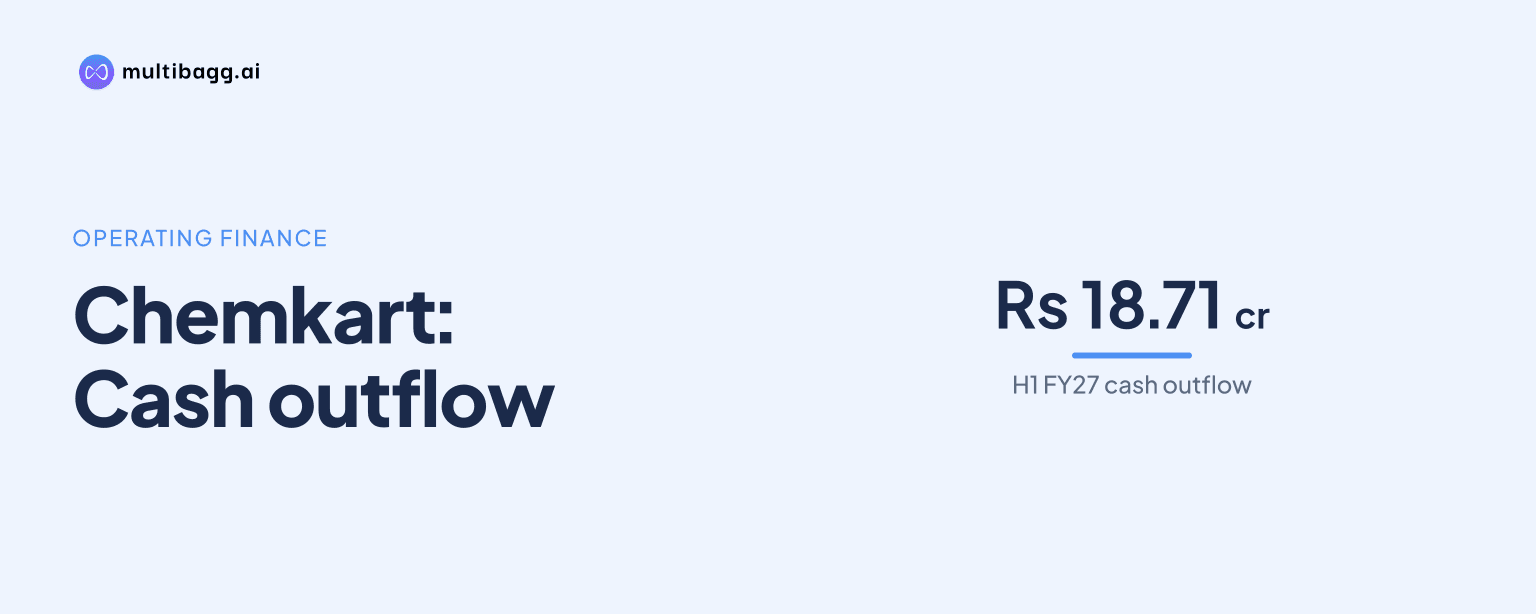
Chemkart reported net cash used in operating activities of Rs 18.71 crore in the first half of fiscal year 2027 (H1 FY27), despite Rs 30.11 crore of profit before tax. A Rs 45.56 crore working-capital use exceeded Rs 30.29 crore of operating profit before working-capital changes, while trade receivables reached Rs 89.50 crore at September 2026.
Know Chemkart India inside out
Results, valuation, peers and who's buying, in one view.
What caused Chemkart’s operating cash outflow in H1 FY27?
Chemkart’s operating cash outflow resulted from a Rs 45.56 crore use of working capital in the September 2026 cash-flow statement. This exceeded Rs 30.29 crore of operating profit before working-capital changes, producing Rs 15.26 crore of cash used from operations before direct taxes. Direct taxes paid of Rs 3.44 crore then brought net operating cash use to Rs 18.71 crore.
The cash-flow statement places the September 2026 outflow alongside a Rs 2.73 crore operating cash outflow for March 2026. These are the periods as labelled in the presentation and are not like-for-like half-year comparisons. Still, working-capital use of Rs 45.56 crore at September 2026 exceeded the Rs 24.18 crore use shown for March 2026, while operating profit before working-capital changes rose to Rs 30.29 crore from Rs 29.14 crore.
Chemkart’s standalone cash-flow statement shows the same broad pattern. Standalone operating profit before working-capital changes was Rs 30.67 crore at September 2026, but a Rs 45.28 crore working-capital use led to Rs 18.05 crore of net cash used in operating activities after Rs 3.44 crore of direct taxes. The difference between standalone and consolidated operating cash use was Rs 65.40 lakh.
How did Chemkart’s working-capital balances change?
Chemkart’s consolidated trade receivables increased by Rs 39.52 crore, reaching Rs 89.50 crore at September 2026 from Rs 49.98 crore at March 2026. Inventories increased by Rs 9.04 crore to Rs 43.77 crore over the same dates, and short-term loans and advances rose by Rs 14.41 crore to Rs 18.45 crore. These balance-sheet movements occurred alongside the aggregate Rs 45.56 crore working-capital cash use disclosed in the cash-flow statement.
Total current assets rose to Rs 185.44 crore at September 2026 from Rs 128.32 crore at March 2026, an increase of Rs 57.12 crore. Within that change, cash and cash equivalents declined by Rs 5.63 crore to Rs 33.02 crore, whereas trade receivables became the largest disclosed current-asset category at Rs 89.50 crore. The presentation does not provide a receivables-days or inventory-days measure.
On the liability side, consolidated trade payables to creditors other than micro and small enterprises increased to Rs 33.54 crore at September 2026 from Rs 17.62 crore at March 2026. Dues to micro and small enterprises rose to Rs 76.40 lakh from Rs 65.30 lakh. Total current liabilities increased by Rs 37.18 crore to Rs 64.33 crore, partly offsetting the increase in current assets but not reversing the reported operating-cash outflow.
Got a follow-up? Ask IRIS
How did Chemkart fund the cash requirement?
Chemkart generated Rs 16.10 crore of financing cash inflow in the September 2026 period, while investing activities used Rs 3.03 crore. Financing inflow did not fully cover the combined Rs 21.73 crore of operating and investing cash use, leaving a net decrease in cash and cash equivalents of Rs 5.63 crore. This agrees with the decline in consolidated cash from Rs 38.65 crore in March 2026 to Rs 33.02 crore in September 2026.
Short-term borrowings increased to Rs 20.30 crore at September 2026 from Rs 4.95 crore at March 2026, a rise of Rs 15.34 crore. Chemkart also reported Rs 1.77 crore of long-term borrowings at September 2026, compared with no long-term borrowings shown at March 2026. The presentation reports the financing cash inflow and the balance-sheet borrowing movement, but does not state a specific allocation of financing proceeds.
The standalone figures similarly show Rs 16.11 crore of financing cash inflow and Rs 2.16 crore used in investing activities at September 2026. The standalone net decrease in cash was Rs 4.10 crore, reducing cash and cash equivalents to Rs 32.39 crore from Rs 36.50 crore. Consolidated capital work in progress also rose to Rs 9.57 crore at September 2026 from Rs 4.87 crore at March 2026, while property, plant and equipment declined to Rs 8.18 crore from Rs 8.34 crore.
How did Chemkart’s profit growth compare with cash generation?
Chemkart’s consolidated revenue from operations nearly doubled to Rs 205.87 crore in H1 FY27 from Rs 103.23 crore in H1 FY26, an increase of 99.4%. Earnings before interest, tax, depreciation and amortisation (EBITDA) increased 107.5% to Rs 29.37 crore, and profit after tax (PAT) rose 122.2% to Rs 22.56 crore. Cash conversion differed from these income-statement results because the September 2026 cash-flow statement recorded a Rs 45.56 crore working-capital cash use.
Margins also increased during H1 FY27. EBITDA margin rose by 60 basis points to 14.3% from 13.7% in H1 FY26, while PAT margin increased by 120 basis points to 11.0% from 9.8%. A basis point equals one-hundredth of a percentage point. Finance cost rose to Rs 1.01 crore in H1 FY27 from Rs 78.20 lakh in H1 FY26, alongside the later September 2026 rise in short-term borrowings.
Product revenue data show that Amino Acids supplied Rs 102.86 crore, or 50.0%, of H1 FY27 revenue, while Sports Nutrition supplied Rs 59.34 crore, or 28.8%. Protein revenue was Rs 17.27 crore, or 8.4%, compared with Rs 4.90 crore for the full FY26. These product figures describe revenue composition, but the presentation does not link any individual product category to receivables, inventory, advances or the cash-flow movement.
Conclusion
Chemkart’s H1 FY27 financial statements show fast profit and revenue growth alongside a substantial requirement for working capital. Consolidated revenue reached Rs 205.87 crore and PAT reached Rs 22.56 crore, but receivables, inventories and short-term loans and advances all increased between March 2026 and September 2026. The Rs 45.56 crore working-capital use turned Rs 30.29 crore of pre-working-capital operating profit into Rs 18.71 crore of operating cash outflow after tax.
The next balance-sheet and cash-flow update will show whether receivables of Rs 89.50 crore, inventory of Rs 43.77 crore and short-term borrowings of Rs 20.30 crore change as revenue develops. Chemkart’s presentation provides no cash-conversion target, receivables-collection target or borrowing-reduction plan, leaving no disclosed management timetable for the working-capital build-up.