










Cheviot first-half operating cash flow falls 44% to Rs 28.0653 crore
Key highlights
- Cheviot’s net operating cash inflow fell 44% to Rs 28.0653 crore in the half year ended September 30, 2026.
- Cheviot’s first-half profit rose to Rs 56.25 crore from Rs 43.5499 crore year on year.
- Net direct taxes paid increased to Rs 13.0085 crore from Rs 8.6666 crore.
- Cheviot paid Rs 14.6047 crore in dividends, compared with Rs 2.9209 crore in the prior-year half.
powered by IRIS
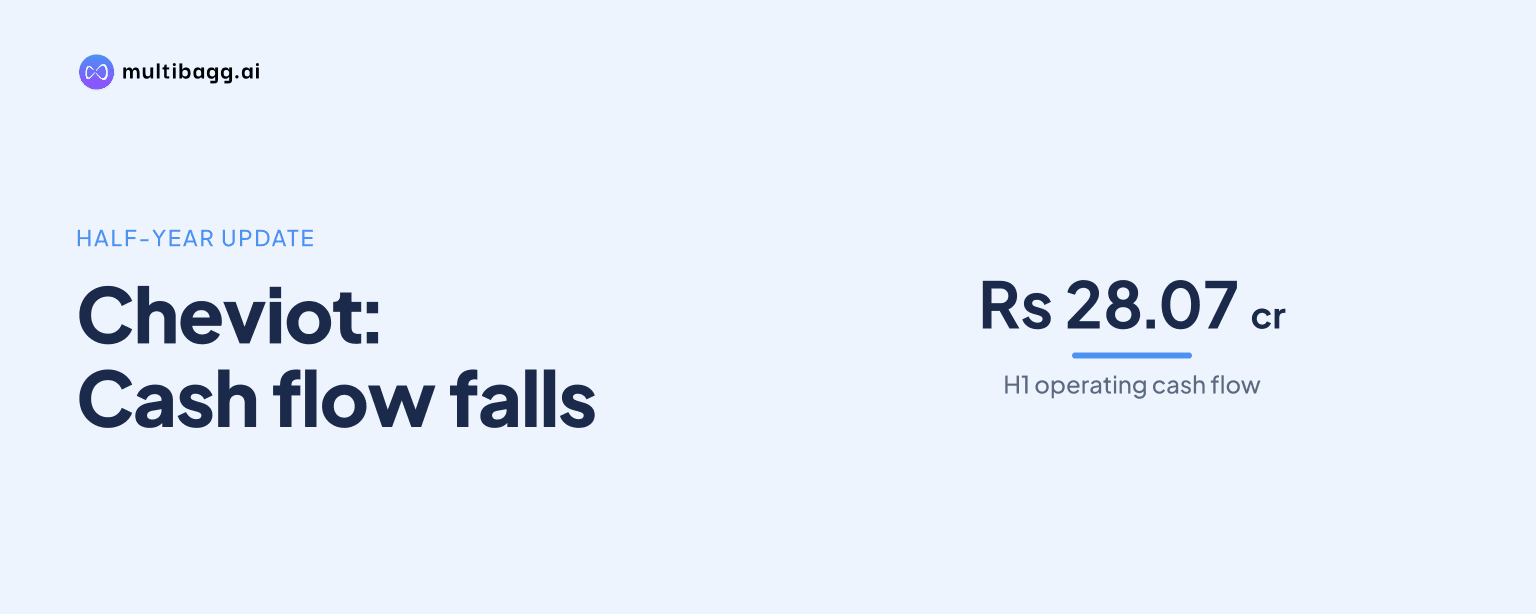
Cheviot Company Limited reported net operating cash inflow of Rs 28.0653 crore for the half year ended September 30, 2026, down 44% from Rs 50.4795 crore a year earlier, despite profit rising to Rs 56.25 crore from Rs 43.5499 crore. Higher direct tax payments, lower operating profit before working-capital movements and increased receivables reduced cash conversion.
Know Cheviot Company inside out
Results, valuation, peers and who's buying, in one view.
Why did Cheviot’s operating cash flow fall despite higher profit?
Cheviot’s operating cash flow fell because cash generated from operations declined to Rs 41.0738 crore from Rs 59.1461 crore and direct taxes paid increased to Rs 13.0085 crore from Rs 8.6666 crore. These changes reduced net cash from operating activities by Rs 22.4142 crore year on year, even as profit for the period increased by Rs 12.7001 crore.
Profit before tax was Rs 70.1103 crore in the half year ended September 30, 2026, compared with Rs 56.2076 crore in the corresponding 2025 period. However, operating profit before working-capital changes was Rs 36.8012 crore, below Rs 42.9612 crore. The cash-flow statement uses the indirect method under Indian Accounting Standard 7, adjusting accounting profit for non-cash and investment-related items.
The largest adjustment was a Rs 31.5275 crore net gain on fair-value changes in investments measured at fair value through profit or loss, compared with a Rs 15.5243 crore gain in the prior-year half. The larger gain reduced the operating-profit starting point in the indirect cash-flow calculation. Depreciation and amortisation added back Rs 3.9119 crore, compared with Rs 3.8274 crore a year earlier.
How did working capital affect Cheviot’s first-half cash generation?
Cheviot received a Rs 4.2726 crore aggregate cash inflow from working-capital movements in the 2026 half year, compared with Rs 16.1849 crore in the prior-year period. The smaller benefit compounded the decline of Rs 6.16 crore in operating profit before working-capital changes.
Inventories released Rs 32.5696 crore of cash, slightly more than Rs 32.4289 crore in the previous first half. This corresponded with inventory falling to Rs 98.2723 crore on September 30, 2026, from Rs 130.8419 crore on March 31, 2026. The reduction in inventory was the largest positive working-capital movement disclosed for the six months.
Trade receivables absorbed Rs 23.1878 crore, compared with an outflow of Rs 8.3237 crore a year earlier. Receivables rose to Rs 57.7849 crore at September 30, 2026, from Rs 34.5265 crore at March 31, 2026. Other financial liabilities used Rs 6.8532 crore, versus Rs 2.5623 crore in the prior-year half, while other assets used Rs 2.9357 crore.
Trade payables added Rs 2.1639 crore of cash after reducing cash by Rs 1.5182 crore in the 2025 half year. Provisions added Rs 1.6538 crore, compared with a Rs 0.7674 crore use of cash a year earlier. These offsets did not match the increased receivables outflow and lower overall working-capital contribution.
Got a follow-up? Ask IRIS
What changed in Cheviot’s investment and financing cash flows?
Cheviot’s net cash used in investing activities narrowed to Rs 11.9989 crore from Rs 56.7958 crore in the half year ended September 30, 2026. Investment-sale proceeds increased to Rs 103.5174 crore from Rs 56.9181 crore, more than offsetting investment purchases of Rs 114.5946 crore, which were higher than Rs 106.3406 crore a year earlier.
Purchases of property, plant, equipment and other intangible assets fell to Rs 3.5039 crore from Rs 8.5366 crore. Interest received rose to Rs 1.3488 crore from Rs 0.4941 crore, while dividend received increased to Rs 1.2314 crore from Rs 0.5812 crore. Non-current investments on the balance sheet rose to Rs 361.805 crore at September 30, 2026 from Rs 326.2186 crore at March 31, 2026.
Cheviot used Rs 16.5435 crore in financing activities, against a Rs 0.4784 crore inflow in the corresponding 2025 half year. Dividend paid was Rs 14.6047 crore, up from Rs 2.9209 crore, and current borrowings declined by Rs 1.5913 crore on a net basis rather than providing Rs 3.7588 crore of cash in the prior-year period.
Lease-liability payments were Rs 0.2376 crore, compared with Rs 0.2266 crore, and finance costs paid were Rs 0.1099 crore. Current borrowings stood at Rs 5.6597 crore at September 30, 2026, below Rs 7.251 crore at March 31, 2026. The financing outflow, together with the investment outflow, absorbed most of the operating cash inflow.
What do Cheviot’s results and closing cash balance show?
Cheviot’s revenue from operations rose to Rs 360.3683 crore for the half year ended September 30, 2026 from Rs 267.9349 crore a year earlier, while total income increased to Rs 397.703 crore from Rs 285.7317 crore. Total expenses rose to Rs 327.5927 crore from Rs 229.5241 crore, led by material costs of Rs 244.7803 crore against Rs 148.6502 crore.
The filing states that Cheviot recognised Rs 7.3978 crore of additional revenue in the 2026 first half after Gazette notifications from the Office of the Jute Commissioner revised sale prices of jute bags supplied to State Procurement Agencies in earlier years. The company reports one significant primary business segment, Jute Goods, and therefore did not disclose segment-level cash-flow information.
Cash and cash equivalents ended the half year at Rs 2.4716 crore, compared with Rs 2.9496 crore at March 31, 2026, after a Rs 0.4771 crore net decrease. The closing balance comprised Rs 0.0437 crore of cash on hand and Rs 2.4279 crore of bank balances. In the corresponding 2025 half year, cash and cash equivalents closed at Rs 3.6671 crore.
Cheviot’s unaudited results were reviewed by its audit committee and approved by its board on November 14, 2026. The statutory auditor conducted a limited review under the Securities and Exchange Board of India listing regulations, rather than an audit, for the quarter and half year ended September 30, 2026.
Conclusion
Cheviot’s first-half results show a divergence between reported profit and operating cash generation. Revenue, profit before tax and profit for the period all increased in the six months to September 30, 2026, but the cash inflow from operations fell because the indirect-method calculation included a larger investment fair-value gain, working capital contributed less cash and direct tax payments rose.
The next disclosed matter to watch is whether the Rs 57.7849 crore receivables balance at September 30, 2026 converts into cash after its Rs 23.1878 crore first-half outflow. Investors can also monitor subsequent investment purchases and sale proceeds after Cheviot reported Rs 114.5946 crore of purchases, Rs 103.5174 crore of sales and Rs 14.6047 crore of dividend payments in the six months.