










Cholamandalam Investment and Finance Q2 FY27 PAT rises 41%
Key highlights
- Cholamandalam's Q2 FY27 disbursements rose 47% year-on-year to ₹35,872 crore.
- Cholamandalam reported Q2 FY27 profit after tax of ₹1,630 crore, up 41% year-on-year.
- Cholamandalam's AUM reached ₹2,68,009 crore at the end of Q2 FY27, up 25% year-on-year.
- Cholamandalam proposed a capital raise of up to ₹5,000 crore, subject to approvals.
powered by IRIS
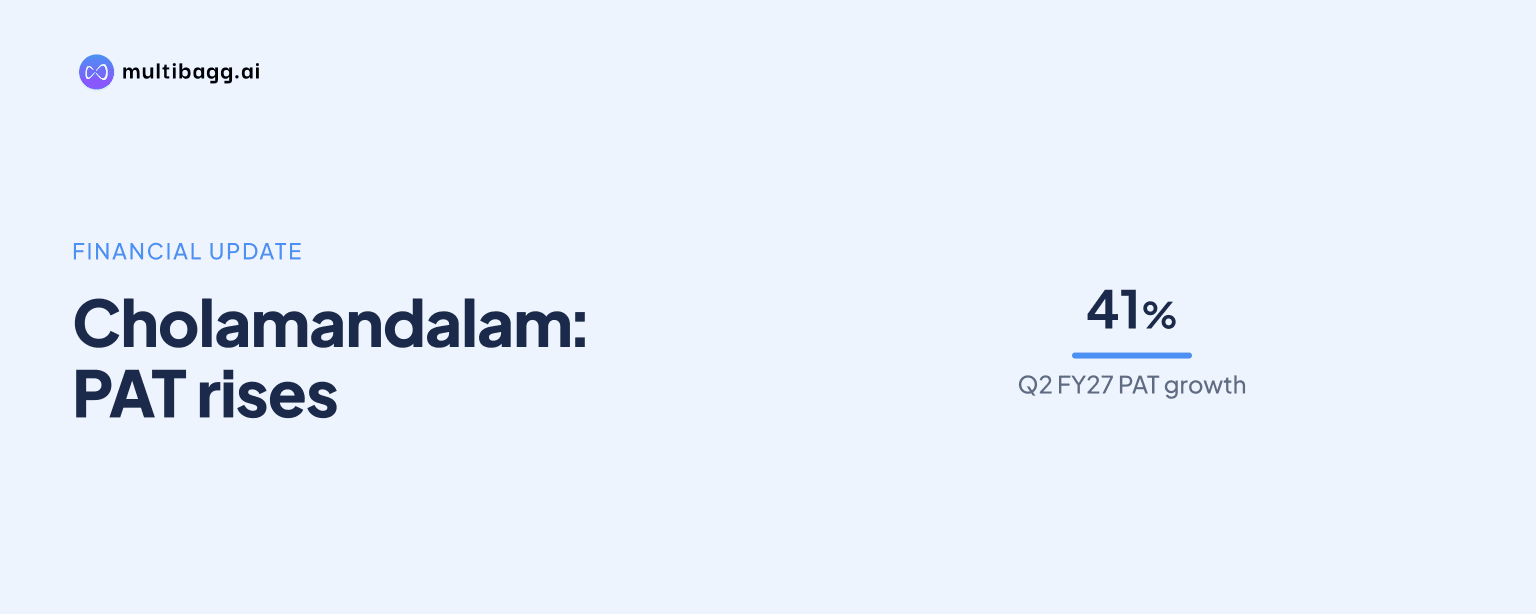
Cholamandalam Investment and Finance Company reported a 41% year-on-year increase in Q2 FY27 profit after tax to ₹1,630 crore, supported by a 47% rise in aggregate disbursements to ₹35,872 crore and 25% growth in assets under management to ₹2,68,009 crore.
Know Cholamandalam Investment & Finance Company inside out
Results, valuation, peers and who's buying, in one view.
What did Cholamandalam report for Q2 FY27?
Cholamandalam Investment and Finance Company, referred to as Cholamandalam, reported broad-based growth across its lending businesses for the quarter ended 30 September 2026. Aggregate disbursements increased 47% year-on-year to ₹35,872 crore, while AUM stood at ₹2,68,009 crore, up 25% from a year earlier. Net profit was reported at ₹1,630 crore, marking 41% year-on-year growth.
The performance was discussed by the company’s leadership during its earnings call on 28 October 2026. Vellayan Subbiah, Executive Chairman, said demand and execution remained strong across vehicle finance, small and medium enterprise lending, and consumer finance. Management linked vehicle-finance momentum to replacement demand, improving economic activity and healthy freight utilisation.
The Q2 result followed a strong first half. For H1 FY27, Cholamandalam reported disbursements of ₹65,484 crore, up 34% year-on-year, and profit after tax of ₹3,284 crore, up 43%. The company also reported a net interest margin of 8.0% for the first half.
Which lending segments supported Cholamandalam's growth?
Cholamandalam said growth during the quarter was spread across vehicle, SME and consumer-finance businesses rather than being dependent on a single product line. Its lending franchise has expanded across these categories, which helped lift aggregate disbursements faster than the growth in the outstanding loan book.
Within the loan against property, SME and secured business personal loan portfolio, AUM rose 27% year-on-year to ₹72,356 crore. Loan against property AUM was ₹57,447 crore, up 24%, while SME AUM reached ₹10,943 crore, up 45%. Secured business personal loan AUM stood at ₹3,966 crore, an increase of 35%.
Call highlights also pointed to rapid expansion in newer and consumer-oriented segments. Consumer-loan disbursements were reported to have tripled year-on-year, while gold-loan growth was cited at 320%. These figures underline the company’s effort to diversify its lending mix beyond its established vehicle-finance business.
Management said the distribution network continued to support disbursement growth. It also referred to plans to expand the branch network through RLG conversions, although no branch-count target or completion timeline was disclosed in the supplied material.
Got a follow-up? Ask IRIS
How is Cholamandalam funding its planned expansion?
Cholamandalam had a capital adequacy ratio of 20.62% at the end of September 2026, including Tier 1 capital of 16.02%. The company also said conversion of compulsorily convertible debentures into equity shares had been completed by that date.
Given the pace of loan growth, the board approved a proposal to raise up to ₹5,000 crore of capital. The proposed fundraise remains subject to shareholder and regulatory approvals. Management said the additional capital is intended to strengthen the capital base and preserve flexibility for future growth while maintaining capital adequacy.
For investors in non-banking financial companies, capital availability is material because sustained AUM expansion requires sufficient regulatory capital alongside stable funding. The proposed raise does not itself confirm the timing, instrument, pricing or final amount of issuance. Those details were not provided in the earnings-call material.
What does the result mean for investors and the lending sector?
The quarter shows that Cholamandalam’s disbursement growth of 47% was ahead of its 25% AUM growth, indicating continued loan originations across multiple categories. Profit growth of 41% and the reported 8.0% H1 net interest margin provide context on earnings performance, while the capital proposal reflects management’s preparation for continued balance-sheet expansion.
Management retained its FY27 growth guidance of 25%, despite the stronger first-half disbursement numbers. It cited the company’s historical performance pattern in the third and fourth quarters while maintaining this guidance. The statement is a management outlook, not a confirmed financial outcome.
Asset quality and funding costs remain important variables for lenders as portfolios expand. The earnings-call highlights cited a 37-basis-point reduction in credit costs, but the supplied material does not provide the corresponding absolute credit-cost figure. Investors will therefore need subsequent disclosures to assess whether this improvement is sustained as newer portfolios scale.
The company made the audio recording of its 28 October 2026 earnings call available on its investor-relations website. The discussion included participation from Executive Chairman Vellayan Subbiah, Managing Director and Chief Executive Officer Ravindra Kumar Kundu, and President and Chief Financial Officer D Arul Selvan.
Conclusion
Cholamandalam delivered higher Q2 FY27 profit, disbursements and AUM, with growth spanning vehicle finance, SME lending and consumer loans. The 47% rise in disbursements to ₹35,872 crore, 25% AUM growth to ₹2,68,009 crore and 41% increase in profit after tax to ₹1,630 crore were the central reported measures of the quarter.
The next items to watch are shareholder and regulatory decisions on the proposed capital raise of up to ₹5,000 crore, progress against the retained 25% FY27 growth guidance, and future disclosures on credit costs, asset quality and segment-level loan growth.