










Cipla India posts record quarter as chronic therapies lift growth
Key highlights
- Cipla’s One India business grew 12% year on year in Q2 FY27 and reached its highest-ever quarterly revenue.
- Cipla’s branded prescription business grew 15% year on year through September 2026, according to IQVIA data.
- Antidiabetes was the fastest-growing named therapy at 50%, ahead of dermatology at 16% and respiratory and urology at 11% each.
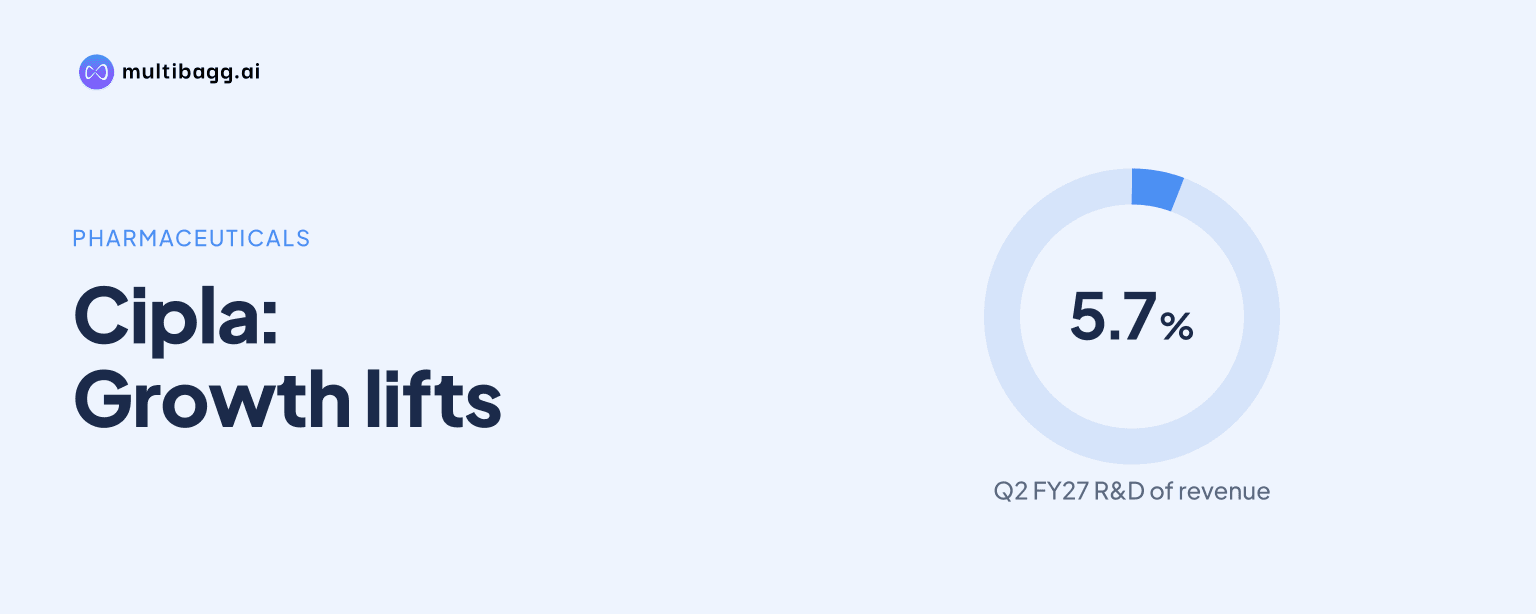
- Cipla invested Rs 423 crore in research and development in Q2 FY27, equal to 5.7% of revenue.
powered by IRIS
Cipla Limited said its One India business recorded its highest-ever quarterly revenue in Q2 FY27, as branded prescription sales rose 15% year on year through September 2026. Management attributed the performance to chronic therapies, where antidiabetes grew 50%, alongside respiratory, dermatology and urology growth and targeted product launches.
Know Cipla inside out
Results, valuation, peers and who's buying, in one view.
How fast did Cipla’s India business grow in Q2 FY27?
Cipla’s One India business grew 12% year on year in Q2 FY27 and achieved its highest-ever quarterly revenue, although management did not disclose the segment’s revenue amount. The company said this extended a run of double-digit quarterly growth, supported by execution in key therapies and the resilience of its franchise in the India pharmaceutical market, or IPM.
The branded prescription business expanded 15% year on year in the year to date through September 2026, according to IQVIA data cited by management. That was faster than the 12% growth reported for One India overall, indicating that branded prescriptions were a principal contributor to the domestic result. Cipla described the growth as market outperformance, but did not provide the IPM growth rate or a numerical gap versus the market on the call.
The domestic outcome formed part of broader company growth. Cipla reported quarterly revenue of Rs 7,404 crore in Q2 FY27, a 4% quarter-on-quarter increase, while management said performance was broad-based across key businesses. The One India record quarter is therefore a domestic operating milestone rather than a separately disclosed financial total, and the transcript does not specify its contribution to company revenue.
Which chronic therapies drove Cipla’s prescription growth?
Cipla said chronic therapies drove prescription growth, with antidiabetes increasing 50%, dermatology 16%, respiratory 11% and urology 11% in the year to date through September 2026. The figures show antidiabetes expanding faster than the other named chronic areas, while respiratory continued to grow as Cipla broadened its domestic therapy base.
The company’s chronic mix was 60.3% on a moving annual total, or MAT, basis for September 2026, according to IQVIA. That measure places chronic medicines at more than three-fifths of the portfolio cited by management. Cipla attributed the therapy-level gains to brand equity, volume growth and field execution, rather than identifying price increases as the driver.
Antidiabetes was particularly relevant because management included glucagon-like peptide, or GLP, products within the 50% growth figure. In the question-and-answer session, management said it was seeing month-on-month growth of about 5% to 10% in GLP-1 therapies, particularly tirzepatide, where Cipla participates. It also said Yurpeak had become the second-largest brand in the GLP rankings, although no sales value or market-share percentage was supplied.
Respiratory remained a material part of the domestic strategy even as antidiabetes grew more quickly. Cipla said it would strengthen its position in chronic therapies while maintaining the trajectory built in respiratory, and reported 11% respiratory growth for the September 2026 year-to-date period. The contrast between 50% antidiabetes growth and 11% respiratory growth indicates that the latest prescription momentum came from a wider set of therapies than respiratory alone.
Got a follow-up? Ask IRIS
What products did Cipla launch in India during the quarter?
Cipla added products across four therapy areas in Q2 FY27: Revesmart in respiratory, Galvus DM and SR in antidiabetes, Dytor E in cardiovascular care and Rizontem in anti-infectives. Management said these targeted launches were intended to deepen Cipla’s presence in priority therapy areas and increase portfolio breadth, but it did not disclose sales from individual brands.
The antidiabetes additions, Galvus DM and SR, align with the company’s reported 50% growth in that therapy in the year to date through September 2026. Revesmart also supports the respiratory franchise, which grew 11% in the same period. Cipla’s domestic product programme therefore addressed both its established respiratory base and the faster-growing antidiabetes portfolio.
Beyond prescription medicines, the trade-generic business posted double-digit quarter-on-quarter growth and introduced more than 15 products during Q2 FY27. Management identified portfolio expansion as a key driver in that business. It did not quantify trade-generics revenue, so the scale of its contribution relative to the 15% branded-prescription growth cannot be calculated from the transcript.
Cipla also said its consumer health unit continued an upward trajectory, with Nicotex, Omnigel and Cipladine retaining leadership positions in their respective segments. Management reported healthy secondary growth and improved operating profitability in consumer health, while saying it was exploring product and channel investments to extend distribution. No revenue, margin percentage or market-share figure was provided for this unit.
How does Cipla plan to sustain India growth?
Cipla plans to sustain India growth through execution in branded prescriptions, trade generics and consumer wellness, while increasing its presence in chronic therapies. Management stated this priority while reporting 12% One India growth in Q2 FY27 and a 60.3% chronic mix as of MAT September 2026, linking future execution to the portfolio composition already achieved.
New launches are one mechanism in that plan. In addition to the more than 15 trade-generic introductions, Cipla’s Q2 FY27 branded launches covered respiratory, antidiabetes, cardiovascular and anti-infective therapies. The company said it leads the IPM by volume share, but did not provide the percentage share, a ranking date or a comparable competitor figure.
Management also pointed to distribution expansion in consumer health as a further opportunity. Nicotex, Omnigel and Cipladine were named as segment leaders, and Cipla said the business was investing in products and channels as it pursues further reach. The transcript does not state a spending amount, timing or quantitative distribution target, so the financial effect of these initiatives remains undisclosed.
The domestic growth plan sits alongside company-wide investment in future products. Cipla spent Rs 423 crore on research and development in Q2 FY27, equal to 5.7% of revenue, and guided to full-year research and development spending of 6% to 7% of revenue. Management said the quarter’s spending was largely directed towards product filings and key development programmes, though it did not allocate that expenditure between India and overseas markets.
Conclusion
Cipla’s reported India performance in Q2 FY27 was marked by a record quarterly result for One India, 12% year-on-year growth and 15% branded-prescription growth through September 2026. The 50% increase in antidiabetes, compared with 11% in respiratory and urology and 16% in dermatology, indicates that the domestic growth mix is extending across several chronic therapy areas while respiratory remains part of the base.
The next indicators are whether Cipla can maintain double-digit domestic growth as its Q2 FY27 launches develop, including Galvus DM and SR, Revesmart, Dytor E and Rizontem. Management’s stated plan is to outperform the market in branded prescriptions, trade generics and consumer wellness, but the transcript gives no numerical India revenue target or timeline for the consumer-health distribution investments.