










Cipla retains $1 billion US target on supply ramp
Key highlights
- Cipla retained its $1 billion annualised North America revenue target for the FY27 exit after Q2 revenue rose to $172 million from $162 million in Q1.
- Generic Ventolin supply from Cipla’s new North America facility is the main near-term growth driver, with the company holding a 22% share of the US albuterol MDI market in late September 2026.
- Cipla expects generic Advair to launch in Q3 FY27, alongside two further respiratory approvals and one peptide approval during FY27.
- Cipla reported an 18.7% Q2 EBITDA margin, Rs 878 crore in profit after tax and Rs 9,823 crore in net cash equivalents as of September 30.
powered by IRIS
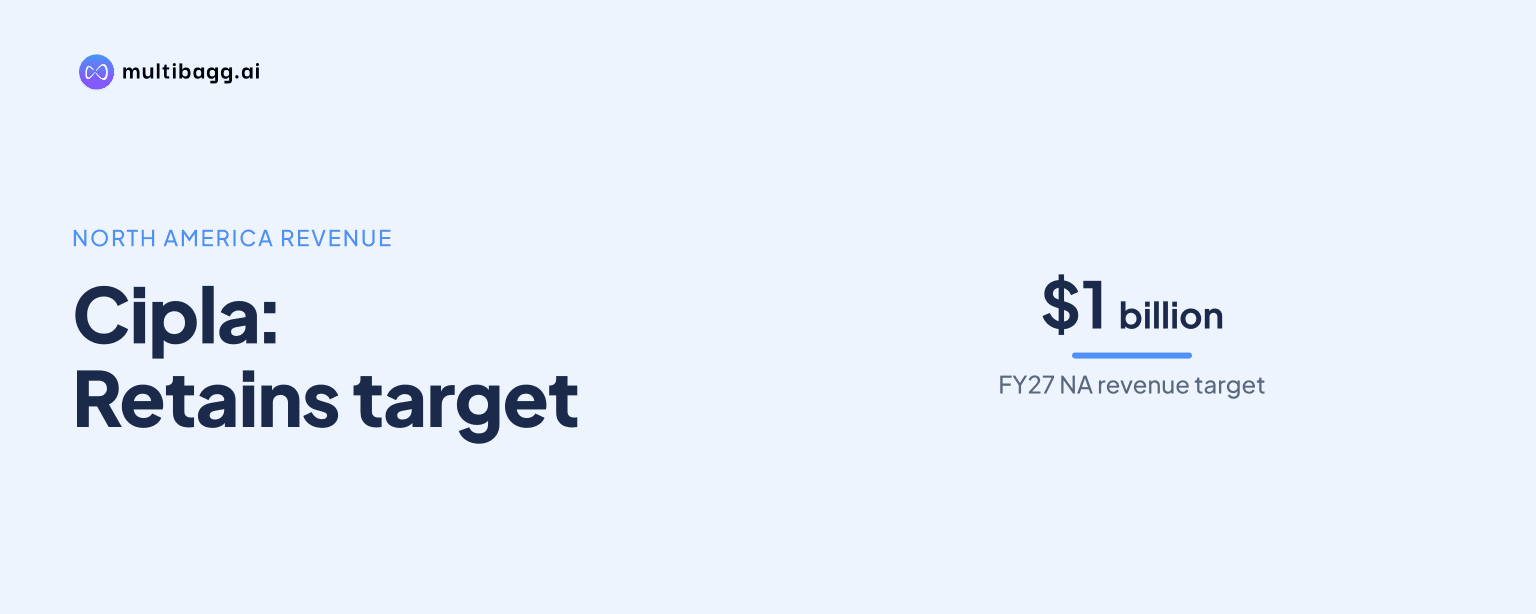
Cipla Limited retained its target to exit FY27 at a $1 billion annualised North America revenue run rate after reporting $172 million in North America revenue in Q2 FY27, up $10 million sequentially. Management said the planned step-up depends on expanding Ventolin supply, launching generic Advair in Q3 and obtaining three further US approvals, rather than winter respiratory demand.
Know Cipla inside out
Results, valuation, peers and who's buying, in one view.
How does Cipla plan to reach its US target?
Cipla plans to reach the $1 billion annualised North America exit run rate through new launches and production scale-up, with the target unchanged after Q2 FY27 revenue of $172 million. North America revenue increased from $162 million in Q1 FY27, while consolidated revenue was Rs 7,404 crore, up 4% quarter on quarter.
Management said generic Ventolin, approved in Q1 FY27, and generic Advair, approved in Q2 FY27, should contribute significantly as supply and commercial availability increase. Cipla also expects two additional respiratory approvals and one peptide approval during FY27. It did not provide a product-level revenue bridge to the $1 billion run rate.
Cipla excluded Lanreotide from its $1 billion calculation. Management said it is pursuing remediation with Pharmathen to resume Lanreotide supply and separately working on a new North American site for a filing, but neither route is included in the FY27 exit-run-rate target.
The target therefore relies on the ramp of Ventolin and Advair and on approvals for the remaining two respiratory assets and peptide opportunity. Management described these as multiple pathways to the target, but said approval timing remains partly dependent on the US Food and Drug Administration, or FDA.
Why is Ventolin supply central to Cipla's forecast?
Ventolin supply is central because Cipla said output from its new North America manufacturing facility, rather than customer access or seasonal demand, is limiting the immediate ramp. The company held a 22% share of the overall US albuterol metered-dose inhaler, or MDI, market in the last week of September 2026, according to IQVIA data cited by management.
Management described the US albuterol market as approximately 24 million units. It said Cipla has the commercial relationships needed to expand Ventolin distribution and could gain a higher share in generic Ventolin than in Proventil generics because it is the only generic in Ventolin.
Cipla did not disclose Ventolin volumes, current product share or production capacity. However, management said the increase in supply could be exponential from current levels, rather than merely two, three or four times, as the facility reaches fuller production.
Management also said a typical winter respiratory uplift is not a major component of its calculation. The expected second-half contribution instead rests on the new facility increasing supply, while Cipla's existing 22% position in the broader albuterol MDI market supports its view of customer demand and channel access.
When will Cipla launch Advair and its next products?
Cipla said generic Advair will launch in Q3 FY27 and should begin building revenue through Q3 and Q4. The product was approved in July, but management said its launch took a couple of months longer than usual because it is the first dry-powder inhaler, or DPI, to emerge from Cipla's new US plant.
The Advair approval was Cipla's first DPI approval from its US manufacturing network. Management said Ventolin and Advair were the first launches from units that had undergone remediation, making their ramp-up more complex than it expects for later products.
Cipla expects two more respiratory products and one peptide opportunity to be approved during FY27. Management said it was confident about approval and closer to launch, but did not specify whether decisions would fall in Q3 or Q4 because FDA review timing is outside its full control.
One of the future respiratory assets is a partnered product from Cipla's Goa facility, which has manufactured MDIs for some time, according to management. The other will come from the US facility. Cipla said the Goa asset needs no production ramp, while the US team now has experience from Ventolin and Advair that should avoid similar launch challenges.
Got a follow-up? Ask IRIS
What other pipeline and financial factors support the plan?
Cipla is funding development and launch preparation through research and development spending of Rs 423 crore in Q2 FY27, or 5.7% of revenue. Management retained its full-year R&D guidance of 6% to 7% of revenue and said it plans approximately 45 to 50 filings over the next three years, particularly for the US market.
The company also has four biosimilar programmes under development for global markets. Its exclusive agreement with Qilu Pharmaceutical covers US commercialisation of a biosimilar to Keytruda, Pembrolizumab, and management said it expects to file next year in time for the 2029 calendar-year patent expiry.
Management said the Pembrolizumab biosimilar could be among the first wave of launches once it reaches the market, but this opportunity is outside the FY27 respiratory-led ramp. Cipla said its teams will be involved in the filing process alongside Qilu, reflecting its regulatory and commercial role in North America.
Cipla reported an earnings before interest, tax, depreciation and amortisation, or EBITDA, margin excluding other income of 18.7% in Q2 FY27, up 200 basis points sequentially. Profit after tax was Rs 878 crore, or 11.9% of sales, while net cash equivalents were Rs 9,823 crore as of September 30.
How do manufacturing and regulatory matters affect Cipla's plan?
Cipla said recent key US approvals have been mitigated away from the Pithampur site, with new products sourced from US sites or Goa. The FDA classified an inspection at Invagen Unit 3 in New York as Voluntary Action Indicated, or VAI, during the previous quarter.
A routine good manufacturing practice inspection at Cipla's Invagen facility in Long Island, New York, conducted during the current month, concluded with zero Form 483 observations. Management cited this outcome alongside the US and Goa sourcing of pipeline assets when saying it sees no current downside to near- and medium-term approvals from the Pithampur matter.
Pithampur received seven Form 483 observations following an FDA follow-up inspection in the previous quarter. Management said there were no repeat observations and no data-integrity findings, and it is working to resolve the observations after the facility received an Official Action Indicated status approximately three-and-a-half years earlier.
Management said a VAI classification for Pithampur would create further opportunities over time, but did not make that outcome part of the FY27 US target. The nearer-term US plan instead depends on output at the new North America plant, Advair's Q3 launch and the three pending approvals.
Conclusion
Cipla's unchanged $1 billion North America exit-run-rate target is an execution plan built around product supply and launches. Q2 North America revenue of $172 million was $10 million higher than Q1, but management expects the larger second-half increase to come from Ventolin production, Advair revenue and additional respiratory and peptide products, with Lanreotide excluded.
The next disclosed milestones are Advair's Q3 FY27 launch and revenue build through Q3 and Q4, FDA decisions on the two respiratory assets and peptide opportunity, and the pace of supply expansion at the new US facility. Management also plans sequential EBITDA margin improvement over the remaining quarters while maintaining FY27 guidance of 18.5% to 20%.